

Broadband Terahertz Spectroscopy
123
2.3 THz Generation and Detection from Air Plasma
Another non-linear technique that has gained popularity in the generation and detection of THz is the use of air plasma as the active medium [41]. A significant advantage
in generating THz radiation from ambient air is the ultra-broad bandwidth accomplished as this technique is not limited by phonon absorption, phase matching limitations, dispersions, and damage threshold. Developments have seen bandwidth up
to 70 THz with a central wavelength of 30 THz generated using a 50-fs excitation
pulse [41]. Intense THz pulse of energies >5 μJ per pulse has also been generated
using this method [42]. However, an ultrafast amplifier is required as the primary
light source for this method of generation and detection of THz.
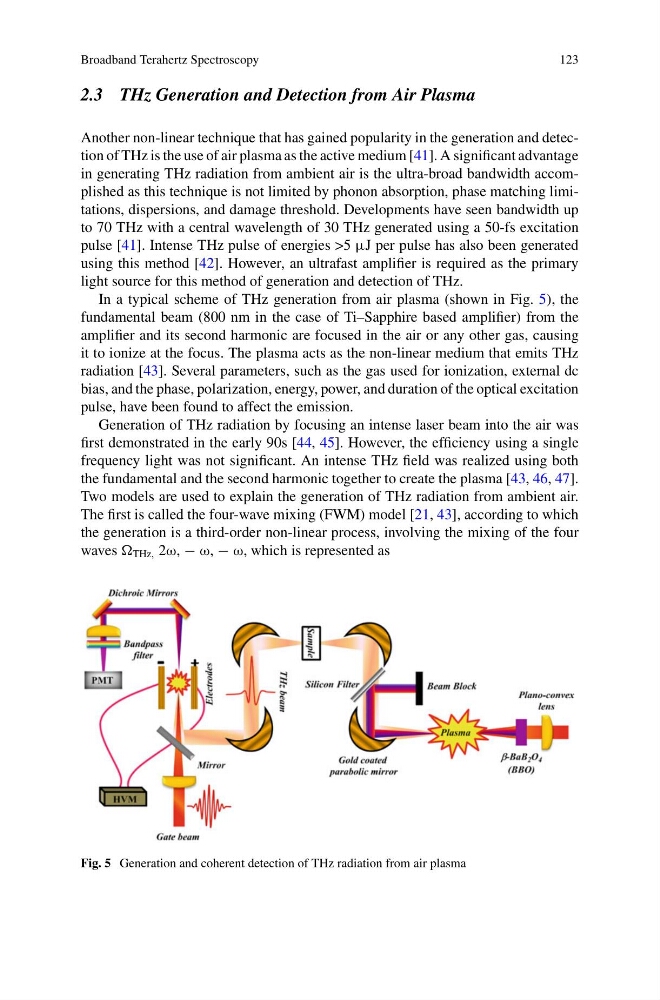
In a typical scheme of THz generation from air plasma (shown in Fig. 5), the
fundamental beam (800 nm in the case of Ti–Sapphire based amplifier) from the
amplifier and its second harmonic are focused in the air or any other gas, causing
it to ionize at the focus. The plasma acts as the non-linear medium that emits THz
radiation [43]. Several parameters, such as the gas used for ionization, external dc
bias, and the phase, polarization, energy, power, and duration of the optical excitation
pulse, have been found to affect the emission.
Generation of THz radiation by focusing an intense laser beam into the air was
first demonstrated in the early 90s [44, 45]. However, the efficiency using a single
frequency light was not significant. An intense THz field was realized using both
the fundamental and the second harmonic together to create the plasma [43, 46, 47].
Two models are used to explain the generation of THz radiation from ambient air.
The first is called the four-wave mixing (FWM) model [21, 43], according to which
the generation is a third-order non-linear process, involving the mixing of the four
waves THz, 2ω, − ω, − ω, which is represented as
Fig. 5 Generation and coherent detection of THz radiation from air plasma
123
2.3 THz Generation and Detection from Air Plasma
Another non-linear technique that has gained popularity in the generation and detection of THz is the use of air plasma as the active medium [41]. A significant advantage
in generating THz radiation from ambient air is the ultra-broad bandwidth accomplished as this technique is not limited by phonon absorption, phase matching limitations, dispersions, and damage threshold. Developments have seen bandwidth up
to 70 THz with a central wavelength of 30 THz generated using a 50-fs excitation
pulse [41]. Intense THz pulse of energies >5 μJ per pulse has also been generated
using this method [42]. However, an ultrafast amplifier is required as the primary
light source for this method of generation and detection of THz.
In a typical scheme of THz generation from air plasma (shown in Fig. 5), the
fundamental beam (800 nm in the case of Ti–Sapphire based amplifier) from the
amplifier and its second harmonic are focused in the air or any other gas, causing
it to ionize at the focus. The plasma acts as the non-linear medium that emits THz
radiation [43]. Several parameters, such as the gas used for ionization, external dc
bias, and the phase, polarization, energy, power, and duration of the optical excitation
pulse, have been found to affect the emission.
Generation of THz radiation by focusing an intense laser beam into the air was
first demonstrated in the early 90s [44, 45]. However, the efficiency using a single
frequency light was not significant. An intense THz field was realized using both
the fundamental and the second harmonic together to create the plasma [43, 46, 47].
Two models are used to explain the generation of THz radiation from ambient air.
The first is called the four-wave mixing (FWM) model [21, 43], according to which
the generation is a third-order non-linear process, involving the mixing of the four
waves THz, 2ω, − ω, − ω, which is represented as
Fig. 5 Generation and coherent detection of THz radiation from air plasma