

122
S. Banerjee et al.
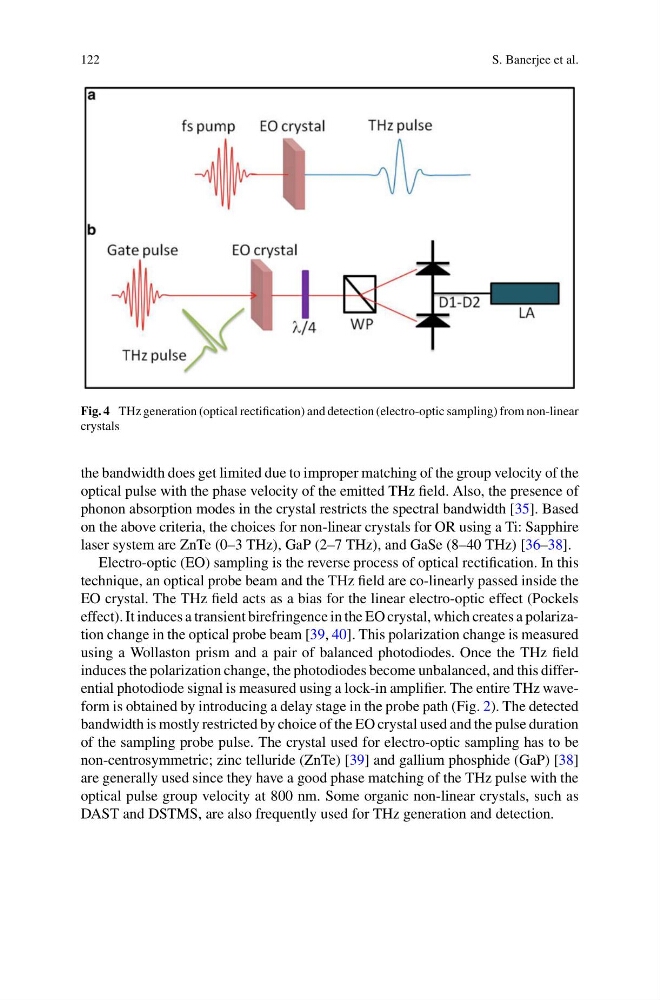
Fig. 4 THz generation (optical rectification) and detection (electro-optic sampling) from non-linear
crystals
the bandwidth does get limited due to improper matching of the group velocity of the
optical pulse with the phase velocity of the emitted THz field. Also, the presence of
phonon absorption modes in the crystal restricts the spectral bandwidth [35]. Based
on the above criteria, the choices for non-linear crystals for OR using a Ti: Sapphire
laser system are ZnTe (0–3 THz), GaP (2–7 THz), and GaSe (8–40 THz) [36–38].
Electro-optic (EO) sampling is the reverse process of optical rectification. In this
technique, an optical probe beam and the THz field are co-linearly passed inside the
EO crystal. The THz field acts as a bias for the linear electro-optic effect (Pockels
effect). It induces a transient birefringence in the EO crystal, which creates a polarization change in the optical probe beam [39, 40]. This polarization change is measured
using a Wollaston prism and a pair of balanced photodiodes. Once the THz field
induces the polarization change, the photodiodes become unbalanced, and this differential photodiode signal is measured using a lock-in amplifier. The entire THz waveform is obtained by introducing a delay stage in the probe path (Fig. 2). The detected
bandwidth is mostly restricted by choice of the EO crystal used and the pulse duration
of the sampling probe pulse. The crystal used for electro-optic sampling has to be
non-centrosymmetric; zinc telluride (ZnTe) [39] and gallium phosphide (GaP) [38]
are generally used since they have a good phase matching of the THz pulse with the
optical pulse group velocity at 800 nm. Some organic non-linear crystals, such as
DAST and DSTMS, are also frequently used for THz generation and detection.
S. Banerjee et al.
Fig. 4 THz generation (optical rectification) and detection (electro-optic sampling) from non-linear
crystals
the bandwidth does get limited due to improper matching of the group velocity of the
optical pulse with the phase velocity of the emitted THz field. Also, the presence of
phonon absorption modes in the crystal restricts the spectral bandwidth [35]. Based
on the above criteria, the choices for non-linear crystals for OR using a Ti: Sapphire
laser system are ZnTe (0–3 THz), GaP (2–7 THz), and GaSe (8–40 THz) [36–38].
Electro-optic (EO) sampling is the reverse process of optical rectification. In this
technique, an optical probe beam and the THz field are co-linearly passed inside the
EO crystal. The THz field acts as a bias for the linear electro-optic effect (Pockels
effect). It induces a transient birefringence in the EO crystal, which creates a polarization change in the optical probe beam [39, 40]. This polarization change is measured
using a Wollaston prism and a pair of balanced photodiodes. Once the THz field
induces the polarization change, the photodiodes become unbalanced, and this differential photodiode signal is measured using a lock-in amplifier. The entire THz waveform is obtained by introducing a delay stage in the probe path (Fig. 2). The detected
bandwidth is mostly restricted by choice of the EO crystal used and the pulse duration
of the sampling probe pulse. The crystal used for electro-optic sampling has to be
non-centrosymmetric; zinc telluride (ZnTe) [39] and gallium phosphide (GaP) [38]
are generally used since they have a good phase matching of the THz pulse with the
optical pulse group velocity at 800 nm. Some organic non-linear crystals, such as
DAST and DSTMS, are also frequently used for THz generation and detection.