

112
S. Roy et al.
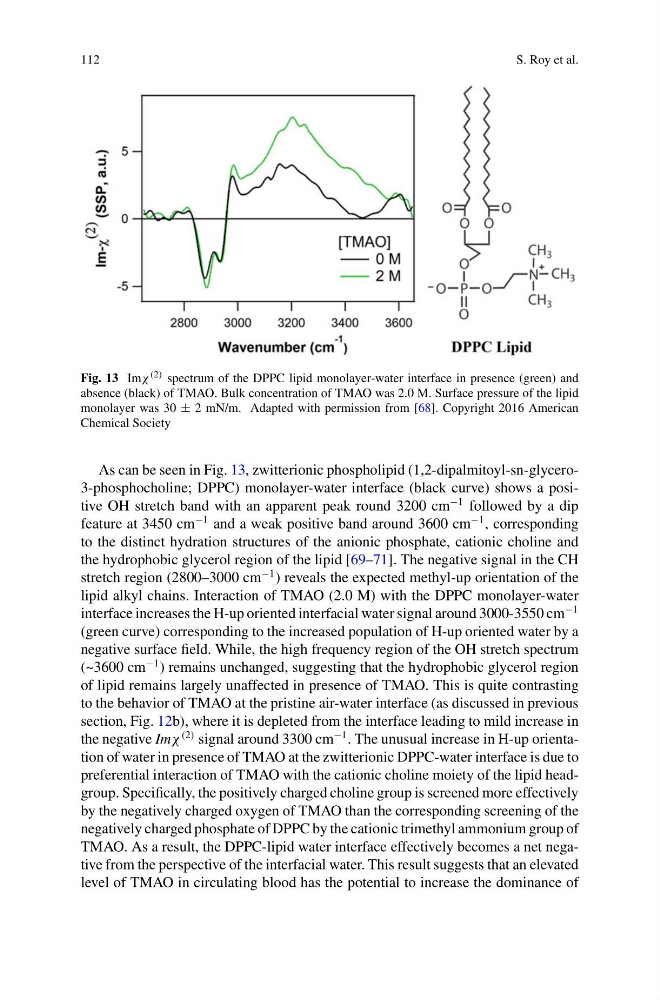
Fig. 13 Imχ (2) spectrum of the DPPC lipid monolayer-water interface in presence (green) and
absence (black) of TMAO. Bulk concentration of TMAO was 2.0 M. Surface pressure of the lipid
monolayer was 30 ± 2 mN/m. Adapted with permission from [68]. Copyright 2016 American
Chemical Society
As can be seen in Fig. 13, zwitterionic phospholipid (1,2-dipalmitoyl-sn-glycero3-phosphocholine; DPPC) monolayer-water interface (black curve) shows a positive OH stretch band with an apparent peak round 3200 cm
−1 followed by a dip
feature at 3450 cm
−1 and a weak positive band around 3600 cm
−1 , corresponding
to the distinct hydration structures of the anionic phosphate, cationic choline and
the hydrophobic glycerol region of the lipid [69–71]. The negative signal in the CH
stretch region (2800–3000 cm
−1 ) reveals the expected methyl-up orientation of the
lipid alkyl chains. Interaction of TMAO (2.0 M) with the DPPC monolayer-water
interface increases the H-up oriented interfacial water signal around 3000-3550 cm
−1
(green curve) corresponding to the increased population of H-up oriented water by a
negative surface field. While, the high frequency region of the OH stretch spectrum
(~3600 cm
−1 ) remains unchanged, suggesting that the hydrophobic glycerol region
of lipid remains largely unaffected in presence of TMAO. This is quite contrasting
to the behavior of TMAO at the pristine air-water interface (as discussed in previous
section, Fig. 12b), where it is depleted from the interface leading to mild increase in
the negative Imχ
(2) signal around 3300 cm
−1 . The unusual increase in H-up orientation of water in presence of TMAO at the zwitterionic DPPC-water interface is due to
preferential interaction of TMAO with the cationic choline moiety of the lipid headgroup. Specifically, the positively charged choline group is screened more effectively
by the negatively charged oxygen of TMAO than the corresponding screening of the
negatively charged phosphate of DPPC by the cationic trimethyl ammonium group of
TMAO. As a result, the DPPC-lipid water interface effectively becomes a net negative from the perspective of the interfacial water. This result suggests that an elevated
level of TMAO in circulating blood has the potential to increase the dominance of
S. Roy et al.
Fig. 13 Imχ (2) spectrum of the DPPC lipid monolayer-water interface in presence (green) and
absence (black) of TMAO. Bulk concentration of TMAO was 2.0 M. Surface pressure of the lipid
monolayer was 30 ± 2 mN/m. Adapted with permission from [68]. Copyright 2016 American
Chemical Society
As can be seen in Fig. 13, zwitterionic phospholipid (1,2-dipalmitoyl-sn-glycero3-phosphocholine; DPPC) monolayer-water interface (black curve) shows a positive OH stretch band with an apparent peak round 3200 cm
−1 followed by a dip
feature at 3450 cm
−1 and a weak positive band around 3600 cm
−1 , corresponding
to the distinct hydration structures of the anionic phosphate, cationic choline and
the hydrophobic glycerol region of the lipid [69–71]. The negative signal in the CH
stretch region (2800–3000 cm
−1 ) reveals the expected methyl-up orientation of the
lipid alkyl chains. Interaction of TMAO (2.0 M) with the DPPC monolayer-water
interface increases the H-up oriented interfacial water signal around 3000-3550 cm
−1
(green curve) corresponding to the increased population of H-up oriented water by a
negative surface field. While, the high frequency region of the OH stretch spectrum
(~3600 cm
−1 ) remains unchanged, suggesting that the hydrophobic glycerol region
of lipid remains largely unaffected in presence of TMAO. This is quite contrasting
to the behavior of TMAO at the pristine air-water interface (as discussed in previous
section, Fig. 12b), where it is depleted from the interface leading to mild increase in
the negative Imχ
(2) signal around 3300 cm
−1 . The unusual increase in H-up orientation of water in presence of TMAO at the zwitterionic DPPC-water interface is due to
preferential interaction of TMAO with the cationic choline moiety of the lipid headgroup. Specifically, the positively charged choline group is screened more effectively
by the negatively charged oxygen of TMAO than the corresponding screening of the
negatively charged phosphate of DPPC by the cationic trimethyl ammonium group of
TMAO. As a result, the DPPC-lipid water interface effectively becomes a net negative from the perspective of the interfacial water. This result suggests that an elevated
level of TMAO in circulating blood has the potential to increase the dominance of