

Classical- and Heterodyne-Detected Vibrational Sum …
109
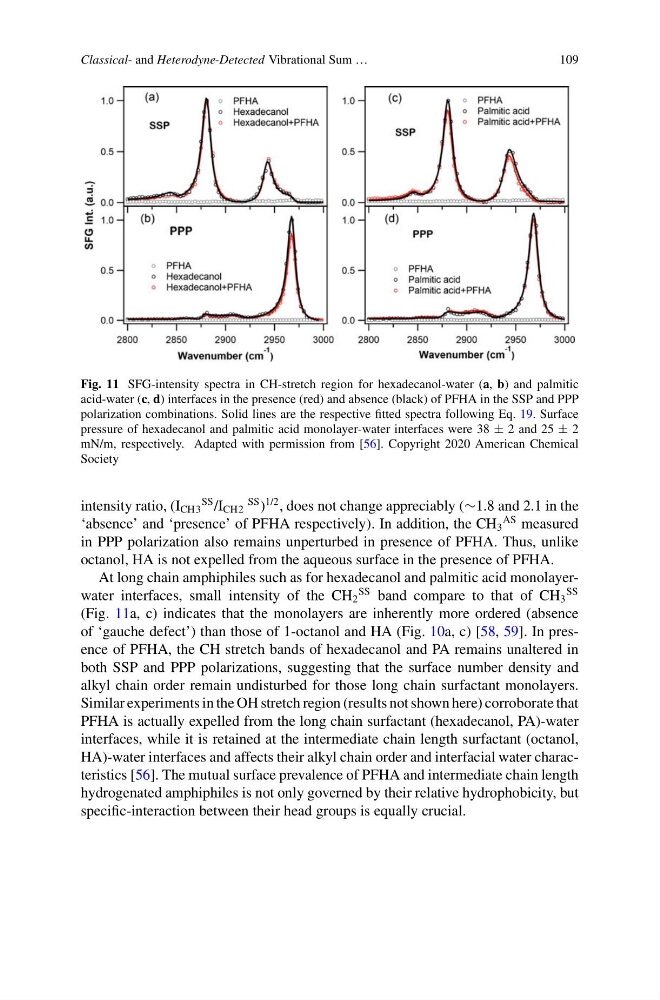
Fig. 11 SFG-intensity spectra in CH-stretch region for hexadecanol-water (a, b) and palmitic
acid-water (c, d) interfaces in the presence (red) and absence (black) of PFHA in the SSP and PPP
polarization combinations. Solid lines are the respective fitted spectra following Eq. 19. Surface
pressure of hexadecanol and palmitic acid monolayer-water interfaces were 38 ± 2 and 25 ± 2
mN/m, respectively. Adapted with permission from [56]. Copyright 2020 American Chemical
Society
intensity ratio, (I CH3
SS /I CH2
SS )
1/2 , does not change appreciably (∼1.8 and 2.1 in the
‘absence’ and ‘presence’ of PFHA respectively). In addition, the CH 3
AS measured
in PPP polarization also remains unperturbed in presence of PFHA. Thus, unlike
octanol, HA is not expelled from the aqueous surface in the presence of PFHA.
At long chain amphiphiles such as for hexadecanol and palmitic acid monolayerwater interfaces, small intensity of the CH 2
SS band compare to that of CH 3
SS
(Fig. 11a, c) indicates that the monolayers are inherently more ordered (absence
of ‘gauche defect’) than those of 1-octanol and HA (Fig. 10a, c) [58, 59]. In presence of PFHA, the CH stretch bands of hexadecanol and PA remains unaltered in
both SSP and PPP polarizations, suggesting that the surface number density and
alkyl chain order remain undisturbed for those long chain surfactant monolayers.
Similar experiments in the OH stretch region (results not shown here) corroborate that
PFHA is actually expelled from the long chain surfactant (hexadecanol, PA)-water
interfaces, while it is retained at the intermediate chain length surfactant (octanol,
HA)-water interfaces and affects their alkyl chain order and interfacial water characteristics [56]. The mutual surface prevalence of PFHA and intermediate chain length
hydrogenated amphiphiles is not only governed by their relative hydrophobicity, but
specific-interaction between their head groups is equally crucial.
109
Fig. 11 SFG-intensity spectra in CH-stretch region for hexadecanol-water (a, b) and palmitic
acid-water (c, d) interfaces in the presence (red) and absence (black) of PFHA in the SSP and PPP
polarization combinations. Solid lines are the respective fitted spectra following Eq. 19. Surface
pressure of hexadecanol and palmitic acid monolayer-water interfaces were 38 ± 2 and 25 ± 2
mN/m, respectively. Adapted with permission from [56]. Copyright 2020 American Chemical
Society
intensity ratio, (I CH3
SS /I CH2
SS )
1/2 , does not change appreciably (∼1.8 and 2.1 in the
‘absence’ and ‘presence’ of PFHA respectively). In addition, the CH 3
AS measured
in PPP polarization also remains unperturbed in presence of PFHA. Thus, unlike
octanol, HA is not expelled from the aqueous surface in the presence of PFHA.
At long chain amphiphiles such as for hexadecanol and palmitic acid monolayerwater interfaces, small intensity of the CH 2
SS band compare to that of CH 3
SS
(Fig. 11a, c) indicates that the monolayers are inherently more ordered (absence
of ‘gauche defect’) than those of 1-octanol and HA (Fig. 10a, c) [58, 59]. In presence of PFHA, the CH stretch bands of hexadecanol and PA remains unaltered in
both SSP and PPP polarizations, suggesting that the surface number density and
alkyl chain order remain undisturbed for those long chain surfactant monolayers.
Similar experiments in the OH stretch region (results not shown here) corroborate that
PFHA is actually expelled from the long chain surfactant (hexadecanol, PA)-water
interfaces, while it is retained at the intermediate chain length surfactant (octanol,
HA)-water interfaces and affects their alkyl chain order and interfacial water characteristics [56]. The mutual surface prevalence of PFHA and intermediate chain length
hydrogenated amphiphiles is not only governed by their relative hydrophobicity, but
specific-interaction between their head groups is equally crucial.