

108
S. Roy et al.
Perfluorinated organic compounds such as perfluoro carboxylic acid (PFCA) is one
of the emerging POPs [55]. Perfluoro compounds are anthropogenic and ocean water
is their primary sink. For the long-range transport and speciation of PFCA, its interaction with aqueous interface (ocean surface) and hydrogenated amphiphiles (e.g., fatty
acid, alcohol, and lipid) and ions that are usually present at ocean surface are of critical importance. Classical-VSFG measurement of perfluoroheptanoic acid (PFHA;
C 6 F 13 COOH)-water interface in the presence of hydrogenated amphiphiles such as
octanol, heptanoic acid (HA), hexadecanol and palmitic acid (PA), reveals intricate
details of the surface prevalence of PFHA and its interaction with other surfactants.
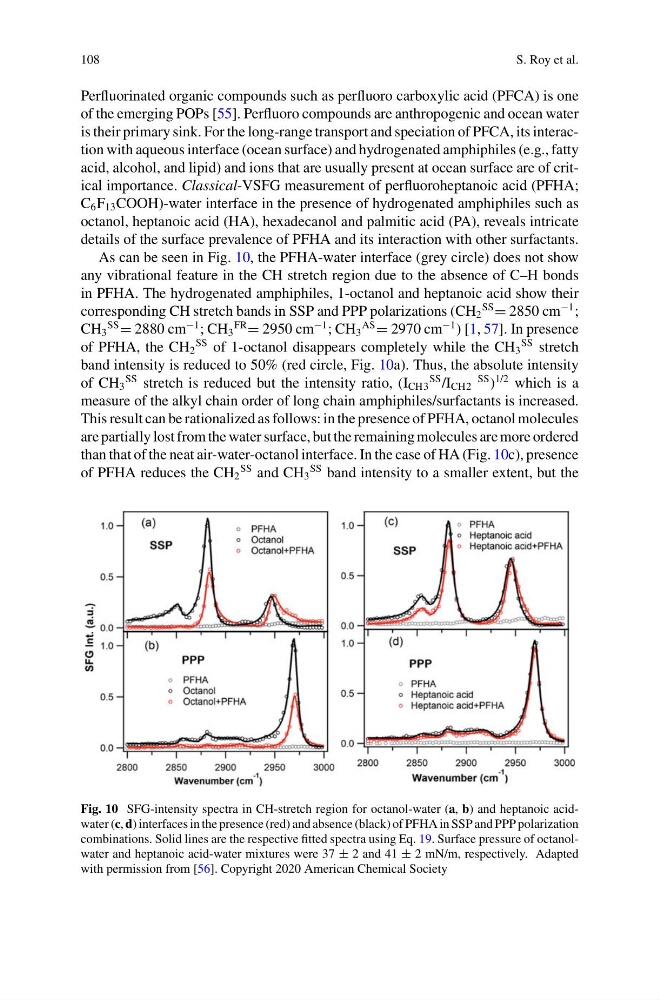
As can be seen in Fig. 10, the PFHA-water interface (grey circle) does not show
any vibrational feature in the CH stretch region due to the absence of C–H bonds
in PFHA. The hydrogenated amphiphiles, 1-octanol and heptanoic acid show their
corresponding CH stretch bands in SSP and PPP polarizations (CH 2
SS
= 2850 cm
−1 ;
CH 3
SS
= 2880 cm
−1 ; CH 3
FR
= 2950 cm
−1 ; CH 3
AS
= 2970 cm
−1 ) [1, 57]. In presence
of PFHA, the CH 2
SS of 1-octanol disappears completely while the CH 3
SS stretch
band intensity is reduced to 50% (red circle, Fig. 10a). Thus, the absolute intensity
of CH 3
SS stretch is reduced but the intensity ratio, (I CH3
SS /I CH2
SS )
1/2 which is a
measure of the alkyl chain order of long chain amphiphiles/surfactants is increased.
This result can be rationalized as follows: in the presence of PFHA, octanol molecules
are partially lost from the water surface, but the remaining molecules are more ordered
than that of the neat air-water-octanol interface. In the case of HA (Fig. 10c), presence
of PFHA reduces the CH 2
SS and CH 3
SS band intensity to a smaller extent, but the
Fig. 10 SFG-intensity spectra in CH-stretch region for octanol-water (a, b) and heptanoic acidwater (c, d) interfaces in the presence (red) and absence (black) of PFHA in SSP and PPP polarization
combinations. Solid lines are the respective fitted spectra using Eq. 19. Surface pressure of octanolwater and heptanoic acid-water mixtures were 37 ± 2 and 41 ± 2 mN/m, respectively. Adapted
with permission from [56]. Copyright 2020 American Chemical Society
S. Roy et al.
Perfluorinated organic compounds such as perfluoro carboxylic acid (PFCA) is one
of the emerging POPs [55]. Perfluoro compounds are anthropogenic and ocean water
is their primary sink. For the long-range transport and speciation of PFCA, its interaction with aqueous interface (ocean surface) and hydrogenated amphiphiles (e.g., fatty
acid, alcohol, and lipid) and ions that are usually present at ocean surface are of critical importance. Classical-VSFG measurement of perfluoroheptanoic acid (PFHA;
C 6 F 13 COOH)-water interface in the presence of hydrogenated amphiphiles such as
octanol, heptanoic acid (HA), hexadecanol and palmitic acid (PA), reveals intricate
details of the surface prevalence of PFHA and its interaction with other surfactants.
As can be seen in Fig. 10, the PFHA-water interface (grey circle) does not show
any vibrational feature in the CH stretch region due to the absence of C–H bonds
in PFHA. The hydrogenated amphiphiles, 1-octanol and heptanoic acid show their
corresponding CH stretch bands in SSP and PPP polarizations (CH 2
SS
= 2850 cm
−1 ;
CH 3
SS
= 2880 cm
−1 ; CH 3
FR
= 2950 cm
−1 ; CH 3
AS
= 2970 cm
−1 ) [1, 57]. In presence
of PFHA, the CH 2
SS of 1-octanol disappears completely while the CH 3
SS stretch
band intensity is reduced to 50% (red circle, Fig. 10a). Thus, the absolute intensity
of CH 3
SS stretch is reduced but the intensity ratio, (I CH3
SS /I CH2
SS )
1/2 which is a
measure of the alkyl chain order of long chain amphiphiles/surfactants is increased.
This result can be rationalized as follows: in the presence of PFHA, octanol molecules
are partially lost from the water surface, but the remaining molecules are more ordered
than that of the neat air-water-octanol interface. In the case of HA (Fig. 10c), presence
of PFHA reduces the CH 2
SS and CH 3
SS band intensity to a smaller extent, but the
Fig. 10 SFG-intensity spectra in CH-stretch region for octanol-water (a, b) and heptanoic acidwater (c, d) interfaces in the presence (red) and absence (black) of PFHA in SSP and PPP polarization
combinations. Solid lines are the respective fitted spectra using Eq. 19. Surface pressure of octanolwater and heptanoic acid-water mixtures were 37 ± 2 and 41 ± 2 mN/m, respectively. Adapted
with permission from [56]. Copyright 2020 American Chemical Society