

Classical- and Heterodyne-Detected Vibrational Sum …
91
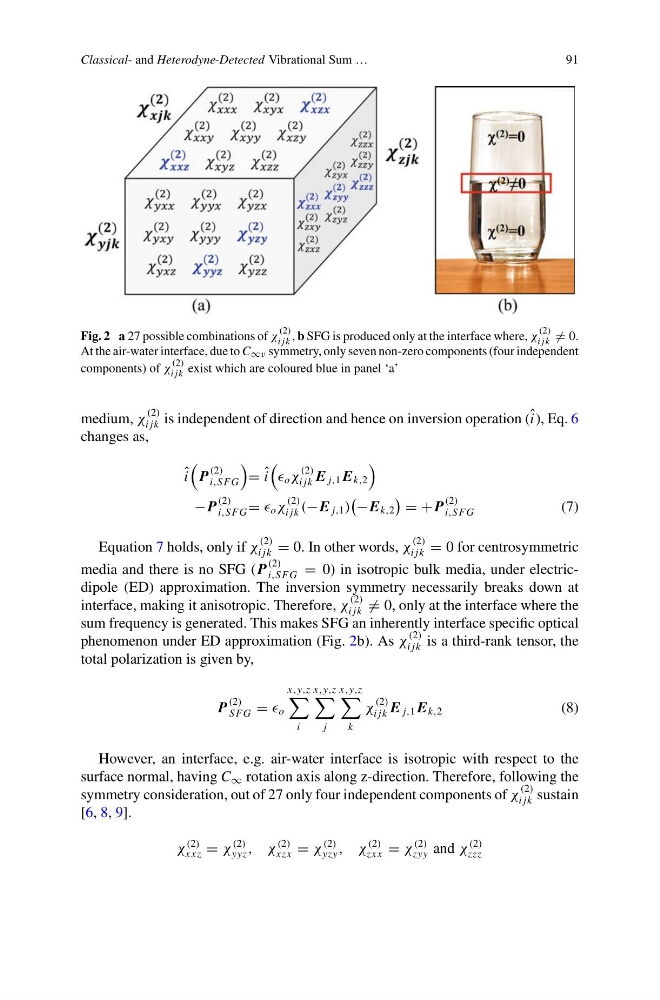
Fig. 2 a 27 possible combinations of χ
(2)
i jk , b SFG is produced only at the interface where, χ
(2)
i jk = 0.
At the air-water interface, due to C ∞v symmetry, only seven non-zero components (four independent
components) of χ
(2)
i jk exist which are coloured blue in panel ‘a’
medium, χ
(2)
i jk is independent of direction and hence on inversion operation ( ˆ
i), Eq. 6
changes as,
ˆ
i
P
(2)
i,SFG
= ˆ
i
o χ
(2)
i jk E j,1 E k,2
− P
(2)
i,SFG = o χ
(2)
i jk (−E j,1 )
−E k,2
= +P
(2)
i,SFG
(7)
Equation 7 holds, only if χ
(2)
i jk = 0. In other words, χ
(2)
i jk = 0 for centrosymmetric
media and there is no SFG ( P
(2)
i,SFG = 0) in isotropic bulk media, under electricdipole (ED) approximation. The inversion symmetry necessarily breaks down at
interface, making it anisotropic. Therefore, χ
(2)
i jk = 0, only at the interface where the
sum frequency is generated. This makes SFG an inherently interface specific optical
phenomenon under ED approximation (Fig. 2b). As χ
(2)
i jk is a third-rank tensor, the
total polarization is given by,
P
(2)
SFG = o
x,y,z
i
x,y,z
j
x,y,z
k
χ
(2)
i jk E j,1 E k,2
(8)
However, an interface, e.g. air-water interface is isotropic with respect to the
surface normal, having C ∞ rotation axis along z-direction. Therefore, following the
symmetry consideration, out of 27 only four independent components of χ
(2)
i jk sustain
[6, 8, 9].
χ
(2)
xxz = χ
(2)
yyz , χ
(2)
xzx = χ
(2)
yzy , χ
(2)
zx x = χ
(2)
zyy and χ
(2)
zzz
91
Fig. 2 a 27 possible combinations of χ
(2)
i jk , b SFG is produced only at the interface where, χ
(2)
i jk = 0.
At the air-water interface, due to C ∞v symmetry, only seven non-zero components (four independent
components) of χ
(2)
i jk exist which are coloured blue in panel ‘a’
medium, χ
(2)
i jk is independent of direction and hence on inversion operation ( ˆ
i), Eq. 6
changes as,
ˆ
i
P
(2)
i,SFG
= ˆ
i
o χ
(2)
i jk E j,1 E k,2
− P
(2)
i,SFG = o χ
(2)
i jk (−E j,1 )
−E k,2
= +P
(2)
i,SFG
(7)
Equation 7 holds, only if χ
(2)
i jk = 0. In other words, χ
(2)
i jk = 0 for centrosymmetric
media and there is no SFG ( P
(2)
i,SFG = 0) in isotropic bulk media, under electricdipole (ED) approximation. The inversion symmetry necessarily breaks down at
interface, making it anisotropic. Therefore, χ
(2)
i jk = 0, only at the interface where the
sum frequency is generated. This makes SFG an inherently interface specific optical
phenomenon under ED approximation (Fig. 2b). As χ
(2)
i jk is a third-rank tensor, the
total polarization is given by,
P
(2)
SFG = o
x,y,z
i
x,y,z
j
x,y,z
k
χ
(2)
i jk E j,1 E k,2
(8)
However, an interface, e.g. air-water interface is isotropic with respect to the
surface normal, having C ∞ rotation axis along z-direction. Therefore, following the
symmetry consideration, out of 27 only four independent components of χ
(2)
i jk sustain
[6, 8, 9].
χ
(2)
xxz = χ
(2)
yyz , χ
(2)
xzx = χ
(2)
yzy , χ
(2)
zx x = χ
(2)
zyy and χ
(2)
zzz