

90
S. Roy et al.
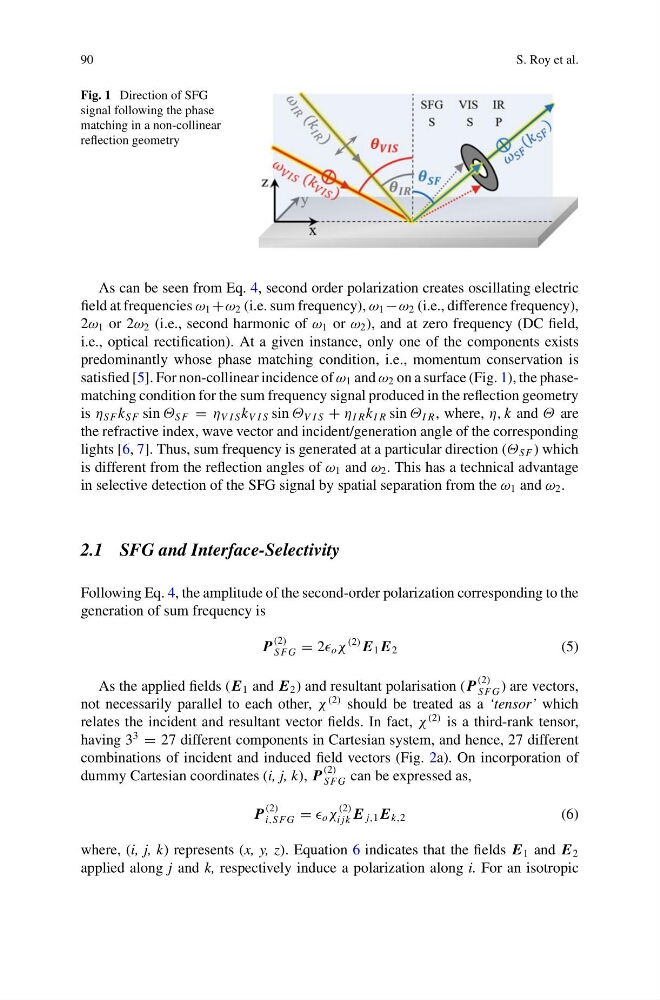
Fig. 1 Direction of SFG
signal following the phase
matching in a non-collinear
reflection geometry
As can be seen from Eq. 4, second order polarization creates oscillating electric
field at frequencies ω 1 +ω 2 (i.e. sum frequency), ω 1 −ω 2 (i.e., difference frequency),
2ω 1 or 2ω 2 (i.e., second harmonic of ω 1 or ω 2 ), and at zero frequency (DC field,
i.e., optical rectification). At a given instance, only one of the components exists
predominantly whose phase matching condition, i.e., momentum conservation is
satisfied [5]. For non-collinear incidence of ω 1 and ω 2 on a surface (Fig. 1), the phasematching condition for the sum frequency signal produced in the reflection geometry
is η SF k SF sin Θ SF = η V I S k V I S sin Θ V I S + η I R k I R sin Θ I R , where, η, k and Θ are
the refractive index, wave vector and incident/generation angle of the corresponding
lights [6, 7]. Thus, sum frequency is generated at a particular direction (Θ SF ) which
is different from the reflection angles of ω 1 and ω 2 . This has a technical advantage
in selective detection of the SFG signal by spatial separation from the ω 1 and ω 2 .
2.1 SFG and Interface-Selectivity
Following Eq. 4, the amplitude of the second-order polarization corresponding to the
generation of sum frequency is
P
(2)
SFG = 2 o χ
(2) E 1 E 2
(5)
As the applied fields (E 1 and E 2 ) and resultant polarisation ( P
(2)
SFG ) are vectors,
not necessarily parallel to each other, χ
(2) should be treated as a ‘tensor’ which
relates the incident and resultant vector fields. In fact, χ
(2) is a third-rank tensor,
having 3
3
= 27 different components in Cartesian system, and hence, 27 different
combinations of incident and induced field vectors (Fig. 2a). On incorporation of
dummy Cartesian coordinates (i, j, k), P
(2)
SFG can be expressed as,
P
(2)
i,SFG = o χ
(2)
i jk E j,1 E k,2
(6)
where, (i, j, k) represents (x, y, z). Equation 6 indicates that the fields E 1 and E 2
applied along j and k, respectively induce a polarization along i. For an isotropic
S. Roy et al.
Fig. 1 Direction of SFG
signal following the phase
matching in a non-collinear
reflection geometry
As can be seen from Eq. 4, second order polarization creates oscillating electric
field at frequencies ω 1 +ω 2 (i.e. sum frequency), ω 1 −ω 2 (i.e., difference frequency),
2ω 1 or 2ω 2 (i.e., second harmonic of ω 1 or ω 2 ), and at zero frequency (DC field,
i.e., optical rectification). At a given instance, only one of the components exists
predominantly whose phase matching condition, i.e., momentum conservation is
satisfied [5]. For non-collinear incidence of ω 1 and ω 2 on a surface (Fig. 1), the phasematching condition for the sum frequency signal produced in the reflection geometry
is η SF k SF sin Θ SF = η V I S k V I S sin Θ V I S + η I R k I R sin Θ I R , where, η, k and Θ are
the refractive index, wave vector and incident/generation angle of the corresponding
lights [6, 7]. Thus, sum frequency is generated at a particular direction (Θ SF ) which
is different from the reflection angles of ω 1 and ω 2 . This has a technical advantage
in selective detection of the SFG signal by spatial separation from the ω 1 and ω 2 .
2.1 SFG and Interface-Selectivity
Following Eq. 4, the amplitude of the second-order polarization corresponding to the
generation of sum frequency is
P
(2)
SFG = 2 o χ
(2) E 1 E 2
(5)
As the applied fields (E 1 and E 2 ) and resultant polarisation ( P
(2)
SFG ) are vectors,
not necessarily parallel to each other, χ
(2) should be treated as a ‘tensor’ which
relates the incident and resultant vector fields. In fact, χ
(2) is a third-rank tensor,
having 3
3
= 27 different components in Cartesian system, and hence, 27 different
combinations of incident and induced field vectors (Fig. 2a). On incorporation of
dummy Cartesian coordinates (i, j, k), P
(2)
SFG can be expressed as,
P
(2)
i,SFG = o χ
(2)
i jk E j,1 E k,2
(6)
where, (i, j, k) represents (x, y, z). Equation 6 indicates that the fields E 1 and E 2
applied along j and k, respectively induce a polarization along i. For an isotropic