

advance, and long-range acoustic devices or other sonic devices may be able to get
animals to move out of harm’s way (Babińska-Werka et al.2015; Grey 2015).
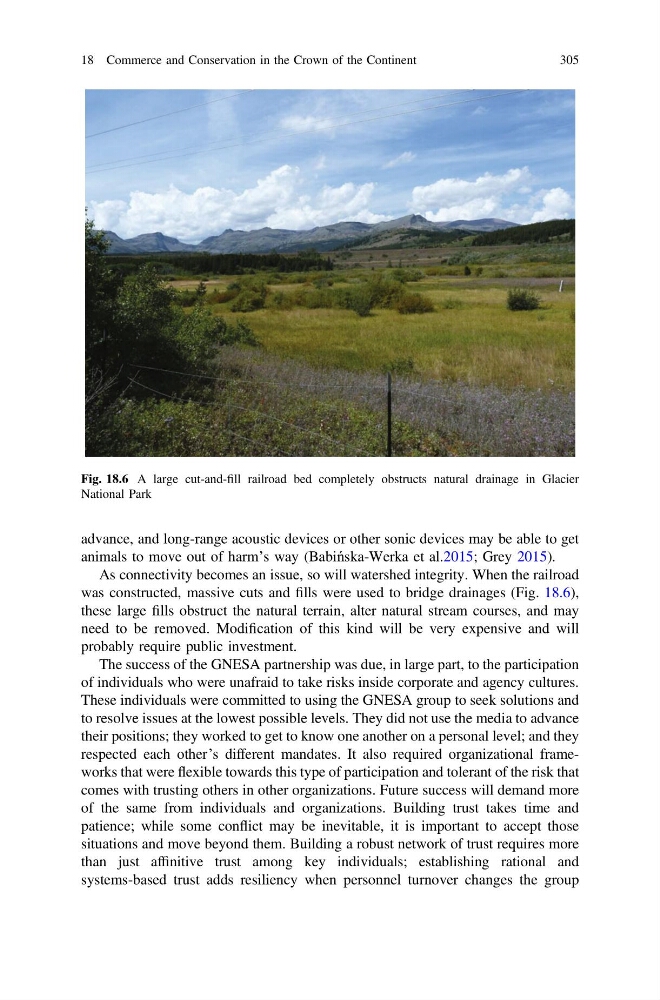
As connectivity becomes an issue, so will watershed integrity. When the railroad
was constructed, massive cuts and fills were used to bridge drainages (Fig. 18.6),
these large fills obstruct the natural terrain, alter natural stream courses, and may
need to be removed. Modification of this kind will be very expensive and will
probably require public investment.
The success of the GNESA partnership was due, in large part, to the participation
of individuals who were unafraid to take risks inside corporate and agency cultures.
These individuals were committed to using the GNESA group to seek solutions and
to resolve issues at the lowest possible levels. They did not use the media to advance
their positions; they worked to get to know one another on a personal level; and they
respected each other’s different mandates. It also required organizational frameworks that were flexible towards this type of participation and tolerant of the risk that
comes with trusting others in other organizations. Future success will demand more
of the same from individuals and organizations. Building trust takes time and
patience; while some conflict may be inevitable, it is important to accept those
situations and move beyond them. Building a robust network of trust requires more
than just affinitive trust among key individuals; establishing rational and
systems-based trust adds resiliency when personnel turnover changes the group
Fig. 18.6 A large cut-and-fill railroad bed completely obstructs natural drainage in Glacier
National Park
18 Commerce and Conservation in the Crown of the Continent
305
animals to move out of harm’s way (Babińska-Werka et al.2015; Grey 2015).
As connectivity becomes an issue, so will watershed integrity. When the railroad
was constructed, massive cuts and fills were used to bridge drainages (Fig. 18.6),
these large fills obstruct the natural terrain, alter natural stream courses, and may
need to be removed. Modification of this kind will be very expensive and will
probably require public investment.
The success of the GNESA partnership was due, in large part, to the participation
of individuals who were unafraid to take risks inside corporate and agency cultures.
These individuals were committed to using the GNESA group to seek solutions and
to resolve issues at the lowest possible levels. They did not use the media to advance
their positions; they worked to get to know one another on a personal level; and they
respected each other’s different mandates. It also required organizational frameworks that were flexible towards this type of participation and tolerant of the risk that
comes with trusting others in other organizations. Future success will demand more
of the same from individuals and organizations. Building trust takes time and
patience; while some conflict may be inevitable, it is important to accept those
situations and move beyond them. Building a robust network of trust requires more
than just affinitive trust among key individuals; establishing rational and
systems-based trust adds resiliency when personnel turnover changes the group
Fig. 18.6 A large cut-and-fill railroad bed completely obstructs natural drainage in Glacier
National Park
18 Commerce and Conservation in the Crown of the Continent
305