

struck by trains and their carcasses also become attractants for bears. As bears come
to scavenge the remains, they themselves become victims.
A third important source of mortality was associated with trestles. The rail line
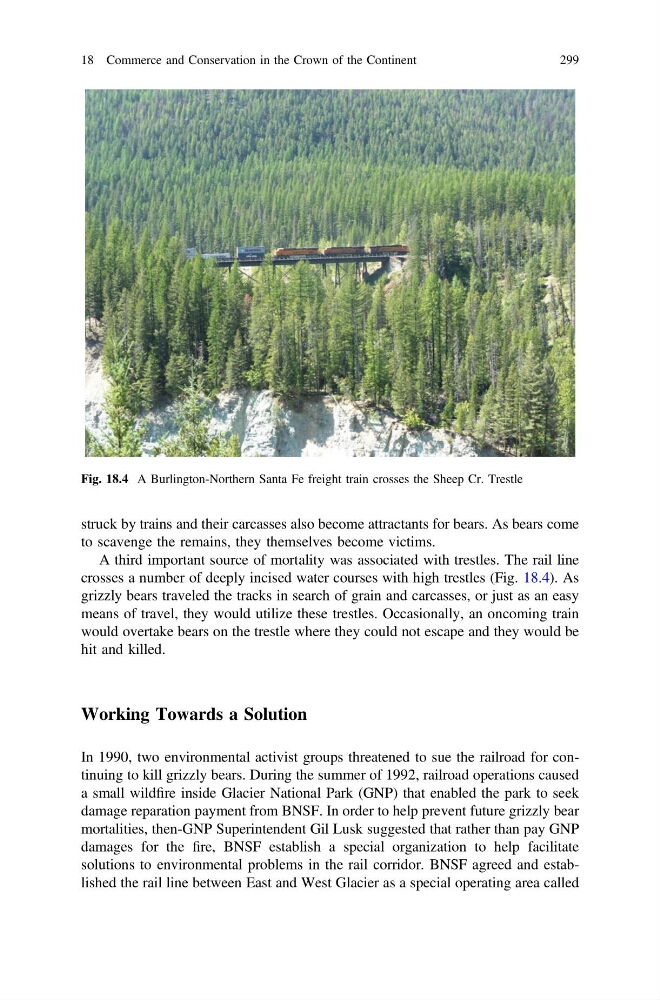
crosses a number of deeply incised water courses with high trestles (Fig. 18.4). As
grizzly bears traveled the tracks in search of grain and carcasses, or just as an easy
means of travel, they would utilize these trestles. Occasionally, an oncoming train
would overtake bears on the trestle where they could not escape and they would be
hit and killed.
Working Towards a Solution
In 1990, two environmental activist groups threatened to sue the railroad for continuing to kill grizzly bears. During the summer of 1992, railroad operations caused
a small wildfire inside Glacier National Park (GNP) that enabled the park to seek
damage reparation payment from BNSF. In order to help prevent future grizzly bear
mortalities, then-GNP Superintendent Gil Lusk suggested that rather than pay GNP
damages for the fire, BNSF establish a special organization to help facilitate
solutions to environmental problems in the rail corridor. BNSF agreed and established the rail line between East and West Glacier as a special operating area called
Fig. 18.4 A Burlington-Northern Santa Fe freight train crosses the Sheep Cr. Trestle
18 Commerce and Conservation in the Crown of the Continent
299
to scavenge the remains, they themselves become victims.
A third important source of mortality was associated with trestles. The rail line
crosses a number of deeply incised water courses with high trestles (Fig. 18.4). As
grizzly bears traveled the tracks in search of grain and carcasses, or just as an easy
means of travel, they would utilize these trestles. Occasionally, an oncoming train
would overtake bears on the trestle where they could not escape and they would be
hit and killed.
Working Towards a Solution
In 1990, two environmental activist groups threatened to sue the railroad for continuing to kill grizzly bears. During the summer of 1992, railroad operations caused
a small wildfire inside Glacier National Park (GNP) that enabled the park to seek
damage reparation payment from BNSF. In order to help prevent future grizzly bear
mortalities, then-GNP Superintendent Gil Lusk suggested that rather than pay GNP
damages for the fire, BNSF establish a special organization to help facilitate
solutions to environmental problems in the rail corridor. BNSF agreed and established the rail line between East and West Glacier as a special operating area called
Fig. 18.4 A Burlington-Northern Santa Fe freight train crosses the Sheep Cr. Trestle
18 Commerce and Conservation in the Crown of the Continent
299