

Conclusion
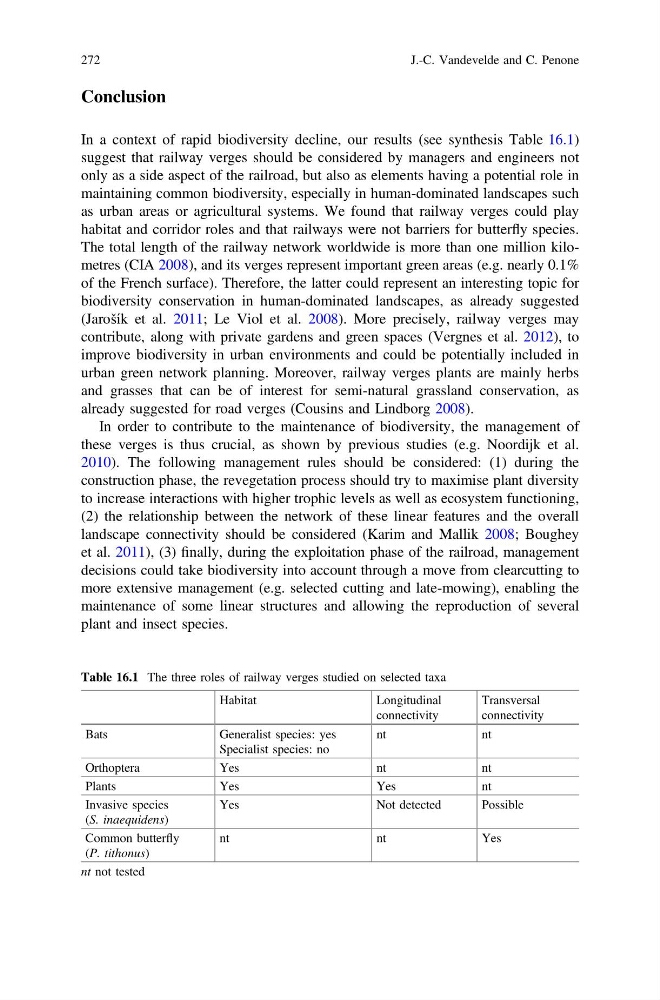
In a context of rapid biodiversity decline, our results (see synthesis Table 16.1)
suggest that railway verges should be considered by managers and engineers not
only as a side aspect of the railroad, but also as elements having a potential role in
maintaining common biodiversity, especially in human-dominated landscapes such
as urban areas or agricultural systems. We found that railway verges could play
habitat and corridor roles and that railways were not barriers for butterfly species.
The total length of the railway network worldwide is more than one million kilometres (CIA 2008), and its verges represent important green areas (e.g. nearly 0.1%
of the French surface). Therefore, the latter could represent an interesting topic for
biodiversity conservation in human-dominated landscapes, as already suggested
(Jarošík et al. 2011; Le Viol et al. 2008). More precisely, railway verges may
contribute, along with private gardens and green spaces (Vergnes et al. 2012), to
improve biodiversity in urban environments and could be potentially included in
urban green network planning. Moreover, railway verges plants are mainly herbs
and grasses that can be of interest for semi-natural grassland conservation, as
already suggested for road verges (Cousins and Lindborg 2008).
In order to contribute to the maintenance of biodiversity, the management of
these verges is thus crucial, as shown by previous studies (e.g. Noordijk et al.
2010). The following management rules should be considered: (1) during the
construction phase, the revegetation process should try to maximise plant diversity
to increase interactions with higher trophic levels as well as ecosystem functioning,
(2) the relationship between the network of these linear features and the overall
landscape connectivity should be considered (Karim and Mallik 2008; Boughey
et al. 2011), (3) finally, during the exploitation phase of the railroad, management
decisions could take biodiversity into account through a move from clearcutting to
more extensive management (e.g. selected cutting and late-mowing), enabling the
maintenance of some linear structures and allowing the reproduction of several
plant and insect species.
Table 16.1 The three roles of railway verges studied on selected taxa
Habitat
Longitudinal
connectivity
Transversal
connectivity
Bats
Generalist species: yes
Specialist species: no
nt
nt
Orthoptera
Yes
nt
nt
Plants
Yes
Yes
nt
Invasive species
(S. inaequidens)
Yes
Not detected
Possible
Common butterfly
(P. tithonus)
nt
nt
Yes
nt not tested
272
J.-C. Vandevelde and C. Penone
In a context of rapid biodiversity decline, our results (see synthesis Table 16.1)
suggest that railway verges should be considered by managers and engineers not
only as a side aspect of the railroad, but also as elements having a potential role in
maintaining common biodiversity, especially in human-dominated landscapes such
as urban areas or agricultural systems. We found that railway verges could play
habitat and corridor roles and that railways were not barriers for butterfly species.
The total length of the railway network worldwide is more than one million kilometres (CIA 2008), and its verges represent important green areas (e.g. nearly 0.1%
of the French surface). Therefore, the latter could represent an interesting topic for
biodiversity conservation in human-dominated landscapes, as already suggested
(Jarošík et al. 2011; Le Viol et al. 2008). More precisely, railway verges may
contribute, along with private gardens and green spaces (Vergnes et al. 2012), to
improve biodiversity in urban environments and could be potentially included in
urban green network planning. Moreover, railway verges plants are mainly herbs
and grasses that can be of interest for semi-natural grassland conservation, as
already suggested for road verges (Cousins and Lindborg 2008).
In order to contribute to the maintenance of biodiversity, the management of
these verges is thus crucial, as shown by previous studies (e.g. Noordijk et al.
2010). The following management rules should be considered: (1) during the
construction phase, the revegetation process should try to maximise plant diversity
to increase interactions with higher trophic levels as well as ecosystem functioning,
(2) the relationship between the network of these linear features and the overall
landscape connectivity should be considered (Karim and Mallik 2008; Boughey
et al. 2011), (3) finally, during the exploitation phase of the railroad, management
decisions could take biodiversity into account through a move from clearcutting to
more extensive management (e.g. selected cutting and late-mowing), enabling the
maintenance of some linear structures and allowing the reproduction of several
plant and insect species.
Table 16.1 The three roles of railway verges studied on selected taxa
Habitat
Longitudinal
connectivity
Transversal
connectivity
Bats
Generalist species: yes
Specialist species: no
nt
nt
Orthoptera
Yes
nt
nt
Plants
Yes
Yes
nt
Invasive species
(S. inaequidens)
Yes
Not detected
Possible
Common butterfly
(P. tithonus)
nt
nt
Yes
nt not tested
272
J.-C. Vandevelde and C. Penone