

inside the fence at the beginning of winter, because these areas are not usually
grazed by livestock or wild ungulates during summer. Therefore, the area inside the
fences may be attractive for herbivores in winter, leading to some ungulates trying
to enter it. Once inside the fenced area, the animal may not be able to find suitable
locations to jump or crawl out of the fence again or may become too weak to do so.
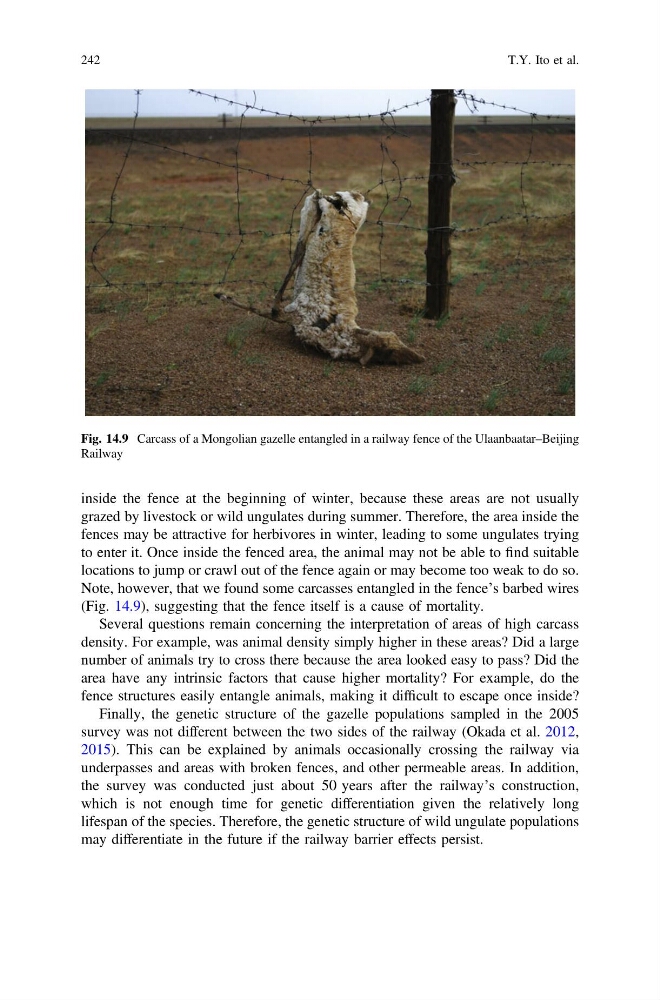
Note, however, that we found some carcasses entangled in the fence’s barbed wires
(Fig. 14.9), suggesting that the fence itself is a cause of mortality.
Several questions remain concerning the interpretation of areas of high carcass
density. For example, was animal density simply higher in these areas? Did a large
number of animals try to cross there because the area looked easy to pass? Did the
area have any intrinsic factors that cause higher mortality? For example, do the
fence structures easily entangle animals, making it difficult to escape once inside?
Finally, the genetic structure of the gazelle populations sampled in the 2005
survey was not different between the two sides of the railway (Okada et al. 2012,
2015). This can be explained by animals occasionally crossing the railway via
underpasses and areas with broken fences, and other permeable areas. In addition,
the survey was conducted just about 50 years after the railway’s construction,
which is not enough time for genetic differentiation given the relatively long
lifespan of the species. Therefore, the genetic structure of wild ungulate populations
may differentiate in the future if the railway barrier effects persist.
Fig. 14.9 Carcass of a Mongolian gazelle entangled in a railway fence of the Ulaanbaatar–Beijing
Railway
242
T.Y. Ito et al.
grazed by livestock or wild ungulates during summer. Therefore, the area inside the
fences may be attractive for herbivores in winter, leading to some ungulates trying
to enter it. Once inside the fenced area, the animal may not be able to find suitable
locations to jump or crawl out of the fence again or may become too weak to do so.
Note, however, that we found some carcasses entangled in the fence’s barbed wires
(Fig. 14.9), suggesting that the fence itself is a cause of mortality.
Several questions remain concerning the interpretation of areas of high carcass
density. For example, was animal density simply higher in these areas? Did a large
number of animals try to cross there because the area looked easy to pass? Did the
area have any intrinsic factors that cause higher mortality? For example, do the
fence structures easily entangle animals, making it difficult to escape once inside?
Finally, the genetic structure of the gazelle populations sampled in the 2005
survey was not different between the two sides of the railway (Okada et al. 2012,
2015). This can be explained by animals occasionally crossing the railway via
underpasses and areas with broken fences, and other permeable areas. In addition,
the survey was conducted just about 50 years after the railway’s construction,
which is not enough time for genetic differentiation given the relatively long
lifespan of the species. Therefore, the genetic structure of wild ungulate populations
may differentiate in the future if the railway barrier effects persist.
Fig. 14.9 Carcass of a Mongolian gazelle entangled in a railway fence of the Ulaanbaatar–Beijing
Railway
242
T.Y. Ito et al.