

carcasses were recorded (Olson 2012). Although the carcass distribution patterns in
different years were similar, there were also some differences. An area of high
carcass density existed to the southeast of Ayrag Town in the 2005 survey
(Fig. 14.8), but a high density was found to the northwest of the town in the 2011
survey. We attribute this interannual difference among areas of high carcass density
to the high environmental unpredictability, which leads to changes in the locations
of suitable sites for wild ungulates. Thus, the areas with high carcass density in one
year do not necessarily indicate that these are the best sites to implement wildlife
crossings. However, because Mongolian gazelles likely have a learning capacity,
the sites are still good candidates given that gazelles had previously used these
areas. For example, some tracked gazelles came back from several hundred kilometers to the same location in the following summer (Ito et al. 2013b).
Carcasses were also found inside the fenced area (Fig. 14.8), suggesting that the
fences did not form a total barrier to wild ungulates. The existence of carcasses
inside the fences might be explained by the fact that plant biomass is more abundant
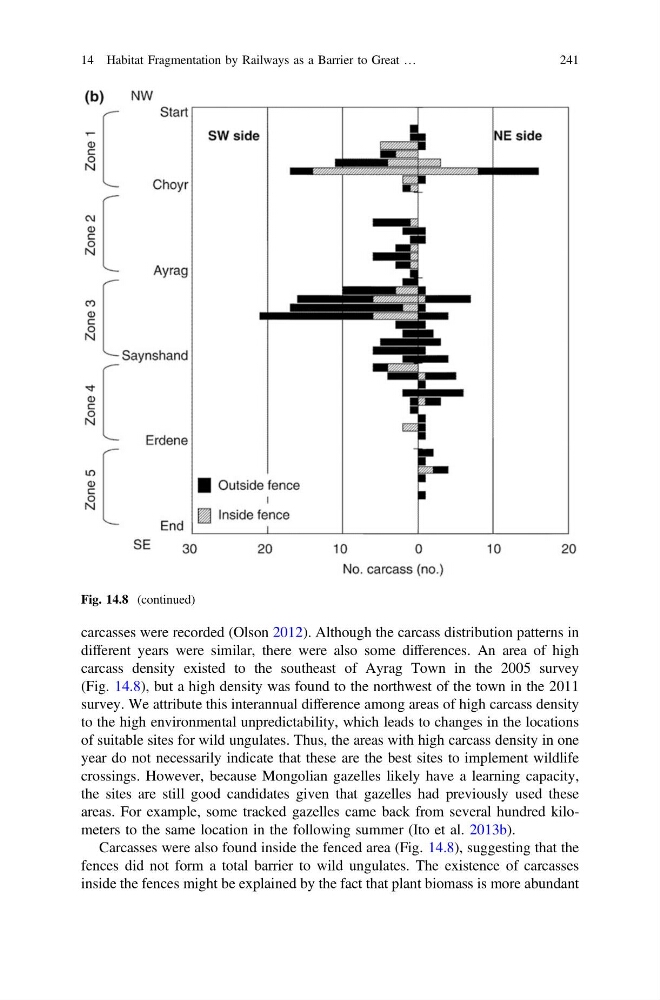
Fig. 14.8 (continued)
14 Habitat Fragmentation by Railways as a Barrier to Great …
241
different years were similar, there were also some differences. An area of high
carcass density existed to the southeast of Ayrag Town in the 2005 survey
(Fig. 14.8), but a high density was found to the northwest of the town in the 2011
survey. We attribute this interannual difference among areas of high carcass density
to the high environmental unpredictability, which leads to changes in the locations
of suitable sites for wild ungulates. Thus, the areas with high carcass density in one
year do not necessarily indicate that these are the best sites to implement wildlife
crossings. However, because Mongolian gazelles likely have a learning capacity,
the sites are still good candidates given that gazelles had previously used these
areas. For example, some tracked gazelles came back from several hundred kilometers to the same location in the following summer (Ito et al. 2013b).
Carcasses were also found inside the fenced area (Fig. 14.8), suggesting that the
fences did not form a total barrier to wild ungulates. The existence of carcasses
inside the fences might be explained by the fact that plant biomass is more abundant
Fig. 14.8 (continued)
14 Habitat Fragmentation by Railways as a Barrier to Great …
241