

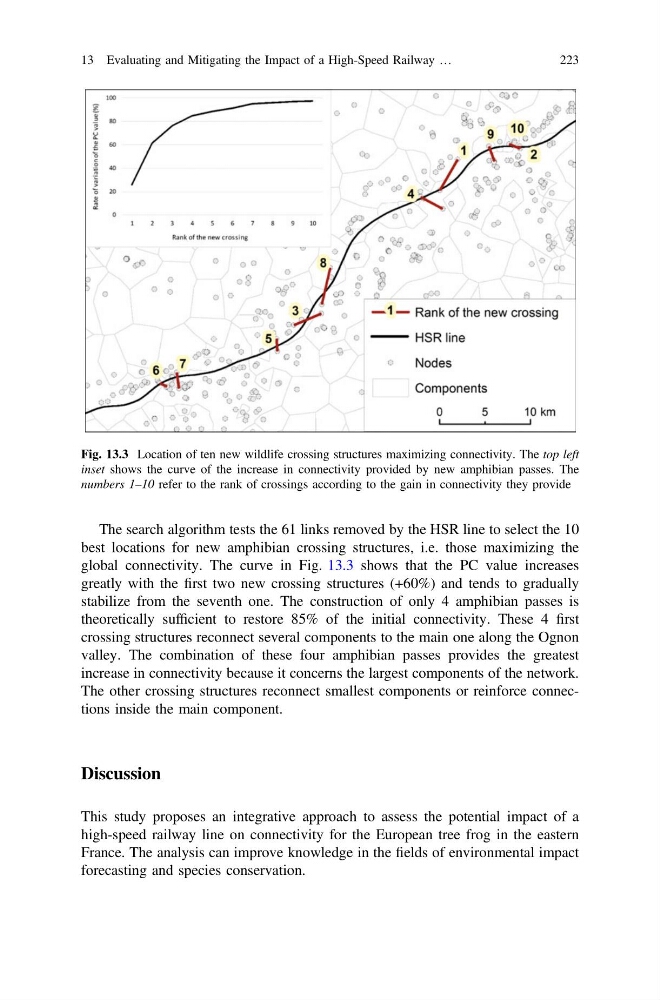
The search algorithm tests the 61 links removed by the HSR line to select the 10
best locations for new amphibian crossing structures, i.e. those maximizing the
global connectivity. The curve in Fig. 13.3 shows that the PC value increases
greatly with the first two new crossing structures (+60%) and tends to gradually
stabilize from the seventh one. The construction of only 4 amphibian passes is
theoretically sufficient to restore 85% of the initial connectivity. These 4 first
crossing structures reconnect several components to the main one along the Ognon
valley. The combination of these four amphibian passes provides the greatest
increase in connectivity because it concerns the largest components of the network.
The other crossing structures reconnect smallest components or reinforce connections inside the main component.
Discussion
This study proposes an integrative approach to assess the potential impact of a
high-speed railway line on connectivity for the European tree frog in the eastern
France. The analysis can improve knowledge in the fields of environmental impact
forecasting and species conservation.
Fig. 13.3 Location of ten new wildlife crossing structures maximizing connectivity. The top left
inset shows the curve of the increase in connectivity provided by new amphibian passes. The
numbers 1–10 refer to the rank of crossings according to the gain in connectivity they provide
13 Evaluating and Mitigating the Impact of a High-Speed Railway …
223
best locations for new amphibian crossing structures, i.e. those maximizing the
global connectivity. The curve in Fig. 13.3 shows that the PC value increases
greatly with the first two new crossing structures (+60%) and tends to gradually
stabilize from the seventh one. The construction of only 4 amphibian passes is
theoretically sufficient to restore 85% of the initial connectivity. These 4 first
crossing structures reconnect several components to the main one along the Ognon
valley. The combination of these four amphibian passes provides the greatest
increase in connectivity because it concerns the largest components of the network.
The other crossing structures reconnect smallest components or reinforce connections inside the main component.
Discussion
This study proposes an integrative approach to assess the potential impact of a
high-speed railway line on connectivity for the European tree frog in the eastern
France. The analysis can improve knowledge in the fields of environmental impact
forecasting and species conservation.
Fig. 13.3 Location of ten new wildlife crossing structures maximizing connectivity. The top left
inset shows the curve of the increase in connectivity provided by new amphibian passes. The
numbers 1–10 refer to the rank of crossings according to the gain in connectivity they provide
13 Evaluating and Mitigating the Impact of a High-Speed Railway …
223