

bustard, Tetrax tetrax), mammals (lesser horseshoe bat, Rhinolophus hipposideros),
reptiles (European pond turtle, Emys orbicularis) and amphibians (European tree
frog, Hyla arborea) (Paul 2011).
In December 2011, a high-speed railway line came into service in the region
after 4 years of construction. It is part of a larger project that improves connections
for eastern France with both Paris and the south of France. This infrastructure is
140 km long and 30 m wide on average and crosses the study area from west to
east following the Ognon valley. The line includes a total 1300 m of viaducts and
2000 m of tunnels. In this study, this infrastructure is considered as impassable
either because it forms a physical barrier or because traffic noise can disrupt the
animals’ behaviors (Eigenbrod et al. 2009; Lengagne 2008) even when the
infrastructure is on a viaduct. This simplified representation of reality is used to
better predict the potential impact of the infrastructure on landscape connectivity
and by repercussion on tree frog populations.
Study Species
The tree frog is widely distributed in Europe from Spain to western Russia, but its
populations have declined in north-western Europe over the last 50 years (Corbett
1989). The species is classified as endangered and is on the IUCN Regional Red
List of Threatened Species for Burgundy-Franche-Comté where it is mainly present
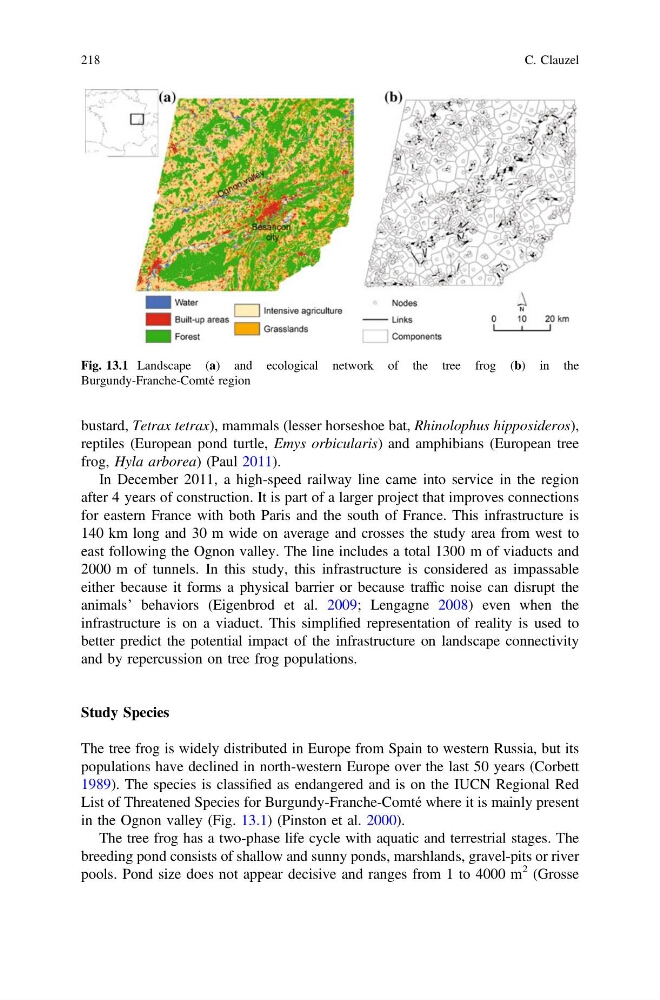
in the Ognon valley (Fig. 13.1) (Pinston et al. 2000).
The tree frog has a two-phase life cycle with aquatic and terrestrial stages. The
breeding pond consists of shallow and sunny ponds, marshlands, gravel-pits or river
pools. Pond size does not appear decisive and ranges from 1 to 4000 m
2 (Grosse
Fig. 13.1 Landscape (a) and ecological network of the tree frog (b) in the
Burgundy-Franche-Comté region
218
C. Clauzel
reptiles (European pond turtle, Emys orbicularis) and amphibians (European tree
frog, Hyla arborea) (Paul 2011).
In December 2011, a high-speed railway line came into service in the region
after 4 years of construction. It is part of a larger project that improves connections
for eastern France with both Paris and the south of France. This infrastructure is
140 km long and 30 m wide on average and crosses the study area from west to
east following the Ognon valley. The line includes a total 1300 m of viaducts and
2000 m of tunnels. In this study, this infrastructure is considered as impassable
either because it forms a physical barrier or because traffic noise can disrupt the
animals’ behaviors (Eigenbrod et al. 2009; Lengagne 2008) even when the
infrastructure is on a viaduct. This simplified representation of reality is used to
better predict the potential impact of the infrastructure on landscape connectivity
and by repercussion on tree frog populations.
Study Species
The tree frog is widely distributed in Europe from Spain to western Russia, but its
populations have declined in north-western Europe over the last 50 years (Corbett
1989). The species is classified as endangered and is on the IUCN Regional Red
List of Threatened Species for Burgundy-Franche-Comté where it is mainly present
in the Ognon valley (Fig. 13.1) (Pinston et al. 2000).
The tree frog has a two-phase life cycle with aquatic and terrestrial stages. The
breeding pond consists of shallow and sunny ponds, marshlands, gravel-pits or river
pools. Pond size does not appear decisive and ranges from 1 to 4000 m
2 (Grosse
Fig. 13.1 Landscape (a) and ecological network of the tree frog (b) in the
Burgundy-Franche-Comté region
218
C. Clauzel