

the velocity difference between these two groups or to their original chemical
composition, though the evidence was not conclusive.
3.8.3 History of Oriental Astronomy
Hirose’s works on the history of oriental astronomy were produced in the years
around his retirement.
Hirose’s first work were the studies of Juji Reki (授時暦, Shou-Shi Calendar, see
Chap. 1) in two problems. The first one (Hirose 1969) was on the influence of the
mathematical method of the Shou-Shi calendar on Japanese mathematics. The
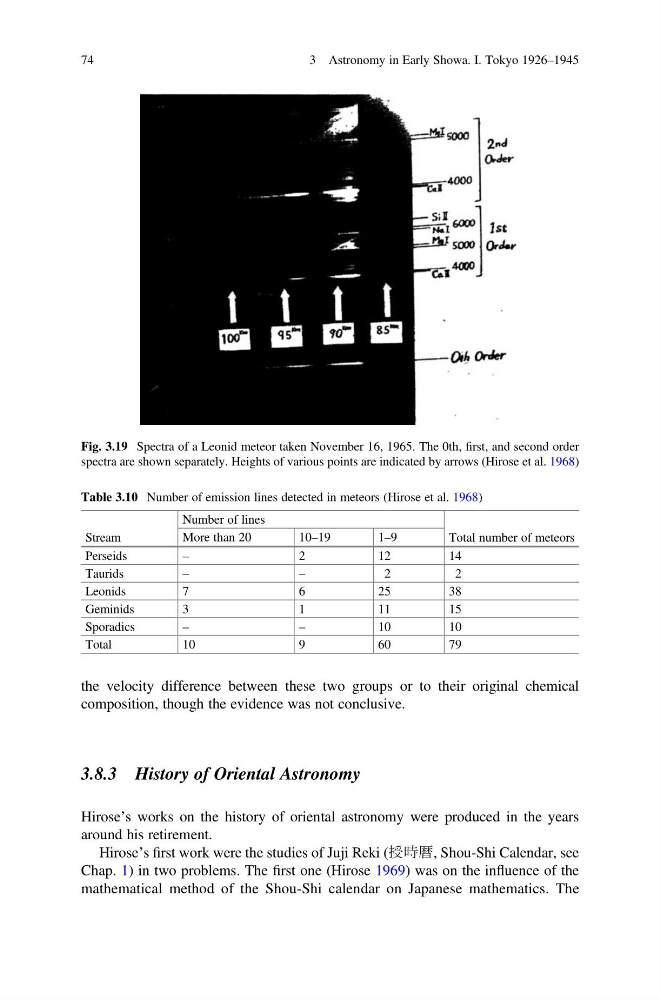
Fig. 3.19 Spectra of a Leonid meteor taken November 16, 1965. The 0th, first, and second order
spectra are shown separately. Heights of various points are indicated by arrows (Hirose et al. 1968)
Table 3.10 Number of emission lines detected in meteors (Hirose et al. 1968)
Stream
Number of lines
Total number of meteors
More than 20
10–19
1–9
Perseids
–
2
1 2
1 4
Taurids
–
–
2
2
Leonids
7
6
25
38
Geminids
3
1
11
15
Sporadics
–
–
10
10
Total
10
9
60
79
74
3 Astronomy in Early Showa. I. Tokyo 1926–1945
composition, though the evidence was not conclusive.
3.8.3 History of Oriental Astronomy
Hirose’s works on the history of oriental astronomy were produced in the years
around his retirement.
Hirose’s first work were the studies of Juji Reki (授時暦, Shou-Shi Calendar, see
Chap. 1) in two problems. The first one (Hirose 1969) was on the influence of the
mathematical method of the Shou-Shi calendar on Japanese mathematics. The
Fig. 3.19 Spectra of a Leonid meteor taken November 16, 1965. The 0th, first, and second order
spectra are shown separately. Heights of various points are indicated by arrows (Hirose et al. 1968)
Table 3.10 Number of emission lines detected in meteors (Hirose et al. 1968)
Stream
Number of lines
Total number of meteors
More than 20
10–19
1–9
Perseids
–
2
1 2
1 4
Taurids
–
–
2
2
Leonids
7
6
25
38
Geminids
3
1
11
15
Sporadics
–
–
10
10
Total
10
9
60
79
74
3 Astronomy in Early Showa. I. Tokyo 1926–1945