

constructed special wide-field cameras with sky field 60
 80
, and the sites were
selected at the Dodaira Station of the TAO, the Mitaka campus, and the Tatebayashi
Station. Tatebayashi is located about 40 km northeast of Dodaira, the Mitaka campus
about 40 km southeast of Dodaira, and Tetebayashi about 60 km north of the Mitaka
campus. Simultaneous observations from these sites were carried out during the
active periods of the major streamers, such as Perseids, Leonids, and Geminids, for
the purpose of dynamical and physical studies of meteors. Observations were made
with automatic cameras at three sites, whereas observations with an objective grating
were made at Dodaira. This combination allowed for the measurement of the
position, height, velocity, and spectrum for each meteor. Figure 3.19 illustrates an
example of the spectra of a Leonid meteor taken on November 16, 1965. The 0th,
first, and second order spectra are shown in the same photographic films. The heights
of this meteor are indicated by arrows. This meteor appeared at a height of around
100 km and disappeared at 85 km. The number of emission lines appeared at around
90 km. Other members of the Leonid stream also showed emission lines with
different chemical species.
In these observations they found many emission lines in the meteor spectra. The
numbers of emission lines were different for different meteor streams, as given in
Table 3.10. Hirose’s group thus found the emission lines in meteors to be very
different from stream to stream. They also showed that the formation of emission
lines depended on the velocity and height of meteors. They noticed that the spectral
features were different for the fast and slow meteor streams. In the fast meteors, such
as Leonids and Perseids, CaII H and K lines were generally the strongest, as well as
in some other lines such as Si II, Na I, Fe I, and others, depending on the brightness
of the meteors. The forbidden line of O I in bright meteors showed quite peculiar
aspects, appearing long before the other lines at heights over 100 km and
disappearing first. In the case of slow meteors, such as Geminids, nearly all the
lines are identified with Fe I except for the D lines of Na I. They supposed that the
difference in the spectra of the fast and slow meteors might have been due to
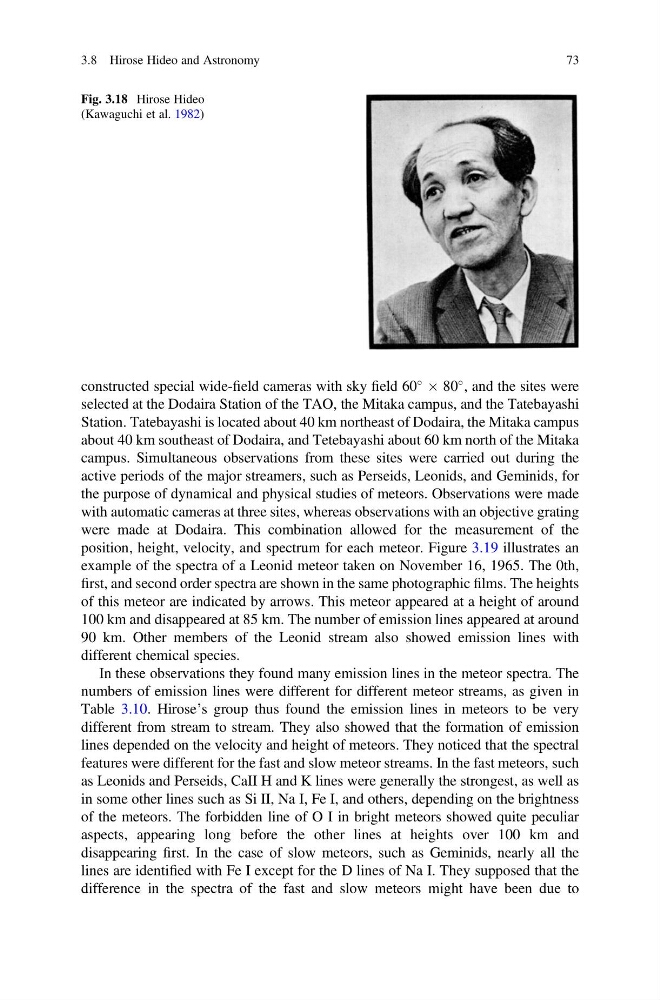
Fig. 3.18 Hirose Hideo
(Kawaguchi et al. 1982)
3.8 Hirose Hideo and Astronomy
73
 80
, and the sites were
selected at the Dodaira Station of the TAO, the Mitaka campus, and the Tatebayashi
Station. Tatebayashi is located about 40 km northeast of Dodaira, the Mitaka campus
about 40 km southeast of Dodaira, and Tetebayashi about 60 km north of the Mitaka
campus. Simultaneous observations from these sites were carried out during the
active periods of the major streamers, such as Perseids, Leonids, and Geminids, for
the purpose of dynamical and physical studies of meteors. Observations were made
with automatic cameras at three sites, whereas observations with an objective grating
were made at Dodaira. This combination allowed for the measurement of the
position, height, velocity, and spectrum for each meteor. Figure 3.19 illustrates an
example of the spectra of a Leonid meteor taken on November 16, 1965. The 0th,
first, and second order spectra are shown in the same photographic films. The heights
of this meteor are indicated by arrows. This meteor appeared at a height of around
100 km and disappeared at 85 km. The number of emission lines appeared at around
90 km. Other members of the Leonid stream also showed emission lines with
different chemical species.
In these observations they found many emission lines in the meteor spectra. The
numbers of emission lines were different for different meteor streams, as given in
Table 3.10. Hirose’s group thus found the emission lines in meteors to be very
different from stream to stream. They also showed that the formation of emission
lines depended on the velocity and height of meteors. They noticed that the spectral
features were different for the fast and slow meteor streams. In the fast meteors, such
as Leonids and Perseids, CaII H and K lines were generally the strongest, as well as
in some other lines such as Si II, Na I, Fe I, and others, depending on the brightness
of the meteors. The forbidden line of O I in bright meteors showed quite peculiar
aspects, appearing long before the other lines at heights over 100 km and
disappearing first. In the case of slow meteors, such as Geminids, nearly all the
lines are identified with Fe I except for the D lines of Na I. They supposed that the
difference in the spectra of the fast and slow meteors might have been due to
Fig. 3.18 Hirose Hideo
(Kawaguchi et al. 1982)
3.8 Hirose Hideo and Astronomy
73