

compared with that of OIII. By this coincidence, the level 2 of OIII becomes
overpopulated, and this causes additional cascade transitions from this level to
low-lying levels, forming strong emission lines compared to the cascade lines in
other transition series (Hatanaka 1946).
Hatanaka first derived the basic equations of the interaction process and obtained
formal solutions. Numerical calculations were performed on the overpopulation of
the level 2 of OIII. Numerical calculations were performed on the intensity of
emission lines due to the overpopulation of the level 2 of OIII. He calculated the
line λ3444Å (energy-level transition 2 to 3 in Fig. 3.6). He also calculated the line
strength of HeII λ3203Å (the same energy-level transition). The relative intensities
of these lines were in range from 1.1 to 1.4 under suitable boundary conditions.
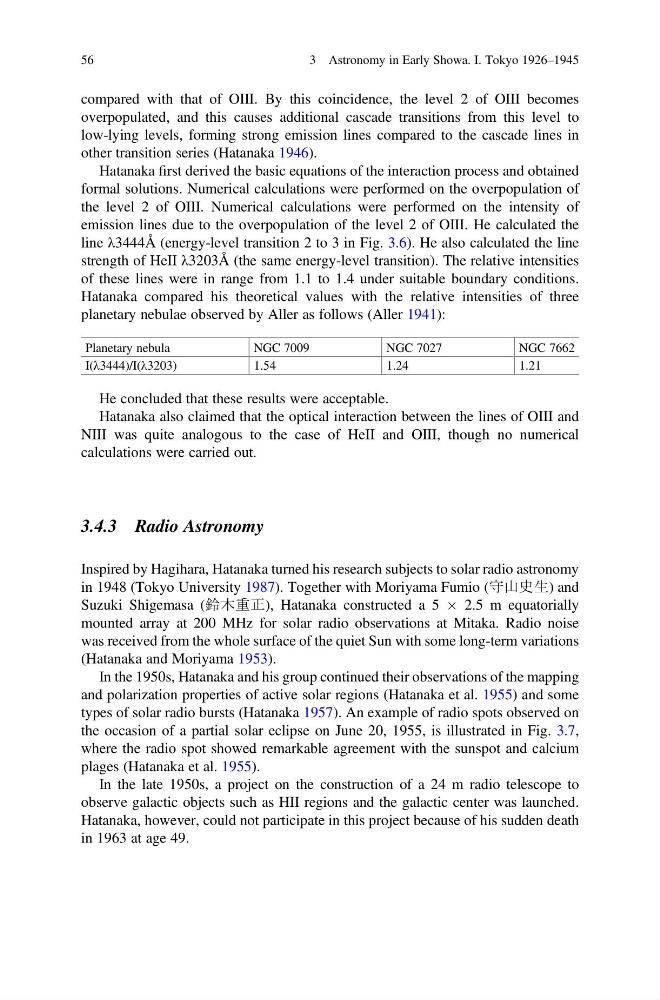
Hatanaka compared his theoretical values with the relative intensities of three
planetary nebulae observed by Aller as follows (Aller 1941):
Planetary nebula
NGC 7009
NGC 7027
NGC 7662
I(λ3444)/I(λ3203)
1.54
1.24
1.21
He concluded that these results were acceptable.
Hatanaka also claimed that the optical interaction between the lines of OIII and
NIII was quite analogous to the case of HeII and OIII, though no numerical
calculations were carried out.
3.4.3 Radio Astronomy
Inspired by Hagihara, Hatanaka turned his research subjects to solar radio astronomy
in 1948 (Tokyo University 1987). Together with Moriyama Fumio (守山史生) and
Suzuki Shigemasa (鈴木重正), Hatanaka constructed a 5 Â 2.5 m equatorially
mounted array at 200 MHz for solar radio observations at Mitaka. Radio noise
was received from the whole surface of the quiet Sun with some long-term variations
(Hatanaka and Moriyama 1953).
In the 1950s, Hatanaka and his group continued their observations of the mapping
and polarization properties of active solar regions (Hatanaka et al. 1955) and some
types of solar radio bursts (Hatanaka 1957). An example of radio spots observed on
the occasion of a partial solar eclipse on June 20, 1955, is illustrated in Fig. 3.7,
where the radio spot showed remarkable agreement with the sunspot and calcium
plages (Hatanaka et al. 1955).
In the late 1950s, a project on the construction of a 24 m radio telescope to
observe galactic objects such as HII regions and the galactic center was launched.
Hatanaka, however, could not participate in this project because of his sudden death
in 1963 at age 49.
56
3 Astronomy in Early Showa. I. Tokyo 1926–1945
overpopulated, and this causes additional cascade transitions from this level to
low-lying levels, forming strong emission lines compared to the cascade lines in
other transition series (Hatanaka 1946).
Hatanaka first derived the basic equations of the interaction process and obtained
formal solutions. Numerical calculations were performed on the overpopulation of
the level 2 of OIII. Numerical calculations were performed on the intensity of
emission lines due to the overpopulation of the level 2 of OIII. He calculated the
line λ3444Å (energy-level transition 2 to 3 in Fig. 3.6). He also calculated the line
strength of HeII λ3203Å (the same energy-level transition). The relative intensities
of these lines were in range from 1.1 to 1.4 under suitable boundary conditions.
Hatanaka compared his theoretical values with the relative intensities of three
planetary nebulae observed by Aller as follows (Aller 1941):
Planetary nebula
NGC 7009
NGC 7027
NGC 7662
I(λ3444)/I(λ3203)
1.54
1.24
1.21
He concluded that these results were acceptable.
Hatanaka also claimed that the optical interaction between the lines of OIII and
NIII was quite analogous to the case of HeII and OIII, though no numerical
calculations were carried out.
3.4.3 Radio Astronomy
Inspired by Hagihara, Hatanaka turned his research subjects to solar radio astronomy
in 1948 (Tokyo University 1987). Together with Moriyama Fumio (守山史生) and
Suzuki Shigemasa (鈴木重正), Hatanaka constructed a 5 Â 2.5 m equatorially
mounted array at 200 MHz for solar radio observations at Mitaka. Radio noise
was received from the whole surface of the quiet Sun with some long-term variations
(Hatanaka and Moriyama 1953).
In the 1950s, Hatanaka and his group continued their observations of the mapping
and polarization properties of active solar regions (Hatanaka et al. 1955) and some
types of solar radio bursts (Hatanaka 1957). An example of radio spots observed on
the occasion of a partial solar eclipse on June 20, 1955, is illustrated in Fig. 3.7,
where the radio spot showed remarkable agreement with the sunspot and calcium
plages (Hatanaka et al. 1955).
In the late 1950s, a project on the construction of a 24 m radio telescope to
observe galactic objects such as HII regions and the galactic center was launched.
Hatanaka, however, could not participate in this project because of his sudden death
in 1963 at age 49.
56
3 Astronomy in Early Showa. I. Tokyo 1926–1945