

was appointed lecturer and then associate professor in 1883 at the university, and he
started a geomagnetic survey of Japan as an assistant of Knott. Together they
delineated the first earthquake hazard map of Japan.
Tanakadate was sent to Europe by the government from 1888 through 1891. He
first studied under William T. Kelvin at Glasgow University, focusing on electricity
and magnetism. He then moved to Berlin University for 1 year before returning to
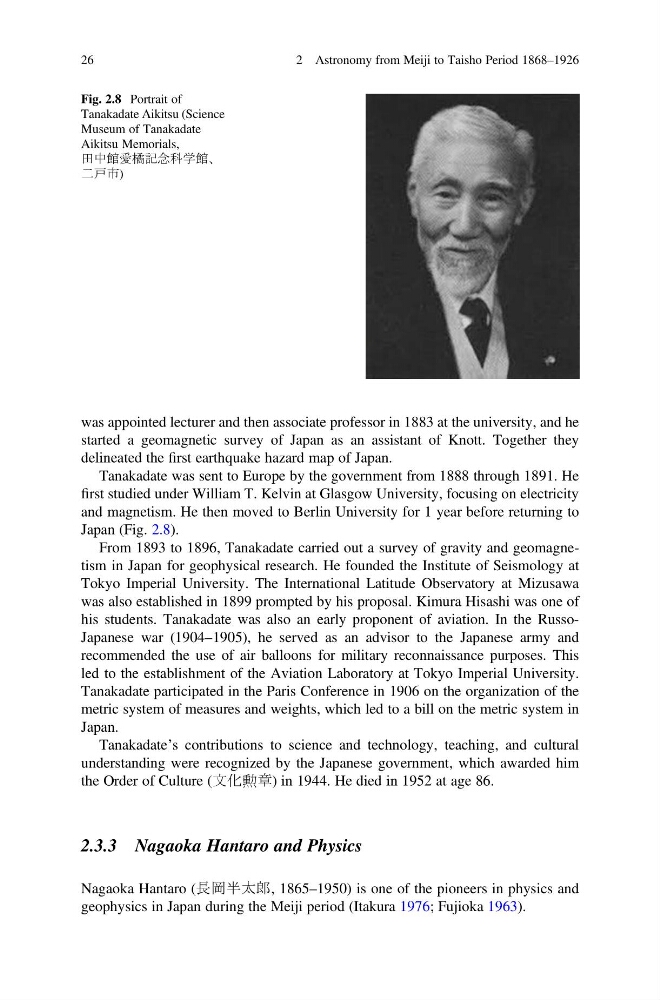
Japan (Fig. 2.8).
From 1893 to 1896, Tanakadate carried out a survey of gravity and geomagnetism in Japan for geophysical research. He founded the Institute of Seismology at
Tokyo Imperial University. The International Latitude Observatory at Mizusawa
was also established in 1899 prompted by his proposal. Kimura Hisashi was one of
his students. Tanakadate was also an early proponent of aviation. In the RussoJapanese war (1904–1905), he served as an advisor to the Japanese army and
recommended the use of air balloons for military reconnaissance purposes. This
led to the establishment of the Aviation Laboratory at Tokyo Imperial University.
Tanakadate participated in the Paris Conference in 1906 on the organization of the
metric system of measures and weights, which led to a bill on the metric system in
Japan.
Tanakadate’s contributions to science and technology, teaching, and cultural
understanding were recognized by the Japanese government, which awarded him
the Order of Culture (文化勲章) in 1944. He died in 1952 at age 86.
2.3.3 Nagaoka Hantaro and Physics
Nagaoka Hantaro (長岡半太郎, 1865–1950) is one of the pioneers in physics and
geophysics in Japan during the Meiji period (Itakura 1976; Fujioka 1963).
Fig. 2.8 Portrait of
Tanakadate Aikitsu (Science
Museum of Tanakadate
Aikitsu Memorials,
田中館愛橘記念科学館、
二戸市)
26
2 Astronomy from Meiji to Taisho Period 1868–1926
started a geomagnetic survey of Japan as an assistant of Knott. Together they
delineated the first earthquake hazard map of Japan.
Tanakadate was sent to Europe by the government from 1888 through 1891. He
first studied under William T. Kelvin at Glasgow University, focusing on electricity
and magnetism. He then moved to Berlin University for 1 year before returning to
Japan (Fig. 2.8).
From 1893 to 1896, Tanakadate carried out a survey of gravity and geomagnetism in Japan for geophysical research. He founded the Institute of Seismology at
Tokyo Imperial University. The International Latitude Observatory at Mizusawa
was also established in 1899 prompted by his proposal. Kimura Hisashi was one of
his students. Tanakadate was also an early proponent of aviation. In the RussoJapanese war (1904–1905), he served as an advisor to the Japanese army and
recommended the use of air balloons for military reconnaissance purposes. This
led to the establishment of the Aviation Laboratory at Tokyo Imperial University.
Tanakadate participated in the Paris Conference in 1906 on the organization of the
metric system of measures and weights, which led to a bill on the metric system in
Japan.
Tanakadate’s contributions to science and technology, teaching, and cultural
understanding were recognized by the Japanese government, which awarded him
the Order of Culture (文化勲章) in 1944. He died in 1952 at age 86.
2.3.3 Nagaoka Hantaro and Physics
Nagaoka Hantaro (長岡半太郎, 1865–1950) is one of the pioneers in physics and
geophysics in Japan during the Meiji period (Itakura 1976; Fujioka 1963).
Fig. 2.8 Portrait of
Tanakadate Aikitsu (Science
Museum of Tanakadate
Aikitsu Memorials,
田中館愛橘記念科学館、
二戸市)
26
2 Astronomy from Meiji to Taisho Period 1868–1926