

at Imperial University in Tokyo (Crew 1934). Because his main field of study was
geophysics, he established a meteorological observatory on campus to conduct
systematic observations of weather and solar phenomena during his stay in Japan.
He also measured surface gravity at sea level and at the summit of Mt. Fuji, 3776m
high from the sea level, with his student Tanakadate Aikitsu. He estimated the
density of the Earth, based on the difference in gravity at different heights of
observed points from the sea level. Mendenhall also made a series of elaborate
measurements of the wavelengths of the solar spectrum employing the best grating
spectrograph of the time. The results of his measurements of Fraunhofer lines were
published in the Memoirs of Imperial University in 1881. He also became interested
in earthquakes while in Japan, and he was one of the founders of the Seismological
Society of Japan.
In 1881, Mendenhall was recalled to Ohio State University as the director of the
newly established Ohio State Meteorological Service. He then successively served
as President of the Rose Polytechnic Institute in Terre Haute, Indiana, Superintendent of the U.S. Coast and Geodetic Survey in Washington, D.C., and President of
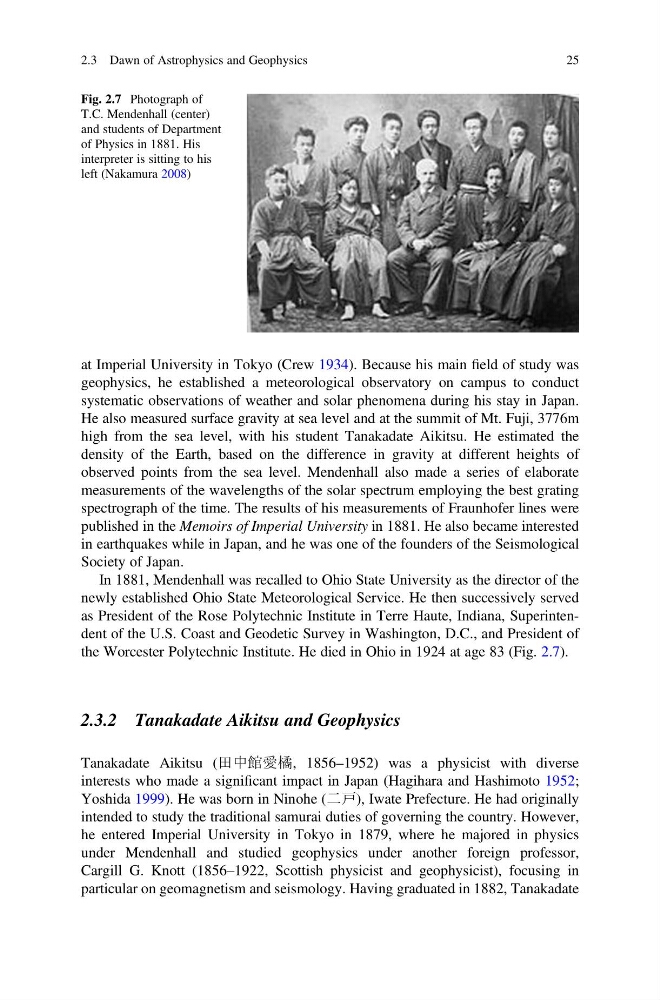
the Worcester Polytechnic Institute. He died in Ohio in 1924 at age 83 (Fig. 2.7).
2.3.2 Tanakadate Aikitsu and Geophysics
Tanakadate Aikitsu (田中館愛橘, 1856–1952) was a physicist with diverse
interests who made a significant impact in Japan (Hagihara and Hashimoto 1952;
Yoshida 1999). He was born in Ninohe (二戸), Iwate Prefecture. He had originally
intended to study the traditional samurai duties of governing the country. However,
he entered Imperial University in Tokyo in 1879, where he majored in physics
under Mendenhall and studied geophysics under another foreign professor,
Cargill G. Knott (1856–1922, Scottish physicist and geophysicist), focusing in
particular on geomagnetism and seismology. Having graduated in 1882, Tanakadate
Fig. 2.7 Photograph of
T.C. Mendenhall (center)
and students of Department
of Physics in 1881. His
interpreter is sitting to his
left (Nakamura 2008)
2.3 Dawn of Astrophysics and Geophysics
25
geophysics, he established a meteorological observatory on campus to conduct
systematic observations of weather and solar phenomena during his stay in Japan.
He also measured surface gravity at sea level and at the summit of Mt. Fuji, 3776m
high from the sea level, with his student Tanakadate Aikitsu. He estimated the
density of the Earth, based on the difference in gravity at different heights of
observed points from the sea level. Mendenhall also made a series of elaborate
measurements of the wavelengths of the solar spectrum employing the best grating
spectrograph of the time. The results of his measurements of Fraunhofer lines were
published in the Memoirs of Imperial University in 1881. He also became interested
in earthquakes while in Japan, and he was one of the founders of the Seismological
Society of Japan.
In 1881, Mendenhall was recalled to Ohio State University as the director of the
newly established Ohio State Meteorological Service. He then successively served
as President of the Rose Polytechnic Institute in Terre Haute, Indiana, Superintendent of the U.S. Coast and Geodetic Survey in Washington, D.C., and President of
the Worcester Polytechnic Institute. He died in Ohio in 1924 at age 83 (Fig. 2.7).
2.3.2 Tanakadate Aikitsu and Geophysics
Tanakadate Aikitsu (田中館愛橘, 1856–1952) was a physicist with diverse
interests who made a significant impact in Japan (Hagihara and Hashimoto 1952;
Yoshida 1999). He was born in Ninohe (二戸), Iwate Prefecture. He had originally
intended to study the traditional samurai duties of governing the country. However,
he entered Imperial University in Tokyo in 1879, where he majored in physics
under Mendenhall and studied geophysics under another foreign professor,
Cargill G. Knott (1856–1922, Scottish physicist and geophysicist), focusing in
particular on geomagnetism and seismology. Having graduated in 1882, Tanakadate
Fig. 2.7 Photograph of
T.C. Mendenhall (center)
and students of Department
of Physics in 1881. His
interpreter is sitting to his
left (Nakamura 2008)
2.3 Dawn of Astrophysics and Geophysics
25