

geometrically classified long-period stars into two groups Gr.I and Gr. II separated
by a dotted line in Fig. 2.5.
At the TAO, Hirayama was appointed Second Director in 1919, succeeding
Terao, and served until his retirement in 1928. As Director of TAO he was elected
member of the executive committee of the International Astronomical Union (IAU),
twice in 1925 and 1928, as will be seen in Chap. 3.
In 1945 he died in Tokyo at age 77.
2.2.5 Hirayama Kiyotsugu and Asteroids
Hirayama Kiyotsugu (平山清次, 1874–1943) contributed to celestial mechanics,
observations of asteroids, and study of the history of astronomy (Hagihara 1943). He
was born in Sendai and learned astronomy at Tokyo Imperial University. Upon
completion of his study he was appointed associate professor (1906) and professor
(1919) of astronomy at the same university. Among his disciples, Hagihara Yusuke
(萩原雄祐), Kaburaki Masaki (鏑木政岐), and Hirose Hideo (広瀬秀雄), all served
as professors of astronomy at Tokyo Imperial University. In 1921, he moved to the
TAO as an engineer of the calendar and time until his retirement in 1935. He died in
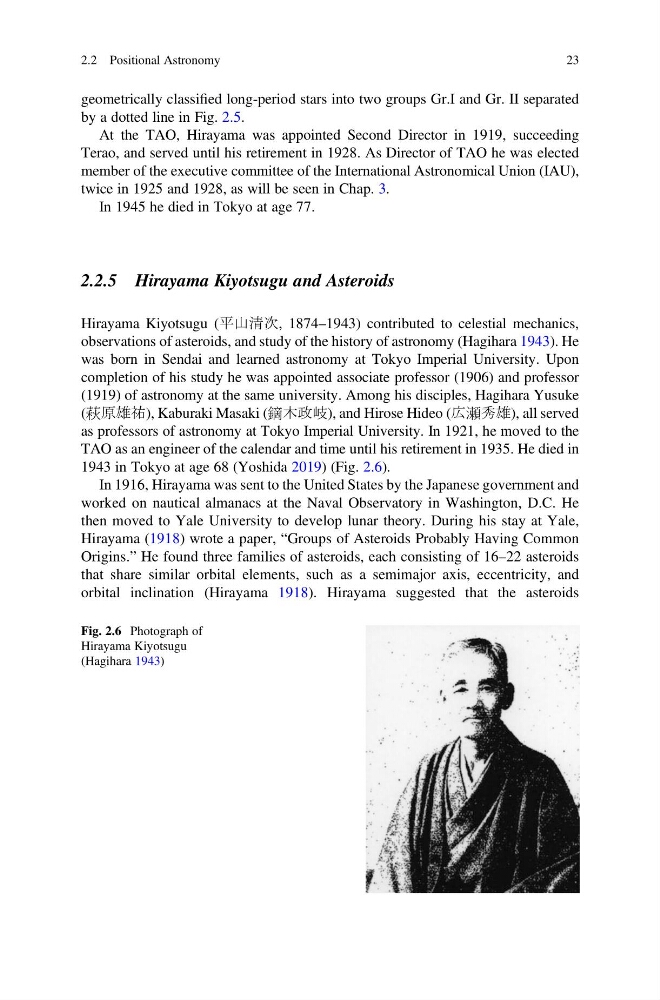
1943 in Tokyo at age 68 (Yoshida 2019) (Fig. 2.6).
In 1916, Hirayama was sent to the United States by the Japanese government and
worked on nautical almanacs at the Naval Observatory in Washington, D.C. He
then moved to Yale University to develop lunar theory. During his stay at Yale,
Hirayama (1918) wrote a paper, “Groups of Asteroids Probably Having Common
Origins.” He found three families of asteroids, each consisting of 16–22 asteroids
that share similar orbital elements, such as a semimajor axis, eccentricity, and
orbital inclination (Hirayama 1918). Hirayama suggested that the asteroids
Fig. 2.6 Photograph of
Hirayama Kiyotsugu
(Hagihara 1943)
2.2 Positional Astronomy
23
by a dotted line in Fig. 2.5.
At the TAO, Hirayama was appointed Second Director in 1919, succeeding
Terao, and served until his retirement in 1928. As Director of TAO he was elected
member of the executive committee of the International Astronomical Union (IAU),
twice in 1925 and 1928, as will be seen in Chap. 3.
In 1945 he died in Tokyo at age 77.
2.2.5 Hirayama Kiyotsugu and Asteroids
Hirayama Kiyotsugu (平山清次, 1874–1943) contributed to celestial mechanics,
observations of asteroids, and study of the history of astronomy (Hagihara 1943). He
was born in Sendai and learned astronomy at Tokyo Imperial University. Upon
completion of his study he was appointed associate professor (1906) and professor
(1919) of astronomy at the same university. Among his disciples, Hagihara Yusuke
(萩原雄祐), Kaburaki Masaki (鏑木政岐), and Hirose Hideo (広瀬秀雄), all served
as professors of astronomy at Tokyo Imperial University. In 1921, he moved to the
TAO as an engineer of the calendar and time until his retirement in 1935. He died in
1943 in Tokyo at age 68 (Yoshida 2019) (Fig. 2.6).
In 1916, Hirayama was sent to the United States by the Japanese government and
worked on nautical almanacs at the Naval Observatory in Washington, D.C. He
then moved to Yale University to develop lunar theory. During his stay at Yale,
Hirayama (1918) wrote a paper, “Groups of Asteroids Probably Having Common
Origins.” He found three families of asteroids, each consisting of 16–22 asteroids
that share similar orbital elements, such as a semimajor axis, eccentricity, and
orbital inclination (Hirayama 1918). Hirayama suggested that the asteroids
Fig. 2.6 Photograph of
Hirayama Kiyotsugu
(Hagihara 1943)
2.2 Positional Astronomy
23