

Hirayama Shin was born in Tokyo as a son of a samurai family. He learned
astronomy from Terao Hisashi in the Department of Astronomy, Tokyo Imperial
University. In 1888, he graduated from university and the next year was sent to
Europe to study astronomy. He first stayed at Greenwich Observatory to study
positional astronomy and then moved to Potsdam Observatory in 1890. In Potsdam,
he learned astrophysics from Herman C. Vogel (1841–1907), who was working on
the revision of the spectral classification of stars at that time. After returning to
Japan, Hirayama was appointed professor of astronomy at the Tokyo Imperial
University, where he taught positional astronomy, celestial mechanics, geodetic
surveying, and, later, astrophysics. In the Meiji era, his research interests were
restricted to positional astronomy, surveying asteroids, and solar eclipse
observations.
From 1918, Hirayama’s interest turned to astrophysics, particularly statistical
astronomy. His first work in the field was the measurement of mean parallax of
stars, for every spectral type from B to K and M stars.
The mean parallax was defined by Jacobus C. Kapteyn (1851–1922) of Groningen University, the Netherlands, as a tool to estimate the distance of stars lying
beyond the limit of trigonometric parallax. For stars with magnitude m and proper
motion μ (arcsecond per year), the mean parallax <π> is defined by
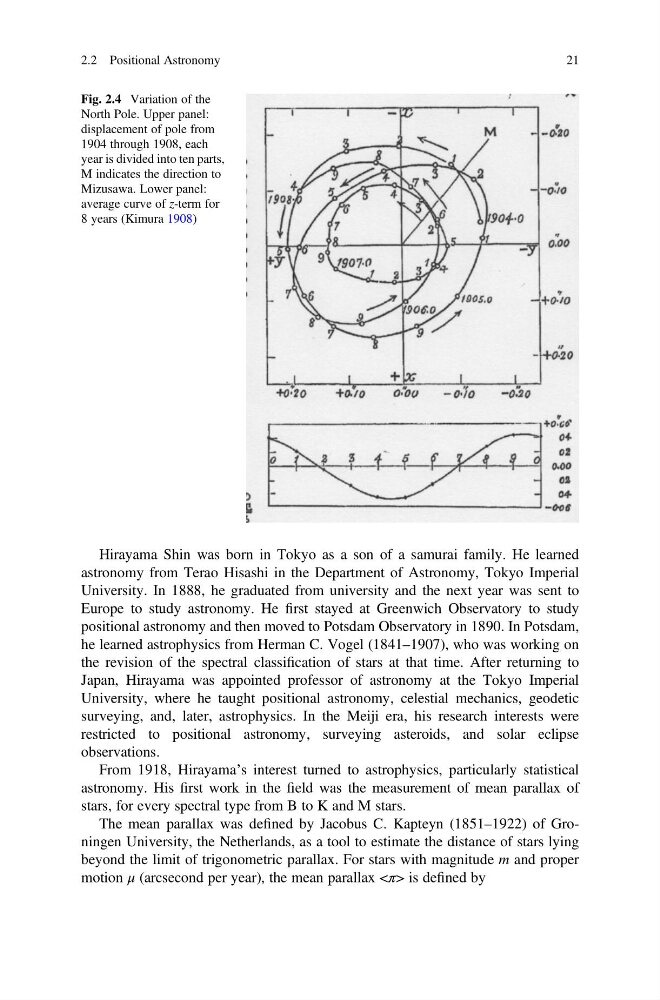
Fig. 2.4 Variation of the
North Pole. Upper panel:
displacement of pole from
1904 through 1908, each
year is divided into ten parts,
M indicates the direction to
Mizusawa. Lower panel:
average curve of z-term for
8 years (Kimura 1908)
2.2 Positional Astronomy
21
astronomy from Terao Hisashi in the Department of Astronomy, Tokyo Imperial
University. In 1888, he graduated from university and the next year was sent to
Europe to study astronomy. He first stayed at Greenwich Observatory to study
positional astronomy and then moved to Potsdam Observatory in 1890. In Potsdam,
he learned astrophysics from Herman C. Vogel (1841–1907), who was working on
the revision of the spectral classification of stars at that time. After returning to
Japan, Hirayama was appointed professor of astronomy at the Tokyo Imperial
University, where he taught positional astronomy, celestial mechanics, geodetic
surveying, and, later, astrophysics. In the Meiji era, his research interests were
restricted to positional astronomy, surveying asteroids, and solar eclipse
observations.
From 1918, Hirayama’s interest turned to astrophysics, particularly statistical
astronomy. His first work in the field was the measurement of mean parallax of
stars, for every spectral type from B to K and M stars.
The mean parallax was defined by Jacobus C. Kapteyn (1851–1922) of Groningen University, the Netherlands, as a tool to estimate the distance of stars lying
beyond the limit of trigonometric parallax. For stars with magnitude m and proper
motion μ (arcsecond per year), the mean parallax <π> is defined by
Fig. 2.4 Variation of the
North Pole. Upper panel:
displacement of pole from
1904 through 1908, each
year is divided into ten parts,
M indicates the direction to
Mizusawa. Lower panel:
average curve of z-term for
8 years (Kimura 1908)
2.2 Positional Astronomy
21