

1.3.6 Kawamoto Komin and Modern Physics
In the early nineteenth century, Dutch learning had already spread among scholars in
many areas of the country. Its focus was mainly science, technology, and medicine.
It was Kawamoto Komin (川本幸民,1810–1871) who first introduced modern
physics and chemistry to Japan in the mid-nineteenth century (Kita 2008).
Kawamoto was born in Sanda (三田), Hyogo Prefecture, as the youngest son of
Kawamoto Shu’an (川本周安), medical doctor of the Sanda clan. Komin studied
Chinese and Dutch medicine in Osaka and then moved to Edo for a broader Dutch
education. He remained in Edo for most of his life, working as a physician and as a
teacher of the Dutch language at his private school Seishu Do (静修堂). His interest
was gradually widened to the basic science of physics and chemistry.
In 1835, Kawamoto married Aochi Hideko (青地秀子), a daughter of Aochi
Rinso (青地林宗, 1775–1833), who was also a Dutch scholar with a deep interest in
the basic sciences. In 1827, he wrote a book entitled Kikai Kanran (気海観瀾、
General View on Air and Water) (Aochi 1827), which presented a concise physical
interpretation of meteorological phenomena of air, water, light, sound, clouds,
thunder, and others in a total of 98 pages (Fig. 1.4).
Kawamoto was extremely impressed on this Aochi’s book. He then started the
study of physics and wrote a series of books called Kikai Kanran Kogi (気海観瀾廣義,
General View of Air and Water, Widely Extended) (Kawamoto 1851), a great
expanded of Kikai Kanran into 15 volumes. His books were published from 1851
to 1856. This series was based on Buijs’s book (1828) on Natural Science in School
as well as several other Dutch books and arranged according to his own scientific
views. The series contained a general overview of physics, including astronomy,
meteorology, and optical instrumentation.
On astronomy, Kawamoto provided a quantitative description of the Solar System, as shown in Fig. 1.5. The Sun is located at a distance of 25 years by the velocity
of bullets from the Earth (one bullet velocity is about 200 m/s). Seven planets
revolve around the Sun under Bode’s law: Mercury, Venus, Earth, Mars, Jupiter,
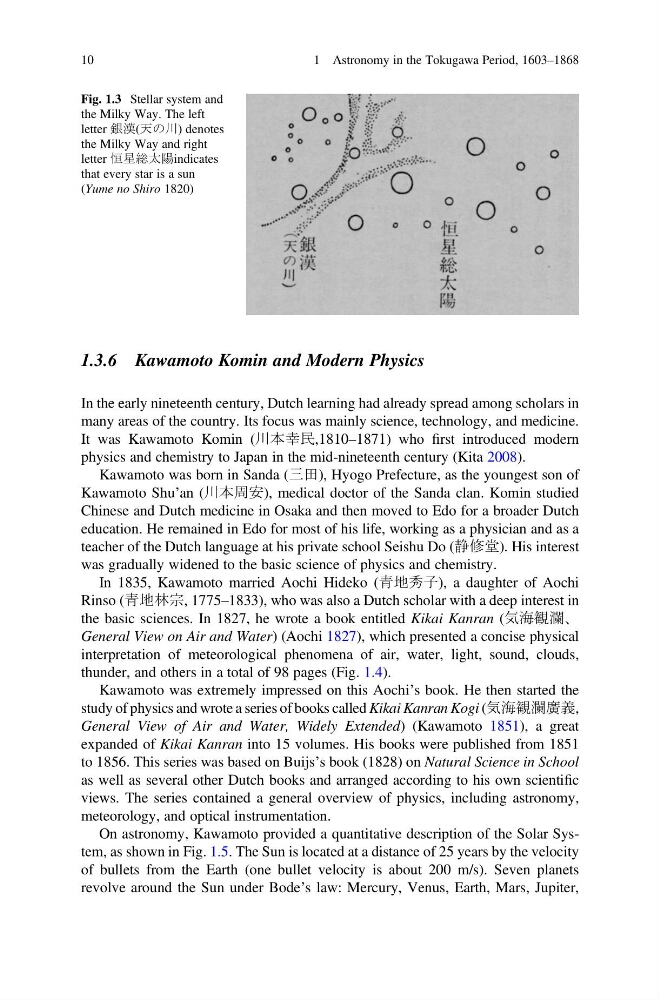
Fig. 1.3 Stellar system and
the Milky Way. The left
letter 銀漢(天の川) denotes
the Milky Way and right
letter 恒星総太陽indicates
that every star is a sun
(Yume no Shiro 1820)
10
1 Astronomy in the Tokugawa Period, 1603–1868
In the early nineteenth century, Dutch learning had already spread among scholars in
many areas of the country. Its focus was mainly science, technology, and medicine.
It was Kawamoto Komin (川本幸民,1810–1871) who first introduced modern
physics and chemistry to Japan in the mid-nineteenth century (Kita 2008).
Kawamoto was born in Sanda (三田), Hyogo Prefecture, as the youngest son of
Kawamoto Shu’an (川本周安), medical doctor of the Sanda clan. Komin studied
Chinese and Dutch medicine in Osaka and then moved to Edo for a broader Dutch
education. He remained in Edo for most of his life, working as a physician and as a
teacher of the Dutch language at his private school Seishu Do (静修堂). His interest
was gradually widened to the basic science of physics and chemistry.
In 1835, Kawamoto married Aochi Hideko (青地秀子), a daughter of Aochi
Rinso (青地林宗, 1775–1833), who was also a Dutch scholar with a deep interest in
the basic sciences. In 1827, he wrote a book entitled Kikai Kanran (気海観瀾、
General View on Air and Water) (Aochi 1827), which presented a concise physical
interpretation of meteorological phenomena of air, water, light, sound, clouds,
thunder, and others in a total of 98 pages (Fig. 1.4).
Kawamoto was extremely impressed on this Aochi’s book. He then started the
study of physics and wrote a series of books called Kikai Kanran Kogi (気海観瀾廣義,
General View of Air and Water, Widely Extended) (Kawamoto 1851), a great
expanded of Kikai Kanran into 15 volumes. His books were published from 1851
to 1856. This series was based on Buijs’s book (1828) on Natural Science in School
as well as several other Dutch books and arranged according to his own scientific
views. The series contained a general overview of physics, including astronomy,
meteorology, and optical instrumentation.
On astronomy, Kawamoto provided a quantitative description of the Solar System, as shown in Fig. 1.5. The Sun is located at a distance of 25 years by the velocity
of bullets from the Earth (one bullet velocity is about 200 m/s). Seven planets
revolve around the Sun under Bode’s law: Mercury, Venus, Earth, Mars, Jupiter,
Fig. 1.3 Stellar system and
the Milky Way. The left
letter 銀漢(天の川) denotes
the Milky Way and right
letter 恒星総太陽indicates
that every star is a sun
(Yume no Shiro 1820)
10
1 Astronomy in the Tokugawa Period, 1603–1868