

1.3.5 Yamagata Banto and Criticism of Traditional
Cosmology
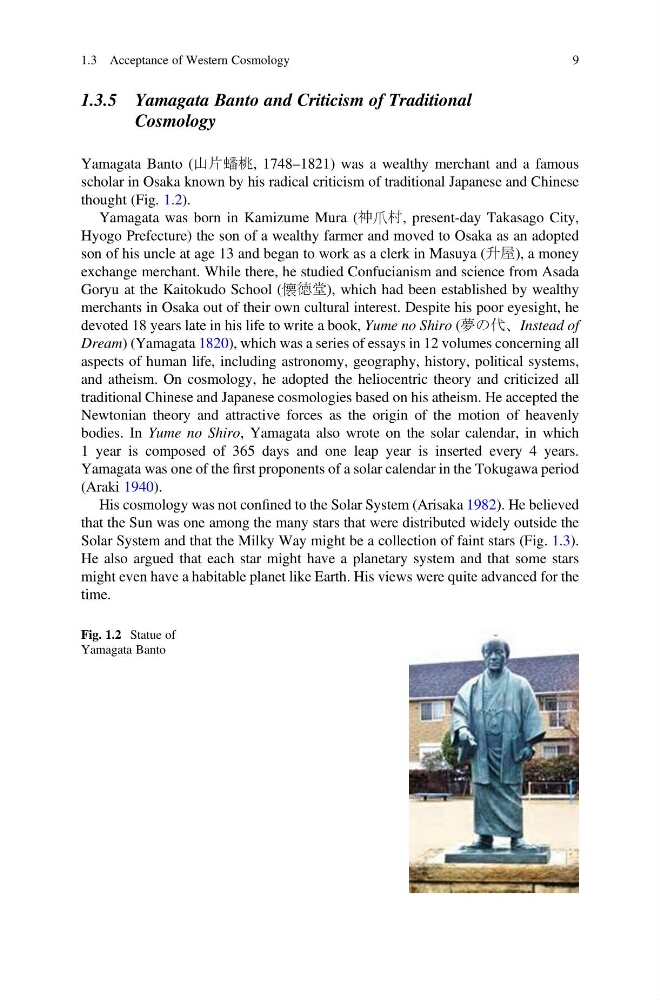
Yamagata Banto (山片蟠桃, 1748–1821) was a wealthy merchant and a famous
scholar in Osaka known by his radical criticism of traditional Japanese and Chinese
thought (Fig. 1.2).
Yamagata was born in Kamizume Mura (神爪村, present-day Takasago City,
Hyogo Prefecture) the son of a wealthy farmer and moved to Osaka as an adopted
son of his uncle at age 13 and began to work as a clerk in Masuya (升屋), a money
exchange merchant. While there, he studied Confucianism and science from Asada
Goryu at the Kaitokudo School (懐徳堂), which had been established by wealthy
merchants in Osaka out of their own cultural interest. Despite his poor eyesight, he
devoted 18 years late in his life to write a book, Yume no Shiro (夢の代、Instead of
Dream) (Yamagata 1820), which was a series of essays in 12 volumes concerning all
aspects of human life, including astronomy, geography, history, political systems,
and atheism. On cosmology, he adopted the heliocentric theory and criticized all
traditional Chinese and Japanese cosmologies based on his atheism. He accepted the
Newtonian theory and attractive forces as the origin of the motion of heavenly
bodies. In Yume no Shiro, Yamagata also wrote on the solar calendar, in which
1 year is composed of 365 days and one leap year is inserted every 4 years.
Yamagata was one of the first proponents of a solar calendar in the Tokugawa period
(Araki 1940).
His cosmology was not confined to the Solar System (Arisaka 1982). He believed
that the Sun was one among the many stars that were distributed widely outside the
Solar System and that the Milky Way might be a collection of faint stars (Fig. 1.3).
He also argued that each star might have a planetary system and that some stars
might even have a habitable planet like Earth. His views were quite advanced for the
time.
Fig. 1.2 Statue of
Yamagata Banto
1.3 Acceptance of Western Cosmology
9
Cosmology
Yamagata Banto (山片蟠桃, 1748–1821) was a wealthy merchant and a famous
scholar in Osaka known by his radical criticism of traditional Japanese and Chinese
thought (Fig. 1.2).
Yamagata was born in Kamizume Mura (神爪村, present-day Takasago City,
Hyogo Prefecture) the son of a wealthy farmer and moved to Osaka as an adopted
son of his uncle at age 13 and began to work as a clerk in Masuya (升屋), a money
exchange merchant. While there, he studied Confucianism and science from Asada
Goryu at the Kaitokudo School (懐徳堂), which had been established by wealthy
merchants in Osaka out of their own cultural interest. Despite his poor eyesight, he
devoted 18 years late in his life to write a book, Yume no Shiro (夢の代、Instead of
Dream) (Yamagata 1820), which was a series of essays in 12 volumes concerning all
aspects of human life, including astronomy, geography, history, political systems,
and atheism. On cosmology, he adopted the heliocentric theory and criticized all
traditional Chinese and Japanese cosmologies based on his atheism. He accepted the
Newtonian theory and attractive forces as the origin of the motion of heavenly
bodies. In Yume no Shiro, Yamagata also wrote on the solar calendar, in which
1 year is composed of 365 days and one leap year is inserted every 4 years.
Yamagata was one of the first proponents of a solar calendar in the Tokugawa period
(Araki 1940).
His cosmology was not confined to the Solar System (Arisaka 1982). He believed
that the Sun was one among the many stars that were distributed widely outside the
Solar System and that the Milky Way might be a collection of faint stars (Fig. 1.3).
He also argued that each star might have a planetary system and that some stars
might even have a habitable planet like Earth. His views were quite advanced for the
time.
Fig. 1.2 Statue of
Yamagata Banto
1.3 Acceptance of Western Cosmology
9