

7.10.2 Unno Wasaburo and Theoretical Astrophysics
Theoretical astrophysics in postwar period was actually initiated by Unno Wasaburo
(海野和三郎, b. 1925) of the University of Tokyo. He was born in Urawa City
(present Saitama City) and entered the University of Tokyo where he studied
astrophysics under Hagihara Yusuke (Chap. 3). After graduation, he continued
studies of astrophysics, and was promoted to an associate professor in 1952 and to
a professor of astronomy in 1963 at the University of Tokyo. He often stayed at
foreign institutes, such as Princeton University Observatory, New Jersey; University
of Michigan Observatory, Ann arbor; Max Planck Institute for Physics, Munich; and
Commonwealth Scientific and Industrial Research Organization, Sydney, in the
1950s and 1960s. After retirement from the University of Tokyo in 1986, he was
appointed as a professor of Kinki University in Osaka, where he continued his work
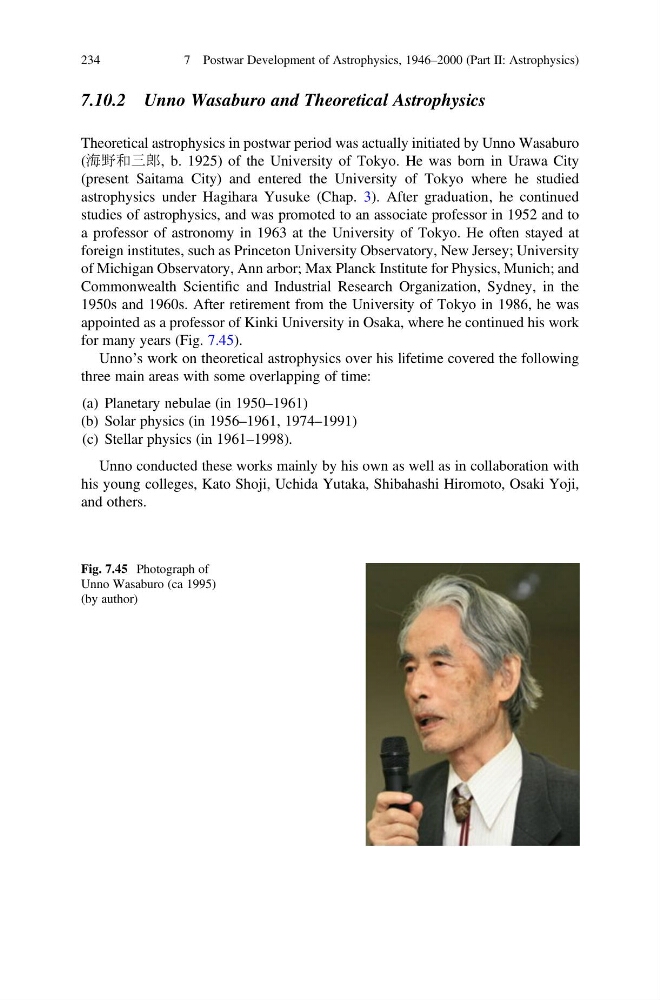
for many years (Fig. 7.45).
Unno’s work on theoretical astrophysics over his lifetime covered the following
three main areas with some overlapping of time:
(a) Planetary nebulae (in 1950–1961)
(b) Solar physics (in 1956–1961, 1974–1991)
(c) Stellar physics (in 1961–1998).
Unno conducted these works mainly by his own as well as in collaboration with
his young colleges, Kato Shoji, Uchida Yutaka, Shibahashi Hiromoto, Osaki Yoji,
and others.
Fig. 7.45 Photograph of
Unno Wasaburo (ca 1995)
(by author)
234
7 Postwar Development of Astrophysics, 1946–2000 (Part II: Astrophysics)
Theoretical astrophysics in postwar period was actually initiated by Unno Wasaburo
(海野和三郎, b. 1925) of the University of Tokyo. He was born in Urawa City
(present Saitama City) and entered the University of Tokyo where he studied
astrophysics under Hagihara Yusuke (Chap. 3). After graduation, he continued
studies of astrophysics, and was promoted to an associate professor in 1952 and to
a professor of astronomy in 1963 at the University of Tokyo. He often stayed at
foreign institutes, such as Princeton University Observatory, New Jersey; University
of Michigan Observatory, Ann arbor; Max Planck Institute for Physics, Munich; and
Commonwealth Scientific and Industrial Research Organization, Sydney, in the
1950s and 1960s. After retirement from the University of Tokyo in 1986, he was
appointed as a professor of Kinki University in Osaka, where he continued his work
for many years (Fig. 7.45).
Unno’s work on theoretical astrophysics over his lifetime covered the following
three main areas with some overlapping of time:
(a) Planetary nebulae (in 1950–1961)
(b) Solar physics (in 1956–1961, 1974–1991)
(c) Stellar physics (in 1961–1998).
Unno conducted these works mainly by his own as well as in collaboration with
his young colleges, Kato Shoji, Uchida Yutaka, Shibahashi Hiromoto, Osaki Yoji,
and others.
Fig. 7.45 Photograph of
Unno Wasaburo (ca 1995)
(by author)
234
7 Postwar Development of Astrophysics, 1946–2000 (Part II: Astrophysics)