

dynamics in the cosmic scale, that had been unfamiliar to both astronomers and
physicists. Main topics were basic theories of shock waves, turbulence, and dynamics of expanding shells of novae and supernovae. Since the 1920s, astrophysicists
had been worked in the spectroscopy and stellar structure based on quantum
mechanics and nuclear physics, and few people interested on the gas-dynamical
phenomena of the universe. In this sense, this symposium was to declare the opening
of the age of new cosmic gas dynamics in astrophysics.
In Japan, Ono Yoro and Sakashita Shiro and their group of Hokkaido University
developed the theory of shock waves under the title of “Propagation of shock waves
in inhomogeneous gases “, (in 1960–1969), mainly on the shock waves in stellar
interior. Kogure and Osaki Toru of Kyoto University worked on the structure and
propagation of shock waves in stellar atmospheres in 1961–1962. Unno Wasaburo
and his group of the University of Tokyo also contributed markedly to the development of cosmic gas dynamics.
The age of cosmic gas dynamics tapered off at the end of the 1960s with the
development of computer technique. Since then, the present style of astrophysics
based on numerical analysis and modelling has taken over the classical cosmic gas
dynamics.
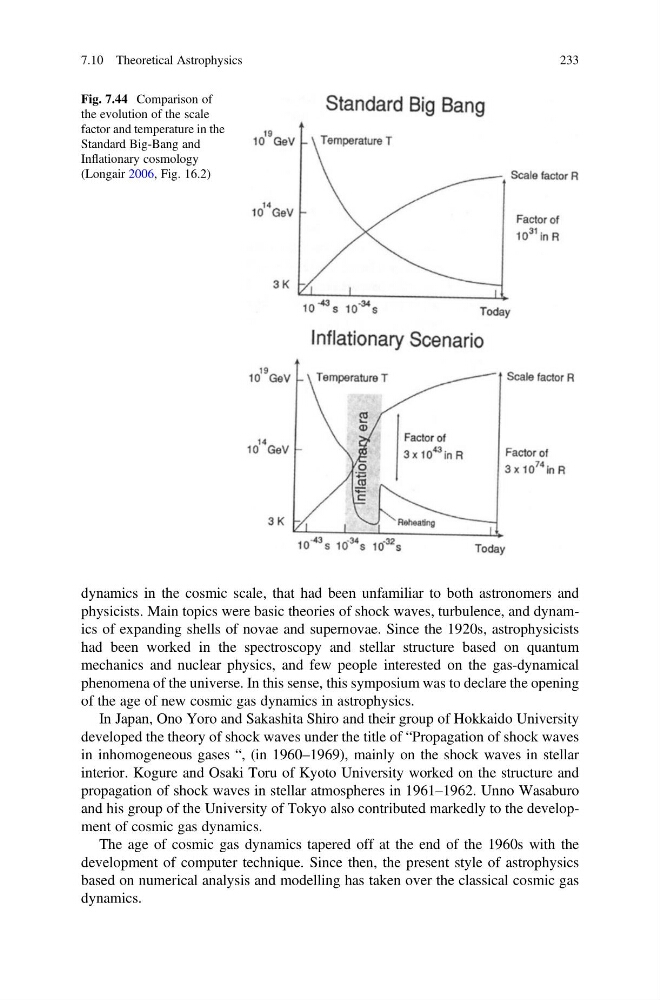
Fig. 7.44 Comparison of
the evolution of the scale
factor and temperature in the
Standard Big-Bang and
Inflationary cosmology
(Longair 2006, Fig. 16.2)
7.10 Theoretical Astrophysics
233
physicists. Main topics were basic theories of shock waves, turbulence, and dynamics of expanding shells of novae and supernovae. Since the 1920s, astrophysicists
had been worked in the spectroscopy and stellar structure based on quantum
mechanics and nuclear physics, and few people interested on the gas-dynamical
phenomena of the universe. In this sense, this symposium was to declare the opening
of the age of new cosmic gas dynamics in astrophysics.
In Japan, Ono Yoro and Sakashita Shiro and their group of Hokkaido University
developed the theory of shock waves under the title of “Propagation of shock waves
in inhomogeneous gases “, (in 1960–1969), mainly on the shock waves in stellar
interior. Kogure and Osaki Toru of Kyoto University worked on the structure and
propagation of shock waves in stellar atmospheres in 1961–1962. Unno Wasaburo
and his group of the University of Tokyo also contributed markedly to the development of cosmic gas dynamics.
The age of cosmic gas dynamics tapered off at the end of the 1960s with the
development of computer technique. Since then, the present style of astrophysics
based on numerical analysis and modelling has taken over the classical cosmic gas
dynamics.
Fig. 7.44 Comparison of
the evolution of the scale
factor and temperature in the
Standard Big-Bang and
Inflationary cosmology
(Longair 2006, Fig. 16.2)
7.10 Theoretical Astrophysics
233