

so-called propeller effect in rapidly rotating magnetic neutron stars. Through the
rapidly rotating magnetic field, some parts of the accreting matter are blown out,
which leads to the reduction of the X-ray luminosity. They suggested that X-rays are
emitted from the magnetic polar regions of neutron stars (Asai et al. 1996, 1998).
7.5.4.3 Stellar Black Holes
In the 1970s, based on data obtained by the UHURU satellite and rocket observations, Oda Minoru and his group (1970–1977) measured the variations of X-ray
intensities and spectral features of Cyg X-1, the most like candidate for a black hole.
Cyg X-1 (V1357 Cygni) is a spectroscopic binary composed of a supergiant (B0 Ib)
and X-ray source, for which Oda’s group found several types of X-ray variations,
such as (a) the existence of millisecond pulses, (b) variations in the average intensity
by a factor of 2 over time on the order of 10
3 seconds, and (c) the oscillatory structure
in X-ray counting rate that lasts typically for several seconds and whose frequency
drifts repeatedly within a few seconds. Among these, the existence of millisecond
pulses implies a small source and, hence, a high specific emissivity at or in the
vicinity of the black hole. In addition, the rapid flaring activity indicates a modified
accretion structure.
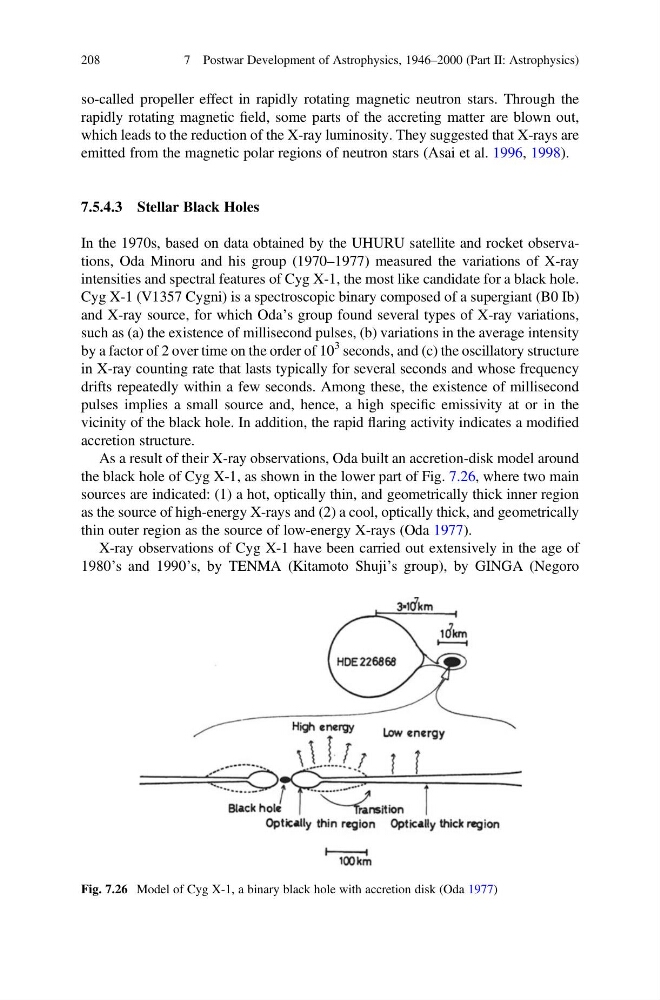
As a result of their X-ray observations, Oda built an accretion-disk model around
the black hole of Cyg X-1, as shown in the lower part of Fig. 7.26, where two main
sources are indicated: (1) a hot, optically thin, and geometrically thick inner region
as the source of high-energy X-rays and (2) a cool, optically thick, and geometrically
thin outer region as the source of low-energy X-rays (Oda 1977).
X-ray observations of Cyg X-1 have been carried out extensively in the age of
1980’s and 1990’s, by TENMA (Kitamoto Shuji’s group), by GINGA (Negoro
Fig. 7.26 Model of Cyg X-1, a binary black hole with accretion disk (Oda 1977)
208
7 Postwar Development of Astrophysics, 1946–2000 (Part II: Astrophysics)
rapidly rotating magnetic field, some parts of the accreting matter are blown out,
which leads to the reduction of the X-ray luminosity. They suggested that X-rays are
emitted from the magnetic polar regions of neutron stars (Asai et al. 1996, 1998).
7.5.4.3 Stellar Black Holes
In the 1970s, based on data obtained by the UHURU satellite and rocket observations, Oda Minoru and his group (1970–1977) measured the variations of X-ray
intensities and spectral features of Cyg X-1, the most like candidate for a black hole.
Cyg X-1 (V1357 Cygni) is a spectroscopic binary composed of a supergiant (B0 Ib)
and X-ray source, for which Oda’s group found several types of X-ray variations,
such as (a) the existence of millisecond pulses, (b) variations in the average intensity
by a factor of 2 over time on the order of 10
3 seconds, and (c) the oscillatory structure
in X-ray counting rate that lasts typically for several seconds and whose frequency
drifts repeatedly within a few seconds. Among these, the existence of millisecond
pulses implies a small source and, hence, a high specific emissivity at or in the
vicinity of the black hole. In addition, the rapid flaring activity indicates a modified
accretion structure.
As a result of their X-ray observations, Oda built an accretion-disk model around
the black hole of Cyg X-1, as shown in the lower part of Fig. 7.26, where two main
sources are indicated: (1) a hot, optically thin, and geometrically thick inner region
as the source of high-energy X-rays and (2) a cool, optically thick, and geometrically
thin outer region as the source of low-energy X-rays (Oda 1977).
X-ray observations of Cyg X-1 have been carried out extensively in the age of
1980’s and 1990’s, by TENMA (Kitamoto Shuji’s group), by GINGA (Negoro
Fig. 7.26 Model of Cyg X-1, a binary black hole with accretion disk (Oda 1977)
208
7 Postwar Development of Astrophysics, 1946–2000 (Part II: Astrophysics)