

discrepancy, Kodaira proposed the possibilities of some other chemical composition
or incomplete degeneracy near the stellar surface (Kodaira 1967).
Since 1970, the theoretical study of white dwarfs has made rapid progress in the
following areas: nonradial oscillation (Osaki Yoji and C. J. Hansen 1973), stellar
winds (Kato Mariko 1983), internal structure (Hoshi Reiun 1998), and others.
Some white dwarfs are known to have strong magnetic fields, which prevent the
formation of accretion disks, and the accreting flows from the second component fall
onto the polar region of the white dwarf along the magnetic lines of force. These
stars are called polar or intermediate polar according to the strength of the magnetic
field.
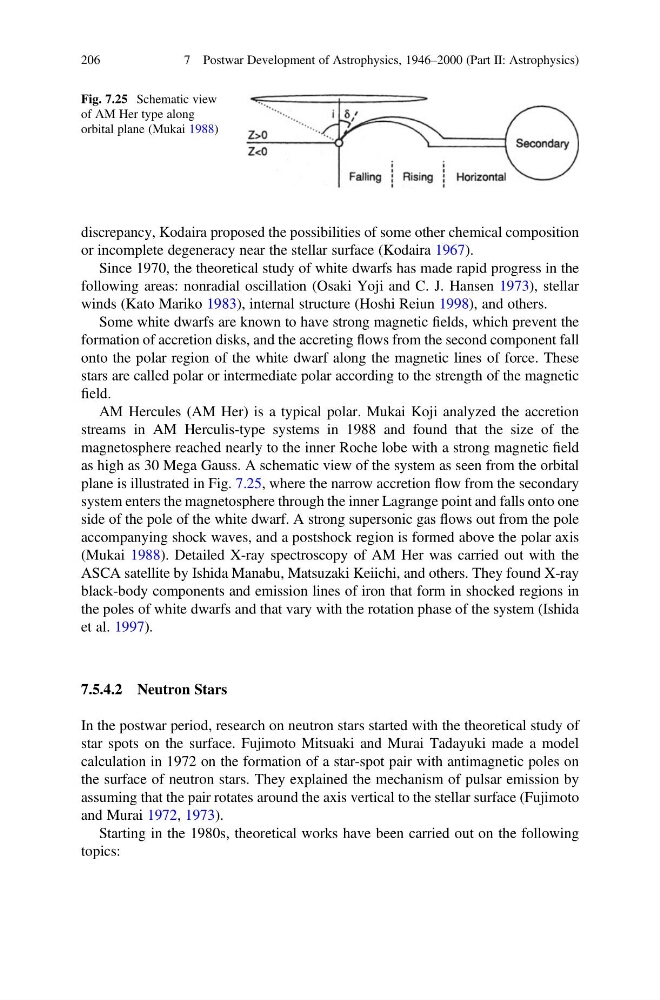
AM Hercules (AM Her) is a typical polar. Mukai Koji analyzed the accretion
streams in AM Herculis-type systems in 1988 and found that the size of the
magnetosphere reached nearly to the inner Roche lobe with a strong magnetic field
as high as 30 Mega Gauss. A schematic view of the system as seen from the orbital
plane is illustrated in Fig. 7.25, where the narrow accretion flow from the secondary
system enters the magnetosphere through the inner Lagrange point and falls onto one
side of the pole of the white dwarf. A strong supersonic gas flows out from the pole
accompanying shock waves, and a postshock region is formed above the polar axis
(Mukai 1988). Detailed X-ray spectroscopy of AM Her was carried out with the
ASCA satellite by Ishida Manabu, Matsuzaki Keiichi, and others. They found X-ray
black-body components and emission lines of iron that form in shocked regions in
the poles of white dwarfs and that vary with the rotation phase of the system (Ishida
et al. 1997).
7.5.4.2 Neutron Stars
In the postwar period, research on neutron stars started with the theoretical study of
star spots on the surface. Fujimoto Mitsuaki and Murai Tadayuki made a model
calculation in 1972 on the formation of a star-spot pair with antimagnetic poles on
the surface of neutron stars. They explained the mechanism of pulsar emission by
assuming that the pair rotates around the axis vertical to the stellar surface (Fujimoto
and Murai 1972, 1973).
Starting in the 1980s, theoretical works have been carried out on the following
topics:
Fig. 7.25 Schematic view
of AM Her type along
orbital plane (Mukai 1988)
206
7 Postwar Development of Astrophysics, 1946–2000 (Part II: Astrophysics)
or incomplete degeneracy near the stellar surface (Kodaira 1967).
Since 1970, the theoretical study of white dwarfs has made rapid progress in the
following areas: nonradial oscillation (Osaki Yoji and C. J. Hansen 1973), stellar
winds (Kato Mariko 1983), internal structure (Hoshi Reiun 1998), and others.
Some white dwarfs are known to have strong magnetic fields, which prevent the
formation of accretion disks, and the accreting flows from the second component fall
onto the polar region of the white dwarf along the magnetic lines of force. These
stars are called polar or intermediate polar according to the strength of the magnetic
field.
AM Hercules (AM Her) is a typical polar. Mukai Koji analyzed the accretion
streams in AM Herculis-type systems in 1988 and found that the size of the
magnetosphere reached nearly to the inner Roche lobe with a strong magnetic field
as high as 30 Mega Gauss. A schematic view of the system as seen from the orbital
plane is illustrated in Fig. 7.25, where the narrow accretion flow from the secondary
system enters the magnetosphere through the inner Lagrange point and falls onto one
side of the pole of the white dwarf. A strong supersonic gas flows out from the pole
accompanying shock waves, and a postshock region is formed above the polar axis
(Mukai 1988). Detailed X-ray spectroscopy of AM Her was carried out with the
ASCA satellite by Ishida Manabu, Matsuzaki Keiichi, and others. They found X-ray
black-body components and emission lines of iron that form in shocked regions in
the poles of white dwarfs and that vary with the rotation phase of the system (Ishida
et al. 1997).
7.5.4.2 Neutron Stars
In the postwar period, research on neutron stars started with the theoretical study of
star spots on the surface. Fujimoto Mitsuaki and Murai Tadayuki made a model
calculation in 1972 on the formation of a star-spot pair with antimagnetic poles on
the surface of neutron stars. They explained the mechanism of pulsar emission by
assuming that the pair rotates around the axis vertical to the stellar surface (Fujimoto
and Murai 1972, 1973).
Starting in the 1980s, theoretical works have been carried out on the following
topics:
Fig. 7.25 Schematic view
of AM Her type along
orbital plane (Mukai 1988)
206
7 Postwar Development of Astrophysics, 1946–2000 (Part II: Astrophysics)