

7.5.4 Compact Stars
Compact stars are the final stage of stellar evolution. When their energy source
becomes exhausted, stars collapse into compact stars, white dwarfs, neutron stars, or
black holes, depending on the original mass of the star.
7.5.4.1 White Dwarf Stars
The first study of white dwarf stars in Japan was made by Araki Toshima in 1934
(Chap. 4). In the postwar period, Suda Kazuo and Hitotuyanagi Zyuiti built a model
of white dwarfs composed of an isothermal core and a convection envelope in
1957–1965 (Hitotuyanagi and Suda 1957). Nariai Kyoji analyzed the atmospheres
of white dwarfs of hydrogen-poor chemical composition, and he derived the UBV
colors of white dwarfs in 1962–1965 (Narial 1962).
Kodaira Keiichi (1967) made spectroscopic observations of the white dwarf
Sirius B at the OAO. He analyzed the profile of the Balmer Hγ line and found that
Sirius B had a slightly larger radius than that predicted by Chandrasekhar (1939) for
white dwarfs consisting of fully degenerate pure helium. To explain this
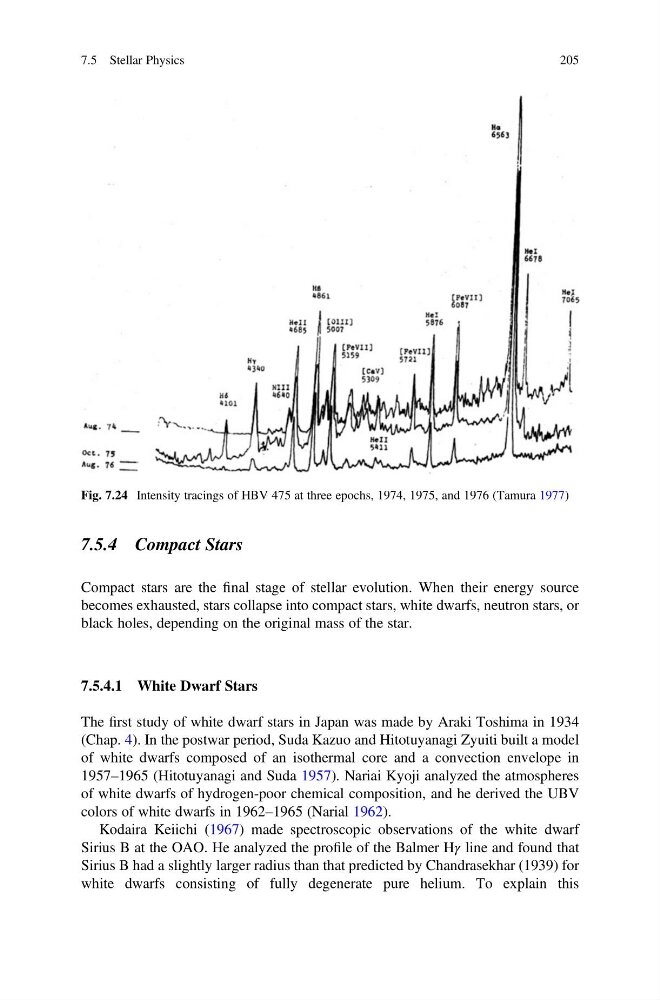
Fig. 7.24 Intensity tracings of HBV 475 at three epochs, 1974, 1975, and 1976 (Tamura 1977)
7.5 Stellar Physics
205
Compact stars are the final stage of stellar evolution. When their energy source
becomes exhausted, stars collapse into compact stars, white dwarfs, neutron stars, or
black holes, depending on the original mass of the star.
7.5.4.1 White Dwarf Stars
The first study of white dwarf stars in Japan was made by Araki Toshima in 1934
(Chap. 4). In the postwar period, Suda Kazuo and Hitotuyanagi Zyuiti built a model
of white dwarfs composed of an isothermal core and a convection envelope in
1957–1965 (Hitotuyanagi and Suda 1957). Nariai Kyoji analyzed the atmospheres
of white dwarfs of hydrogen-poor chemical composition, and he derived the UBV
colors of white dwarfs in 1962–1965 (Narial 1962).
Kodaira Keiichi (1967) made spectroscopic observations of the white dwarf
Sirius B at the OAO. He analyzed the profile of the Balmer Hγ line and found that
Sirius B had a slightly larger radius than that predicted by Chandrasekhar (1939) for
white dwarfs consisting of fully degenerate pure helium. To explain this
Fig. 7.24 Intensity tracings of HBV 475 at three epochs, 1974, 1975, and 1976 (Tamura 1977)
7.5 Stellar Physics
205