

On the formation of the planets, Hayashi presented a timetable for an evolutionary sequence of processes, which begins with the formation of the solar nebula and
ends in the formation of planets and satellites. In the timetable, four stages are
particularly noted: (1) the formation of primordial solar nebula, which is a gas disk
rotating around the protosun in a state of thermal and dynamic equilibrium; (2) the
fragmentation of the primordial solar nebula due to gravitational instability; (3) the
formation of the first giant planet, Jupiter, through the collapse of molecular hydrogen; and (4) the disappearance of the gas component of the disk due to the solar wind
and ultraviolet radiation, which were very strong during the T Tauri stage of the
Sun’s formation (Hayashi 1981).
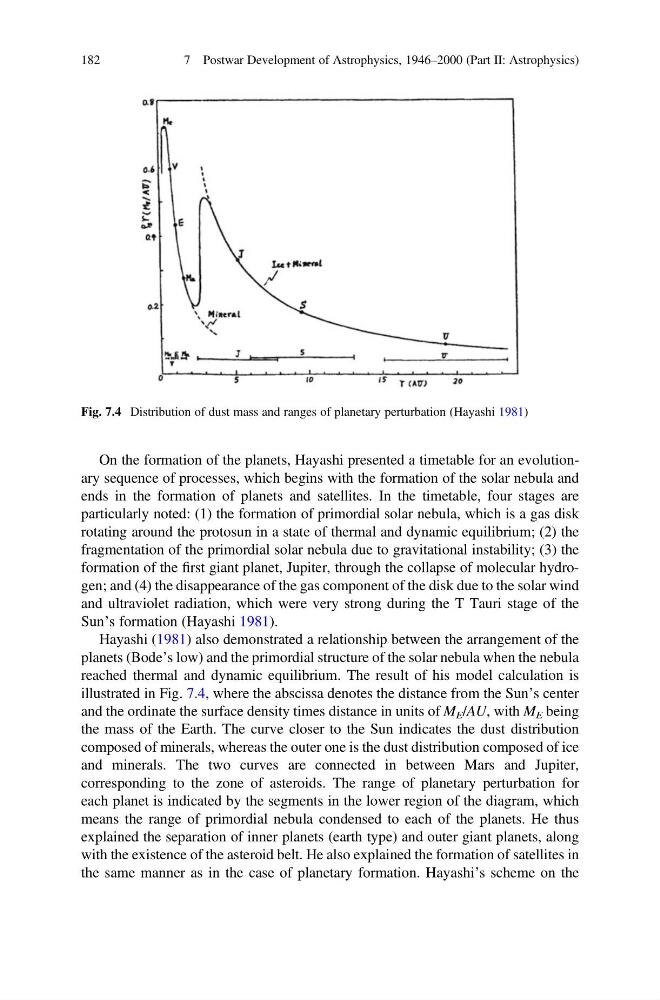
Hayashi (1981) also demonstrated a relationship between the arrangement of the
planets (Bode’s low) and the primordial structure of the solar nebula when the nebula
reached thermal and dynamic equilibrium. The result of his model calculation is
illustrated in Fig. 7.4, where the abscissa denotes the distance from the Sun’s center
and the ordinate the surface density times distance in units of M E /AU, with M E being
the mass of the Earth. The curve closer to the Sun indicates the dust distribution
composed of minerals, whereas the outer one is the dust distribution composed of ice
and minerals. The two curves are connected in between Mars and Jupiter,
corresponding to the zone of asteroids. The range of planetary perturbation for
each planet is indicated by the segments in the lower region of the diagram, which
means the range of primordial nebula condensed to each of the planets. He thus
explained the separation of inner planets (earth type) and outer giant planets, along
with the existence of the asteroid belt. He also explained the formation of satellites in
the same manner as in the case of planetary formation. Hayashi’s scheme on the
Fig. 7.4 Distribution of dust mass and ranges of planetary perturbation (Hayashi 1981)
182
7 Postwar Development of Astrophysics, 1946–2000 (Part II: Astrophysics)
ends in the formation of planets and satellites. In the timetable, four stages are
particularly noted: (1) the formation of primordial solar nebula, which is a gas disk
rotating around the protosun in a state of thermal and dynamic equilibrium; (2) the
fragmentation of the primordial solar nebula due to gravitational instability; (3) the
formation of the first giant planet, Jupiter, through the collapse of molecular hydrogen; and (4) the disappearance of the gas component of the disk due to the solar wind
and ultraviolet radiation, which were very strong during the T Tauri stage of the
Sun’s formation (Hayashi 1981).
Hayashi (1981) also demonstrated a relationship between the arrangement of the
planets (Bode’s low) and the primordial structure of the solar nebula when the nebula
reached thermal and dynamic equilibrium. The result of his model calculation is
illustrated in Fig. 7.4, where the abscissa denotes the distance from the Sun’s center
and the ordinate the surface density times distance in units of M E /AU, with M E being
the mass of the Earth. The curve closer to the Sun indicates the dust distribution
composed of minerals, whereas the outer one is the dust distribution composed of ice
and minerals. The two curves are connected in between Mars and Jupiter,
corresponding to the zone of asteroids. The range of planetary perturbation for
each planet is indicated by the segments in the lower region of the diagram, which
means the range of primordial nebula condensed to each of the planets. He thus
explained the separation of inner planets (earth type) and outer giant planets, along
with the existence of the asteroid belt. He also explained the formation of satellites in
the same manner as in the case of planetary formation. Hayashi’s scheme on the
Fig. 7.4 Distribution of dust mass and ranges of planetary perturbation (Hayashi 1981)
182
7 Postwar Development of Astrophysics, 1946–2000 (Part II: Astrophysics)