

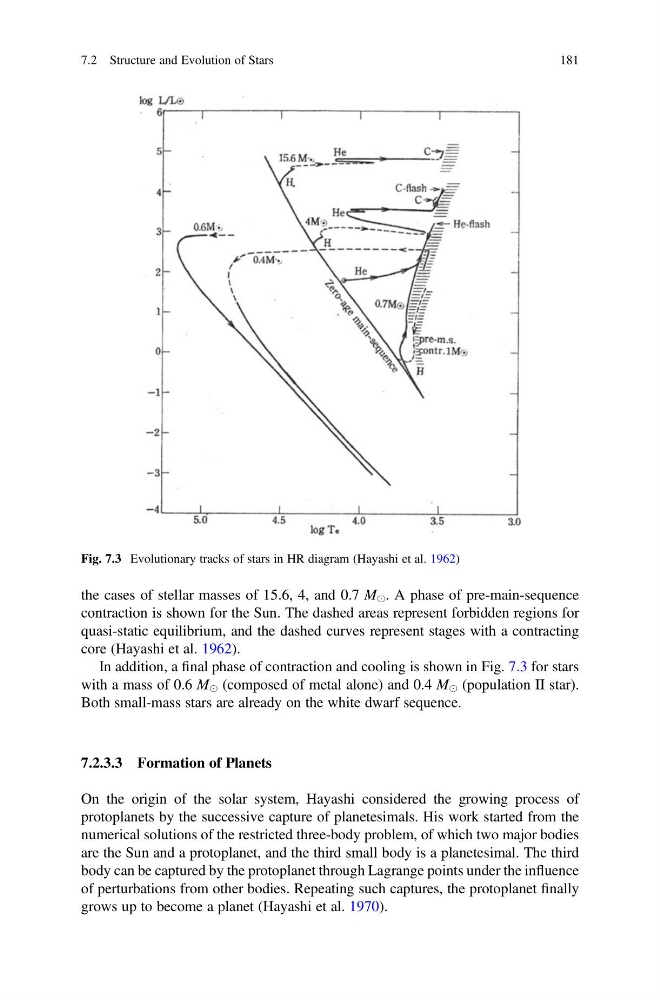
the cases of stellar masses of 15.6, 4, and 0.7 M ☉ . A phase of pre-main-sequence
contraction is shown for the Sun. The dashed areas represent forbidden regions for
quasi-static equilibrium, and the dashed curves represent stages with a contracting
core (Hayashi et al. 1962).
In addition, a final phase of contraction and cooling is shown in Fig. 7.3 for stars
with a mass of 0.6 M ☉ (composed of metal alone) and 0.4 M ☉ (population II star).
Both small-mass stars are already on the white dwarf sequence.
7.2.3.3 Formation of Planets
On the origin of the solar system, Hayashi considered the growing process of
protoplanets by the successive capture of planetesimals. His work started from the
numerical solutions of the restricted three-body problem, of which two major bodies
are the Sun and a protoplanet, and the third small body is a planetesimal. The third
body can be captured by the protoplanet through Lagrange points under the influence
of perturbations from other bodies. Repeating such captures, the protoplanet finally
grows up to become a planet (Hayashi et al. 1970).
Fig. 7.3 Evolutionary tracks of stars in HR diagram (Hayashi et al. 1962)
7.2 Structure and Evolution of Stars
181
contraction is shown for the Sun. The dashed areas represent forbidden regions for
quasi-static equilibrium, and the dashed curves represent stages with a contracting
core (Hayashi et al. 1962).
In addition, a final phase of contraction and cooling is shown in Fig. 7.3 for stars
with a mass of 0.6 M ☉ (composed of metal alone) and 0.4 M ☉ (population II star).
Both small-mass stars are already on the white dwarf sequence.
7.2.3.3 Formation of Planets
On the origin of the solar system, Hayashi considered the growing process of
protoplanets by the successive capture of planetesimals. His work started from the
numerical solutions of the restricted three-body problem, of which two major bodies
are the Sun and a protoplanet, and the third small body is a planetesimal. The third
body can be captured by the protoplanet through Lagrange points under the influence
of perturbations from other bodies. Repeating such captures, the protoplanet finally
grows up to become a planet (Hayashi et al. 1970).
Fig. 7.3 Evolutionary tracks of stars in HR diagram (Hayashi et al. 1962)
7.2 Structure and Evolution of Stars
181