

The DST was designed to acquire solar surface images at the highest spatial
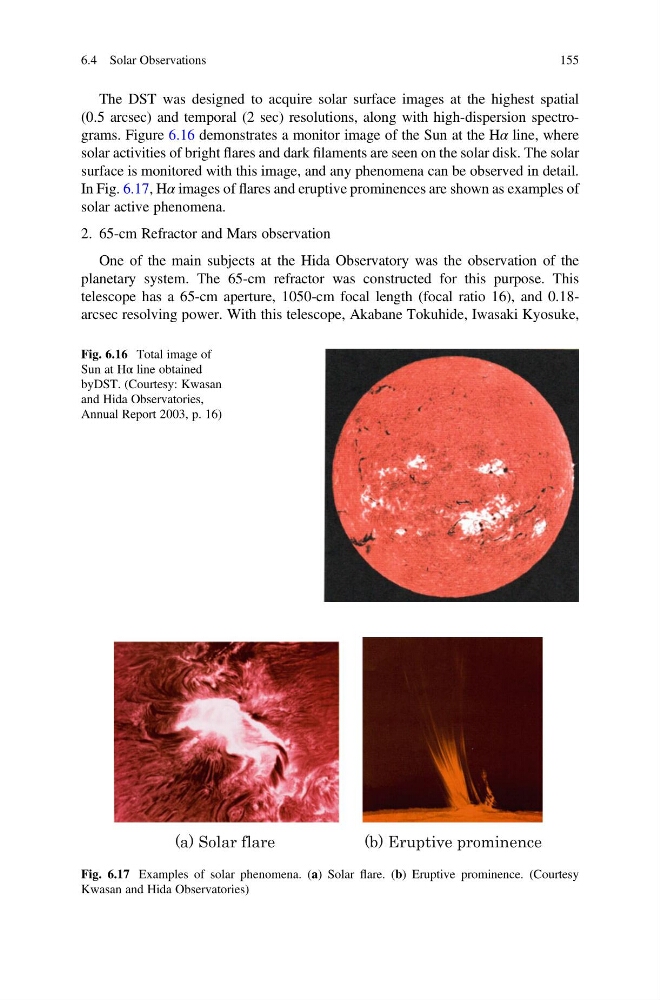
(0.5 arcsec) and temporal (2 sec) resolutions, along with high-dispersion spectrograms. Figure 6.16 demonstrates a monitor image of the Sun at the Hα line, where
solar activities of bright flares and dark filaments are seen on the solar disk. The solar
surface is monitored with this image, and any phenomena can be observed in detail.
In Fig. 6.17, Hα images of flares and eruptive prominences are shown as examples of
solar active phenomena.
2. 65-cm Refractor and Mars observation
One of the main subjects at the Hida Observatory was the observation of the
planetary system. The 65-cm refractor was constructed for this purpose. This
telescope has a 65-cm aperture, 1050-cm focal length (focal ratio 16), and 0.18arcsec resolving power. With this telescope, Akabane Tokuhide, Iwasaki Kyosuke,
Fig. 6.16 Total image of
Sun at Hα line obtained
byDST. (Courtesy: Kwasan
and Hida Observatories,
Annual Report 2003, p. 16)
(a) Solar flare
(b) Eruptive prominence
Fig. 6.17 Examples of solar phenomena. (a) Solar flare. (b) Eruptive prominence. (Courtesy
Kwasan and Hida Observatories)
6.4 Solar Observations
155
(0.5 arcsec) and temporal (2 sec) resolutions, along with high-dispersion spectrograms. Figure 6.16 demonstrates a monitor image of the Sun at the Hα line, where
solar activities of bright flares and dark filaments are seen on the solar disk. The solar
surface is monitored with this image, and any phenomena can be observed in detail.
In Fig. 6.17, Hα images of flares and eruptive prominences are shown as examples of
solar active phenomena.
2. 65-cm Refractor and Mars observation
One of the main subjects at the Hida Observatory was the observation of the
planetary system. The 65-cm refractor was constructed for this purpose. This
telescope has a 65-cm aperture, 1050-cm focal length (focal ratio 16), and 0.18arcsec resolving power. With this telescope, Akabane Tokuhide, Iwasaki Kyosuke,
Fig. 6.16 Total image of
Sun at Hα line obtained
byDST. (Courtesy: Kwasan
and Hida Observatories,
Annual Report 2003, p. 16)
(a) Solar flare
(b) Eruptive prominence
Fig. 6.17 Examples of solar phenomena. (a) Solar flare. (b) Eruptive prominence. (Courtesy
Kwasan and Hida Observatories)
6.4 Solar Observations
155