

6.4.3 Solar Coudé-Telescope at OAO
In 1968, a 65-cm Coudé telescope was constructed at the OAO for solar observations. With this telescope, Tower Telescope at Mitaka was practically retired from
service. Suemoto’s group used this Coudé telescope for observations of active
regions, flares, and magnetic activities. Kawaguchi Ichiro of Kyoto University was
also a regular user of this telescope, mostly for observations of prominences.
In 1979, a newly designed polarimeter was installed. With this polarimeter,
Makita Mitsugu and his group determined the magnetic field of the solar penumbra
by analyzing Zeeman-line profiles. Sunspot spectrograms obtained with this polarimeter in May 1971 are shown in Fig. 6.14. Analyzing these spectrograms, they
derived the magnetic field of penumbra, which was inwardly directed, making an
angle of 34
from the solar surface, with a strength of 1500 Gauss. An outward
Evershed flow of 5.6 km s
À1 , parallel to the lines of magnetic field, was also
observed (Makita 1979).
6.4.4 Domeless Solar Telescope and Hida Observatory
The Hida Observatory was established on a peak of Mt. Ōamami (1290 m above sea
level) in Gifu Prefecture, as a part of the Kwasan and Hida Observatories of Kyoto
University. The main telescopes are the 65-cm refractor (1972) and the domeless
solar telescope (DST, 1979) both made by Zeiss (Kawaguchi 1982).
1. Domeless Solar Telescope
The DST is a 64-cm reflector that is installed at the top of a 20-m-high tower in
order to avoid atmospheric scintillation. (Fig. 6.15). Inside the tower are two
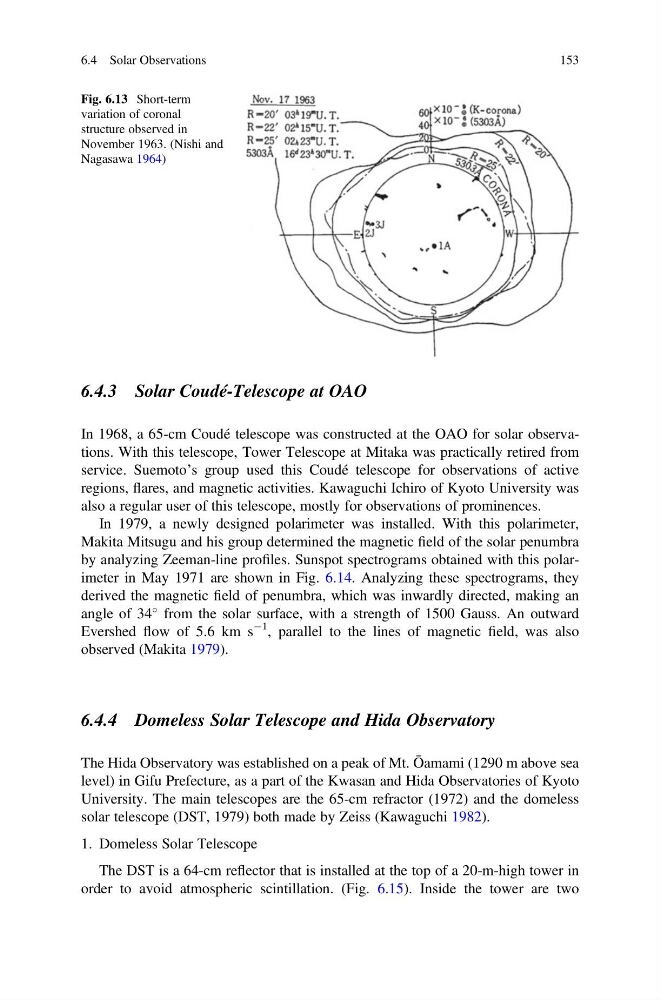
Fig. 6.13 Short-term
variation of coronal
structure observed in
November 1963. (Nishi and
Nagasawa 1964)
6.4 Solar Observations
153
In 1968, a 65-cm Coudé telescope was constructed at the OAO for solar observations. With this telescope, Tower Telescope at Mitaka was practically retired from
service. Suemoto’s group used this Coudé telescope for observations of active
regions, flares, and magnetic activities. Kawaguchi Ichiro of Kyoto University was
also a regular user of this telescope, mostly for observations of prominences.
In 1979, a newly designed polarimeter was installed. With this polarimeter,
Makita Mitsugu and his group determined the magnetic field of the solar penumbra
by analyzing Zeeman-line profiles. Sunspot spectrograms obtained with this polarimeter in May 1971 are shown in Fig. 6.14. Analyzing these spectrograms, they
derived the magnetic field of penumbra, which was inwardly directed, making an
angle of 34
from the solar surface, with a strength of 1500 Gauss. An outward
Evershed flow of 5.6 km s
À1 , parallel to the lines of magnetic field, was also
observed (Makita 1979).
6.4.4 Domeless Solar Telescope and Hida Observatory
The Hida Observatory was established on a peak of Mt. Ōamami (1290 m above sea
level) in Gifu Prefecture, as a part of the Kwasan and Hida Observatories of Kyoto
University. The main telescopes are the 65-cm refractor (1972) and the domeless
solar telescope (DST, 1979) both made by Zeiss (Kawaguchi 1982).
1. Domeless Solar Telescope
The DST is a 64-cm reflector that is installed at the top of a 20-m-high tower in
order to avoid atmospheric scintillation. (Fig. 6.15). Inside the tower are two
Fig. 6.13 Short-term
variation of coronal
structure observed in
November 1963. (Nishi and
Nagasawa 1964)
6.4 Solar Observations
153