

6.4 Solar Observations
6.4.1 Tower Telescope of TAO
In 1929, a 65-cm coelostat (called Tower Telescope) was built at the top of a tower
15 m high on the Mitaka campus of the TAO. Solar light is sent to an underground
observation room for high-dispersion analysis of the solar spectrum. After construction, Tower Telescope was used for a short time, but it was not active for a long time.
Active observations began in 1950 by Suemoto Zenzaburo on the solar chromosphere. His group, Hirayama Tadashi, Hiei Eizaburo, and Makita Mitugu, continued
solar observations with this telescope in the 1960s.
6.4.2 Coronagraph at Norikura Solar Station, TAO
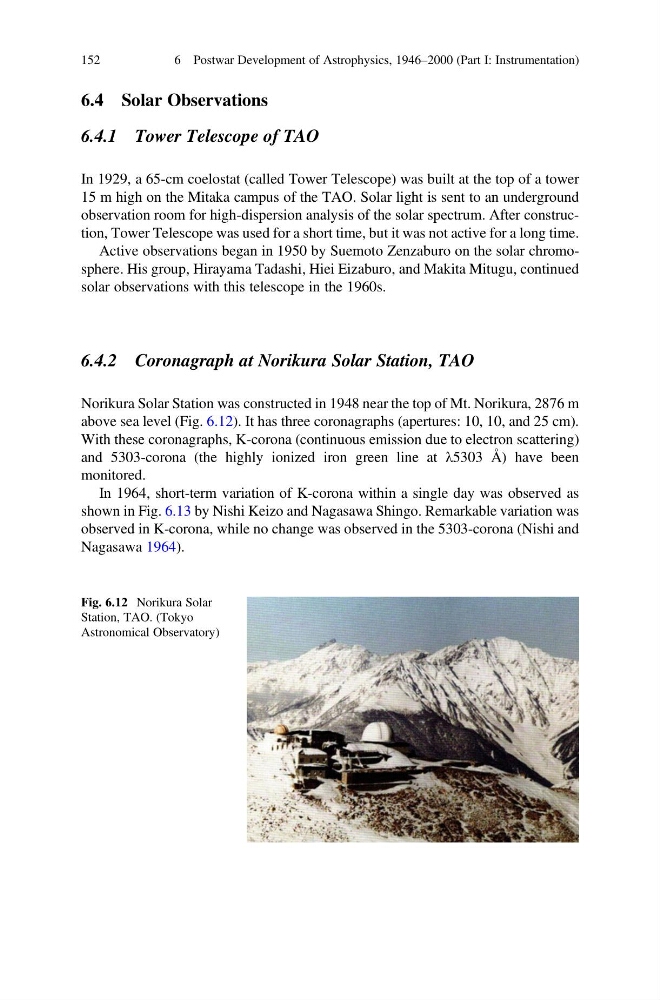
Norikura Solar Station was constructed in 1948 near the top of Mt. Norikura, 2876 m
above sea level (Fig. 6.12). It has three coronagraphs (apertures: 10, 10, and 25 cm).
With these coronagraphs, K-corona (continuous emission due to electron scattering)
and 5303-corona (the highly ionized iron green line at λ5303 Å) have been
monitored.
In 1964, short-term variation of K-corona within a single day was observed as
shown in Fig. 6.13 by Nishi Keizo and Nagasawa Shingo. Remarkable variation was
observed in K-corona, while no change was observed in the 5303-corona (Nishi and
Nagasawa 1964).
Fig. 6.12 Norikura Solar
Station, TAO. (Tokyo
Astronomical Observatory)
152
6 Postwar Development of Astrophysics, 1946–2000 (Part I: Instrumentation)
6.4.1 Tower Telescope of TAO
In 1929, a 65-cm coelostat (called Tower Telescope) was built at the top of a tower
15 m high on the Mitaka campus of the TAO. Solar light is sent to an underground
observation room for high-dispersion analysis of the solar spectrum. After construction, Tower Telescope was used for a short time, but it was not active for a long time.
Active observations began in 1950 by Suemoto Zenzaburo on the solar chromosphere. His group, Hirayama Tadashi, Hiei Eizaburo, and Makita Mitugu, continued
solar observations with this telescope in the 1960s.
6.4.2 Coronagraph at Norikura Solar Station, TAO
Norikura Solar Station was constructed in 1948 near the top of Mt. Norikura, 2876 m
above sea level (Fig. 6.12). It has three coronagraphs (apertures: 10, 10, and 25 cm).
With these coronagraphs, K-corona (continuous emission due to electron scattering)
and 5303-corona (the highly ionized iron green line at λ5303 Å) have been
monitored.
In 1964, short-term variation of K-corona within a single day was observed as
shown in Fig. 6.13 by Nishi Keizo and Nagasawa Shingo. Remarkable variation was
observed in K-corona, while no change was observed in the 5303-corona (Nishi and
Nagasawa 1964).
Fig. 6.12 Norikura Solar
Station, TAO. (Tokyo
Astronomical Observatory)
152
6 Postwar Development of Astrophysics, 1946–2000 (Part I: Instrumentation)