

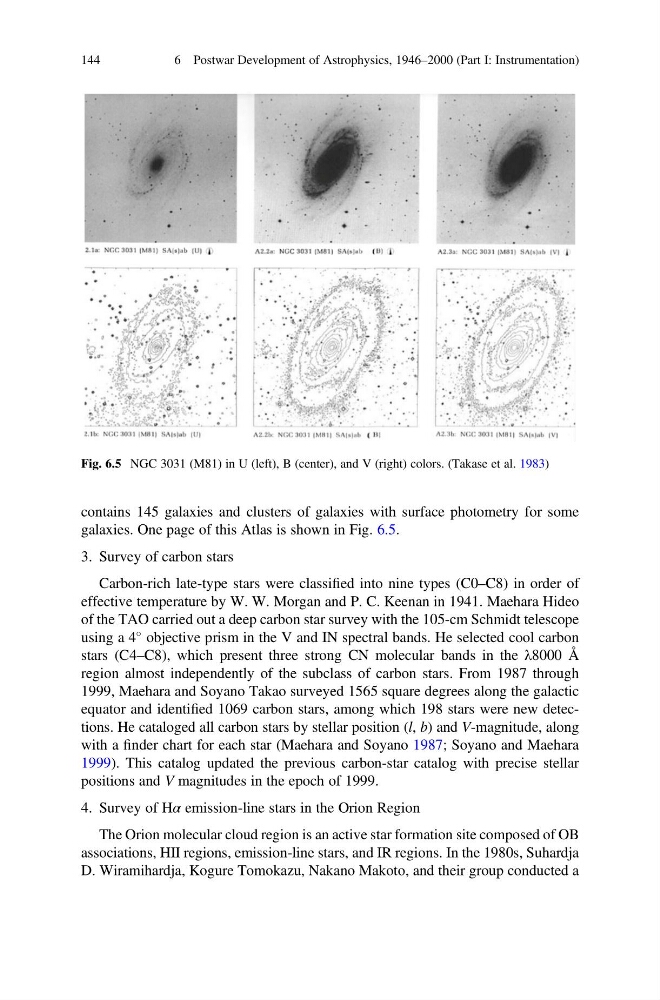
contains 145 galaxies and clusters of galaxies with surface photometry for some
galaxies. One page of this Atlas is shown in Fig. 6.5.
3. Survey of carbon stars
Carbon-rich late-type stars were classified into nine types (C0–C8) in order of
effective temperature by W. W. Morgan and P. C. Keenan in 1941. Maehara Hideo
of the TAO carried out a deep carbon star survey with the 105-cm Schmidt telescope
using a 4
objective prism in the V and IN spectral bands. He selected cool carbon
stars (C4–C8), which present three strong CN molecular bands in the λ8000 Å
region almost independently of the subclass of carbon stars. From 1987 through
1999, Maehara and Soyano Takao surveyed 1565 square degrees along the galactic
equator and identified 1069 carbon stars, among which 198 stars were new detections. He cataloged all carbon stars by stellar position (l, b) and V-magnitude, along
with a finder chart for each star (Maehara and Soyano 1987; Soyano and Maehara
1999). This catalog updated the previous carbon-star catalog with precise stellar
positions and V magnitudes in the epoch of 1999.
4. Survey of Hα emission-line stars in the Orion Region
The Orion molecular cloud region is an active star formation site composed of OB
associations, HII regions, emission-line stars, and IR regions. In the 1980s, Suhardja
D. Wiramihardja, Kogure Tomokazu, Nakano Makoto, and their group conducted a
Fig. 6.5 NGC 3031 (M81) in U (left), B (center), and V (right) colors. (Takase et al. 1983)
144
6 Postwar Development of Astrophysics, 1946–2000 (Part I: Instrumentation)
galaxies. One page of this Atlas is shown in Fig. 6.5.
3. Survey of carbon stars
Carbon-rich late-type stars were classified into nine types (C0–C8) in order of
effective temperature by W. W. Morgan and P. C. Keenan in 1941. Maehara Hideo
of the TAO carried out a deep carbon star survey with the 105-cm Schmidt telescope
using a 4
objective prism in the V and IN spectral bands. He selected cool carbon
stars (C4–C8), which present three strong CN molecular bands in the λ8000 Å
region almost independently of the subclass of carbon stars. From 1987 through
1999, Maehara and Soyano Takao surveyed 1565 square degrees along the galactic
equator and identified 1069 carbon stars, among which 198 stars were new detections. He cataloged all carbon stars by stellar position (l, b) and V-magnitude, along
with a finder chart for each star (Maehara and Soyano 1987; Soyano and Maehara
1999). This catalog updated the previous carbon-star catalog with precise stellar
positions and V magnitudes in the epoch of 1999.
4. Survey of Hα emission-line stars in the Orion Region
The Orion molecular cloud region is an active star formation site composed of OB
associations, HII regions, emission-line stars, and IR regions. In the 1980s, Suhardja
D. Wiramihardja, Kogure Tomokazu, Nakano Makoto, and their group conducted a
Fig. 6.5 NGC 3031 (M81) in U (left), B (center), and V (right) colors. (Takase et al. 1983)
144
6 Postwar Development of Astrophysics, 1946–2000 (Part I: Instrumentation)