

the 122-, 150-, and 305-cm Palomar Schmidt telescope (focal ratio 2.5), the Kiso
Schmidt, though it has a smaller aperture, has a limiting magnitude comparable to
the Palomar Schmidt because of its larger focal ratio. The Kiso Schmidt also has two
objective prisms of apex angles 2
and 4
as well as some basic color filters
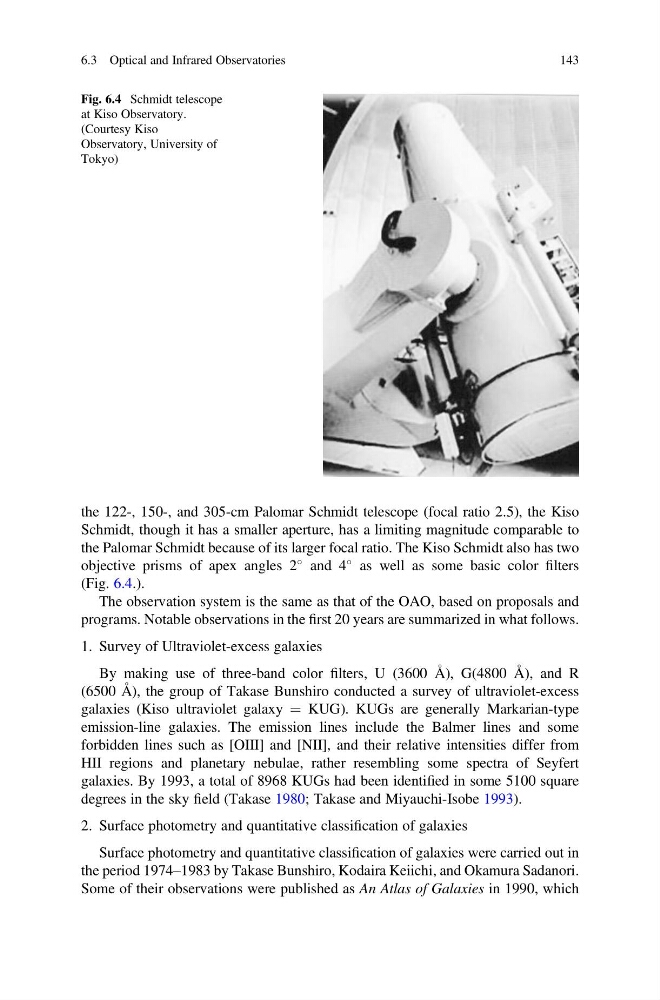
(Fig. 6.4.).
The observation system is the same as that of the OAO, based on proposals and
programs. Notable observations in the first 20 years are summarized in what follows.
1. Survey of Ultraviolet-excess galaxies
By making use of three-band color filters, U (3600 Å), G(4800 Å), and R
(6500 Å), the group of Takase Bunshiro conducted a survey of ultraviolet-excess
galaxies (Kiso ultraviolet galaxy ¼ KUG). KUGs are generally Markarian-type
emission-line galaxies. The emission lines include the Balmer lines and some
forbidden lines such as [OIII] and [NII], and their relative intensities differ from
HII regions and planetary nebulae, rather resembling some spectra of Seyfert
galaxies. By 1993, a total of 8968 KUGs had been identified in some 5100 square
degrees in the sky field (Takase 1980; Takase and Miyauchi-Isobe 1993).
2. Surface photometry and quantitative classification of galaxies
Surface photometry and quantitative classification of galaxies were carried out in
the period 1974–1983 by Takase Bunshiro, Kodaira Keiichi, and Okamura Sadanori.
Some of their observations were published as An Atlas of Galaxies in 1990, which
Fig. 6.4 Schmidt telescope
at Kiso Observatory.
(Courtesy Kiso
Observatory, University of
Tokyo)
6.3 Optical and Infrared Observatories
143
Schmidt, though it has a smaller aperture, has a limiting magnitude comparable to
the Palomar Schmidt because of its larger focal ratio. The Kiso Schmidt also has two
objective prisms of apex angles 2
and 4
as well as some basic color filters
(Fig. 6.4.).
The observation system is the same as that of the OAO, based on proposals and
programs. Notable observations in the first 20 years are summarized in what follows.
1. Survey of Ultraviolet-excess galaxies
By making use of three-band color filters, U (3600 Å), G(4800 Å), and R
(6500 Å), the group of Takase Bunshiro conducted a survey of ultraviolet-excess
galaxies (Kiso ultraviolet galaxy ¼ KUG). KUGs are generally Markarian-type
emission-line galaxies. The emission lines include the Balmer lines and some
forbidden lines such as [OIII] and [NII], and their relative intensities differ from
HII regions and planetary nebulae, rather resembling some spectra of Seyfert
galaxies. By 1993, a total of 8968 KUGs had been identified in some 5100 square
degrees in the sky field (Takase 1980; Takase and Miyauchi-Isobe 1993).
2. Surface photometry and quantitative classification of galaxies
Surface photometry and quantitative classification of galaxies were carried out in
the period 1974–1983 by Takase Bunshiro, Kodaira Keiichi, and Okamura Sadanori.
Some of their observations were published as An Atlas of Galaxies in 1990, which
Fig. 6.4 Schmidt telescope
at Kiso Observatory.
(Courtesy Kiso
Observatory, University of
Tokyo)
6.3 Optical and Infrared Observatories
143