

In 1911, Mukaiyama Observatory for geophysical and astronomical observations
was constructed near the university campus. It was equipped with a Bamberg 8-cm
meridian circle and a Zeiss 13-cm equatorial refractor for astronomical observations.
It was also equipped with a seismometer and meteorological instruments for geophysics. Mukaiyama Observatory served as the meteorological station of Sendai
as well.
5.1.3 Kusakabe Shirota and Geophysics
Kusakabe Shirota (日下部四郎太, 1875–1924) was born into the family of a farmer
in a small village, now part of the city of Yamagata, Yamagata Prefecture. He spent
several years as a novice monk in a Buddhist temple near his house before entering
elementary school. He was a troublesome boy in his youth (Tsugane 1973).
After 3 years at Dai-Ni High School (old) in Sendai, he enrolled in Tokyo
Imperial University, where he studied physics under Tanakadate Aikitsu and
Nagaoka Hantaro. After graduation in 1900, he continued his study of physical
lithology at Nagaoka’s laboratory. This included measurements of elasticity of
numerous kinds of rocks and the propagation velocity of seismic waves in various
strata. To support himself, for several years he held a second job as timekeeper at
Tokyo Astronomical Observatory in Azabu. There he studied positional astronomy
under special circumstances. His lithological works were recognized by the Japan
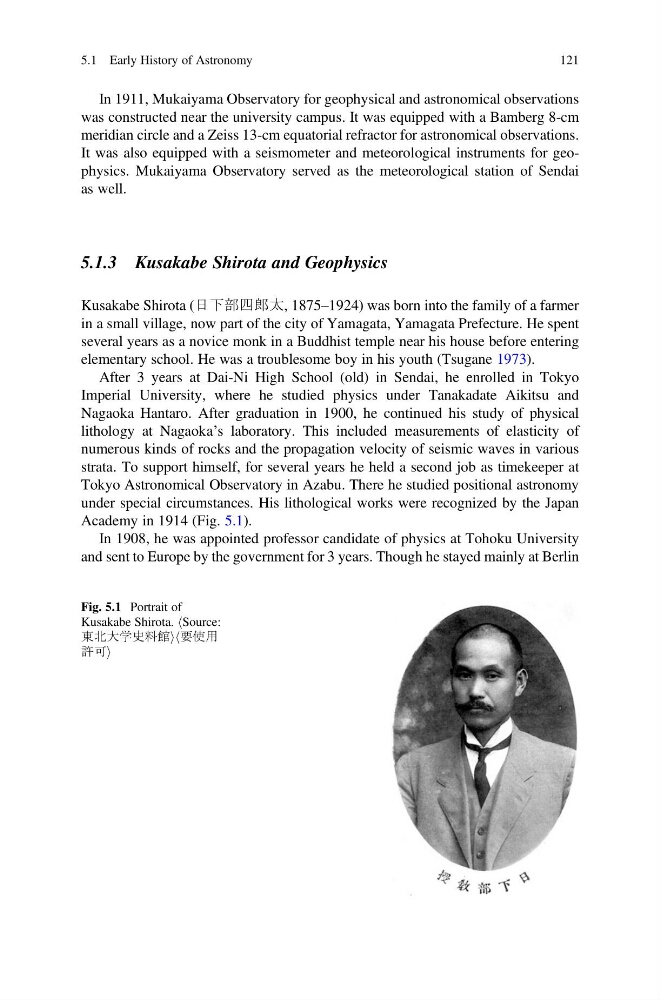
Academy in 1914 (Fig. 5.1).
In 1908, he was appointed professor candidate of physics at Tohoku University
and sent to Europe by the government for 3 years. Though he stayed mainly at Berlin
Fig. 5.1 Portrait of
Kusakabe Shirota. hSource:
東北大学史料館ih要使用
許可i
5.1 Early History of Astronomy
121
was constructed near the university campus. It was equipped with a Bamberg 8-cm
meridian circle and a Zeiss 13-cm equatorial refractor for astronomical observations.
It was also equipped with a seismometer and meteorological instruments for geophysics. Mukaiyama Observatory served as the meteorological station of Sendai
as well.
5.1.3 Kusakabe Shirota and Geophysics
Kusakabe Shirota (日下部四郎太, 1875–1924) was born into the family of a farmer
in a small village, now part of the city of Yamagata, Yamagata Prefecture. He spent
several years as a novice monk in a Buddhist temple near his house before entering
elementary school. He was a troublesome boy in his youth (Tsugane 1973).
After 3 years at Dai-Ni High School (old) in Sendai, he enrolled in Tokyo
Imperial University, where he studied physics under Tanakadate Aikitsu and
Nagaoka Hantaro. After graduation in 1900, he continued his study of physical
lithology at Nagaoka’s laboratory. This included measurements of elasticity of
numerous kinds of rocks and the propagation velocity of seismic waves in various
strata. To support himself, for several years he held a second job as timekeeper at
Tokyo Astronomical Observatory in Azabu. There he studied positional astronomy
under special circumstances. His lithological works were recognized by the Japan
Academy in 1914 (Fig. 5.1).
In 1908, he was appointed professor candidate of physics at Tohoku University
and sent to Europe by the government for 3 years. Though he stayed mainly at Berlin
Fig. 5.1 Portrait of
Kusakabe Shirota. hSource:
東北大学史料館ih要使用
許可i
5.1 Early History of Astronomy
121