

creation of a local calendar in the Sendai region up to the Meiji Revolution. In 1857,
the Navy of the Sendai clan constructed a warship, Kaisei-Maru (開成丸), for the
defense of their domain, and Furuyama held an additional post as the navigating
officer of the ship.
In 1868, the political state of Japan completely changed in the Meiji Revolution.
All the feudal clans vanished, and the capital of Japan moved from Kyoto to Tokyo.
The Tenmonkata of the Sendai clan also vanished, and Furuyama was appointed
astronomer of the Seigaku Kyoku (星学局, Department of Astronomy) in 1870 by
the Meiji government in Tokyo. He contributed to the calendar reform, where the
country swtiched from the Tempo calendar to the Gregorian calendar, which was
promulgated in 1873. Since Seigaku Kyoku was closed in 1874, Furuyama moved to
the Ministry of War and worked there for 14 years. He died in 1887 at age 63.
In Sendai, there was a long tradition of astronomical observations and calendar
making in collaboration with astronomers in Kyoto and Edo. This tradition, however, was not adopted by the new astronomy at Tohoku University, which was
founded in the Meiji era (Takeuchi 2014).
5.1.2 Tohoku University and Astronomy
In 1907, Tohoku Imperial University was established by the Meiji government as the
third Imperial University following Tokyo and Kyoto. The Ministry of Education,
under the advice of Nagaoka Hantaro, selected the first professional staff, which
included Honda Kotaro, Kusakabe Shirota, and Ishiwara Jun, and sent them to
Europe to study physics. From the beginning the university advocated open-door
policies. It was the first national university in Japan to accept female students and
foreign students from 1913.
The Faculty of Science was founded in 1911 with four departments: mathematics,
physics, chemistry, and biology. The first staff of the Department of Physics were
Honda Kotaro (本多光太郎) (experimental physics), Aichi Keiichi (愛知敬一) and
Ishiwara Jun (石原純) (both theoretical physics), and Kusakabe Shirota (日下部四
郎太) (geophysics).
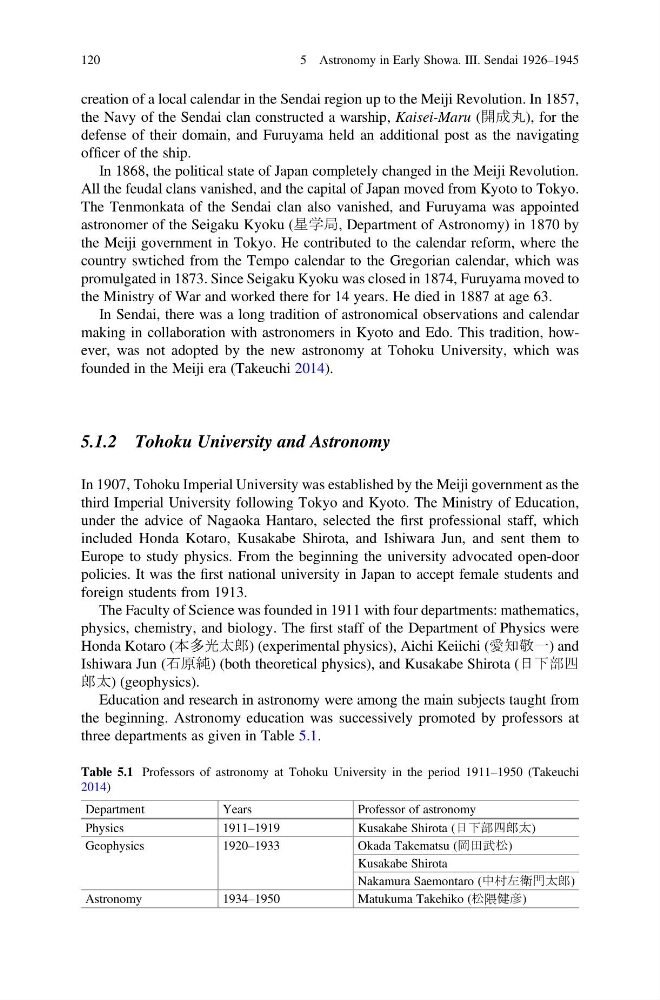
Education and research in astronomy were among the main subjects taught from
the beginning. Astronomy education was successively promoted by professors at
three departments as given in Table 5.1.
Table 5.1 Professors of astronomy at Tohoku University in the period 1911–1950 (Takeuchi
2014)
Department
Years
Professor of astronomy
Physics
1911–1919
Kusakabe Shirota (日下部四郎太)
Geophysics
1920–1933
Okada Takematsu (岡田武松)
Kusakabe Shirota
Nakamura Saemontaro (中村左衛門太郎)
Astronomy
1934–1950
Matukuma Takehiko (松隈健彦)
120
5 Astronomy in Early Showa. III. Sendai 1926–1945
the Navy of the Sendai clan constructed a warship, Kaisei-Maru (開成丸), for the
defense of their domain, and Furuyama held an additional post as the navigating
officer of the ship.
In 1868, the political state of Japan completely changed in the Meiji Revolution.
All the feudal clans vanished, and the capital of Japan moved from Kyoto to Tokyo.
The Tenmonkata of the Sendai clan also vanished, and Furuyama was appointed
astronomer of the Seigaku Kyoku (星学局, Department of Astronomy) in 1870 by
the Meiji government in Tokyo. He contributed to the calendar reform, where the
country swtiched from the Tempo calendar to the Gregorian calendar, which was
promulgated in 1873. Since Seigaku Kyoku was closed in 1874, Furuyama moved to
the Ministry of War and worked there for 14 years. He died in 1887 at age 63.
In Sendai, there was a long tradition of astronomical observations and calendar
making in collaboration with astronomers in Kyoto and Edo. This tradition, however, was not adopted by the new astronomy at Tohoku University, which was
founded in the Meiji era (Takeuchi 2014).
5.1.2 Tohoku University and Astronomy
In 1907, Tohoku Imperial University was established by the Meiji government as the
third Imperial University following Tokyo and Kyoto. The Ministry of Education,
under the advice of Nagaoka Hantaro, selected the first professional staff, which
included Honda Kotaro, Kusakabe Shirota, and Ishiwara Jun, and sent them to
Europe to study physics. From the beginning the university advocated open-door
policies. It was the first national university in Japan to accept female students and
foreign students from 1913.
The Faculty of Science was founded in 1911 with four departments: mathematics,
physics, chemistry, and biology. The first staff of the Department of Physics were
Honda Kotaro (本多光太郎) (experimental physics), Aichi Keiichi (愛知敬一) and
Ishiwara Jun (石原純) (both theoretical physics), and Kusakabe Shirota (日下部四
郎太) (geophysics).
Education and research in astronomy were among the main subjects taught from
the beginning. Astronomy education was successively promoted by professors at
three departments as given in Table 5.1.
Table 5.1 Professors of astronomy at Tohoku University in the period 1911–1950 (Takeuchi
2014)
Department
Years
Professor of astronomy
Physics
1911–1919
Kusakabe Shirota (日下部四郎太)
Geophysics
1920–1933
Okada Takematsu (岡田武松)
Kusakabe Shirota
Nakamura Saemontaro (中村左衛門太郎)
Astronomy
1934–1950
Matukuma Takehiko (松隈健彦)
120
5 Astronomy in Early Showa. III. Sendai 1926–1945