

of both theories from the Zhou to Han Dynasties. Noda argued that the original Kai
t’ien theory in the Zhou Dynasty was the first scientific cosmology in China –
scientific in the sense of being divorced from fantasy and folklore. On the other
hand, Hun t’ien theory was based on observations with spherical armillary yielding a
higher accuracy for the determination of heavenly bodies and for calendrical science.
These theories emerged as the traditional cosmology in China for a long time until
the transmission of Western cosmology in the sixteenth century.
4.5.2 Yabuuchi Kiyoshi and Chinese Science
Yabuuchi Kiyoshi (薮内清 1906–2000) was born in Kobe and studied astronomy
under Shinjo at Kyoto Imperial University. After graduation he worked at the
Research Institute for Humanistic Studies (人文科学研究所) of Kyoto University.
He made significant contributions to the history of Chinese science and technology
(Hashimoto 1982). In 1972, he was awarded the George Sarton Medal from the
History of Science Society of the USA. He was also a member of the Japan
Academy.
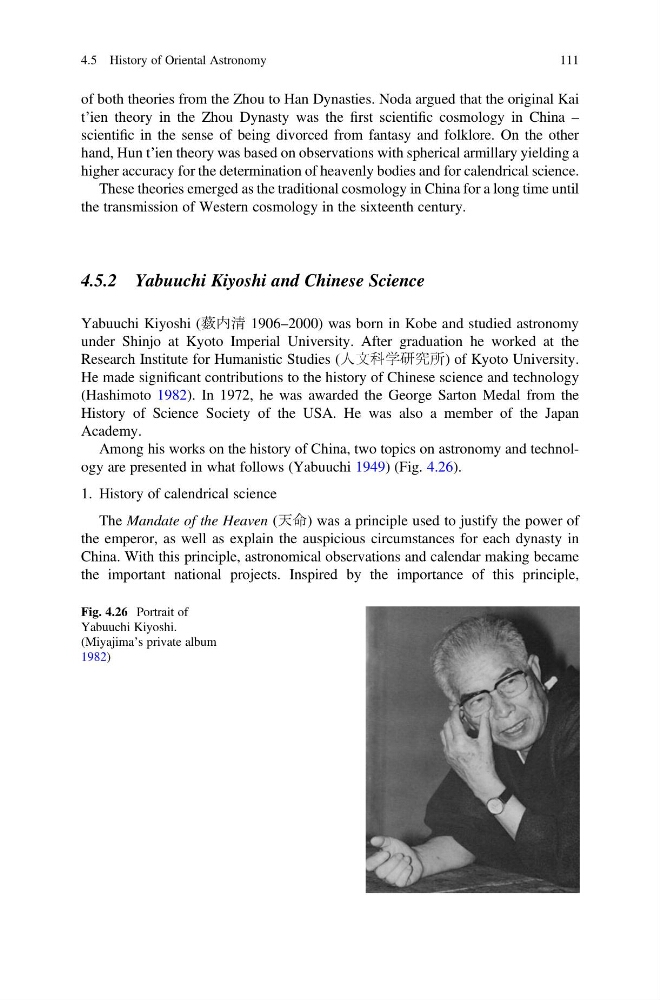
Among his works on the history of China, two topics on astronomy and technology are presented in what follows (Yabuuchi 1949) (Fig. 4.26).
1. History of calendrical science
The Mandate of the Heaven (天命) was a principle used to justify the power of
the emperor, as well as explain the auspicious circumstances for each dynasty in
China. With this principle, astronomical observations and calendar making became
the important national projects. Inspired by the importance of this principle,
Fig. 4.26 Portrait of
Yabuuchi Kiyoshi.
(Miyajima’s private album
1982)
4.5 History of Oriental Astronomy
111
t’ien theory in the Zhou Dynasty was the first scientific cosmology in China –
scientific in the sense of being divorced from fantasy and folklore. On the other
hand, Hun t’ien theory was based on observations with spherical armillary yielding a
higher accuracy for the determination of heavenly bodies and for calendrical science.
These theories emerged as the traditional cosmology in China for a long time until
the transmission of Western cosmology in the sixteenth century.
4.5.2 Yabuuchi Kiyoshi and Chinese Science
Yabuuchi Kiyoshi (薮内清 1906–2000) was born in Kobe and studied astronomy
under Shinjo at Kyoto Imperial University. After graduation he worked at the
Research Institute for Humanistic Studies (人文科学研究所) of Kyoto University.
He made significant contributions to the history of Chinese science and technology
(Hashimoto 1982). In 1972, he was awarded the George Sarton Medal from the
History of Science Society of the USA. He was also a member of the Japan
Academy.
Among his works on the history of China, two topics on astronomy and technology are presented in what follows (Yabuuchi 1949) (Fig. 4.26).
1. History of calendrical science
The Mandate of the Heaven (天命) was a principle used to justify the power of
the emperor, as well as explain the auspicious circumstances for each dynasty in
China. With this principle, astronomical observations and calendar making became
the important national projects. Inspired by the importance of this principle,
Fig. 4.26 Portrait of
Yabuuchi Kiyoshi.
(Miyajima’s private album
1982)
4.5 History of Oriental Astronomy
111