

2. Cosmology in Han Dynasty (Noda 1943)
In the age of Zhou Bi Suan Jing, that is the age of observations using the gnomon,
Kai t’ien theory (蓋天説, the sky as a cover) was widely accepted, according to
which the sky and the Earth are both flat or both convex and parallel. This theory was
developed and expanded into a cosmological theory in the Han Dynasty. Figure 4.25
illustrates a conception of Kai t’ien theory in the case of a convex sky and Earth. The
distance scale one li (里) corresponds to around 500 m.
In the middle of the Han Dynasty, around the time of Christ, the spherical
armillary was invented, and the idea of a spherical sky led to a new cosmology,
Hun t’ien theory (渾天説, enveloping spherical sky). This theory might have been
inspired by the image of a cosmic egg, the yolk being the Earth, but the spherical
form of the Earth was not clearly recognized. Debate between both cosmological
theories lasted a long time during the Han Dynasty. Noda critically traced the history
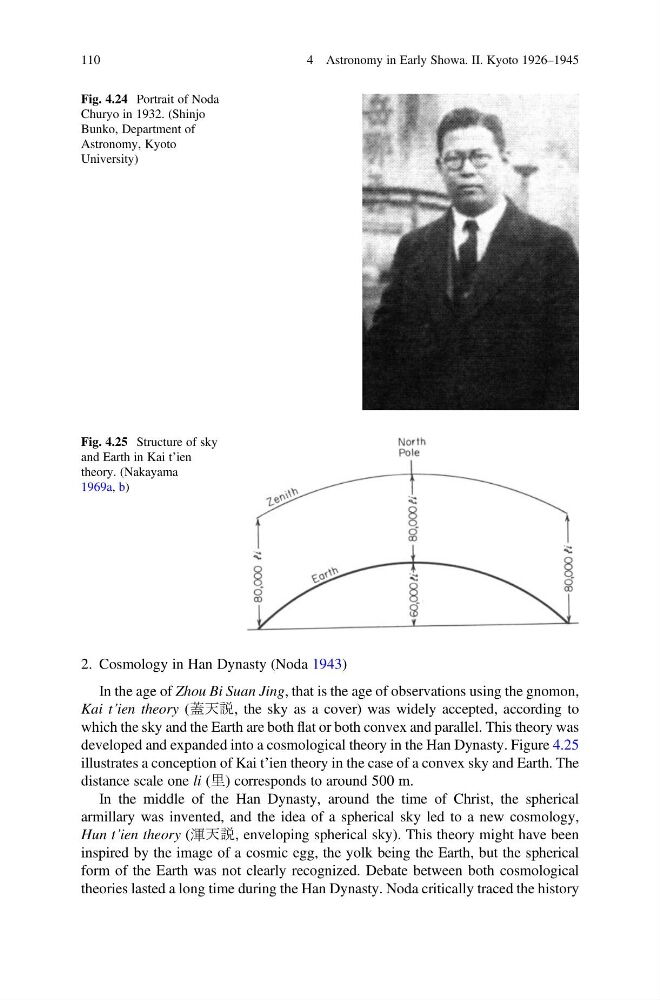
Fig. 4.24 Portrait of Noda
Churyo in 1932. (Shinjo
Bunko, Department of
Astronomy, Kyoto
University)
Fig. 4.25 Structure of sky
and Earth in Kai t’ien
theory. (Nakayama
1969a, b)
110
4 Astronomy in Early Showa. II. Kyoto 1926–1945
In the age of Zhou Bi Suan Jing, that is the age of observations using the gnomon,
Kai t’ien theory (蓋天説, the sky as a cover) was widely accepted, according to
which the sky and the Earth are both flat or both convex and parallel. This theory was
developed and expanded into a cosmological theory in the Han Dynasty. Figure 4.25
illustrates a conception of Kai t’ien theory in the case of a convex sky and Earth. The
distance scale one li (里) corresponds to around 500 m.
In the middle of the Han Dynasty, around the time of Christ, the spherical
armillary was invented, and the idea of a spherical sky led to a new cosmology,
Hun t’ien theory (渾天説, enveloping spherical sky). This theory might have been
inspired by the image of a cosmic egg, the yolk being the Earth, but the spherical
form of the Earth was not clearly recognized. Debate between both cosmological
theories lasted a long time during the Han Dynasty. Noda critically traced the history
Fig. 4.24 Portrait of Noda
Churyo in 1932. (Shinjo
Bunko, Department of
Astronomy, Kyoto
University)
Fig. 4.25 Structure of sky
and Earth in Kai t’ien
theory. (Nakayama
1969a, b)
110
4 Astronomy in Early Showa. II. Kyoto 1926–1945