

surface of companion stars at the primary minimum, but no reflection effects appear
at the secondary minimum. Both effects depend notably on the mass ratio of the
binary components, and the maximum deviation appears at the primary minimum of
the eclipse (Takeda 1934).
4.3.4 Eclipsing Binary of β Lyra Type
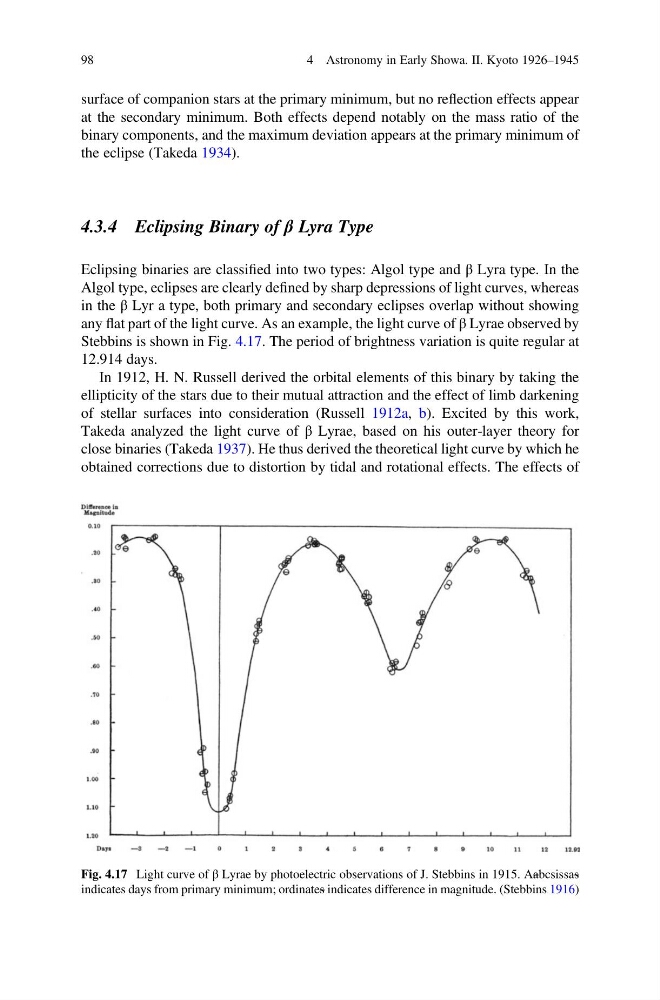
Eclipsing binaries are classified into two types: Algol type and β Lyra type. In the
Algol type, eclipses are clearly defined by sharp depressions of light curves, whereas
in the β Lyr a type, both primary and secondary eclipses overlap without showing
any flat part of the light curve. As an example, the light curve of β Lyrae observed by
Stebbins is shown in Fig. 4.17. The period of brightness variation is quite regular at
12.914 days.
In 1912, H. N. Russell derived the orbital elements of this binary by taking the
ellipticity of the stars due to their mutual attraction and the effect of limb darkening
of stellar surfaces into consideration (Russell 1912a, b). Excited by this work,
Takeda analyzed the light curve of β Lyrae, based on his outer-layer theory for
close binaries (Takeda 1937). He thus derived the theoretical light curve by which he
obtained corrections due to distortion by tidal and rotational effects. The effects of
Fig. 4.17 Light curve of β Lyrae by photoelectric observations of J. Stebbins in 1915. Aabcsissas
indicates days from primary minimum; ordinates indicates difference in magnitude. (Stebbins 1916)
98
4 Astronomy in Early Showa. II. Kyoto 1926–1945
at the secondary minimum. Both effects depend notably on the mass ratio of the
binary components, and the maximum deviation appears at the primary minimum of
the eclipse (Takeda 1934).
4.3.4 Eclipsing Binary of β Lyra Type
Eclipsing binaries are classified into two types: Algol type and β Lyra type. In the
Algol type, eclipses are clearly defined by sharp depressions of light curves, whereas
in the β Lyr a type, both primary and secondary eclipses overlap without showing
any flat part of the light curve. As an example, the light curve of β Lyrae observed by
Stebbins is shown in Fig. 4.17. The period of brightness variation is quite regular at
12.914 days.
In 1912, H. N. Russell derived the orbital elements of this binary by taking the
ellipticity of the stars due to their mutual attraction and the effect of limb darkening
of stellar surfaces into consideration (Russell 1912a, b). Excited by this work,
Takeda analyzed the light curve of β Lyrae, based on his outer-layer theory for
close binaries (Takeda 1937). He thus derived the theoretical light curve by which he
obtained corrections due to distortion by tidal and rotational effects. The effects of
Fig. 4.17 Light curve of β Lyrae by photoelectric observations of J. Stebbins in 1915. Aabcsissas
indicates days from primary minimum; ordinates indicates difference in magnitude. (Stebbins 1916)
98
4 Astronomy in Early Showa. II. Kyoto 1926–1945