

4.3.3 Distorted Outer Envelopes of Stars
Takeda considered the rotational distortion of the outer layers of stars following
Chandrasekhar’s extended Roche model (Takeda 1934). Suppose a star of polytropic
index n ¼ 3, which corresponds to an ordinary main-sequence star. Chandrasekhar
divided the interior of this star into two parts: the deep interior, which contains 90%
of the mass within the sphere of about half the radius, and the outer envelope, which
contains the remaining 10% of the mass (Chandrasekhar 1933).
When the star rotates, both the nucleus and outer envelope deviate from spherical
symmetry. The deviation is small in the nucleus compared to the outer envelope. The
oblateness, expressed by the ratio of the difference of equatorial and polar radii
relative to the equatorial radius, grows with the increase in rotation velocity. While
Chandrasekhar considered the case of slow rotation, Takeda carried out accurate
numerical calculations and found that oblateness was enhanced at a much higher rate
Chandrasekhar’s case for an increase in rotational velocity.
Takeda also considered the steady configuration of a close binary whose orbit is
circular, and the period of rotation is equal to that of revolution.
Binary interaction for the light curve in this system involves the effects of
deformation of the outer layer and the effects of reflection of light. Takeda theoretically considered these effects and derived some general form of the deviation of the
light curve. The effect of deformation reduces the brightness of stars, particularly at
the epochs of light minima, whereas the effect of light reflection brightens up the
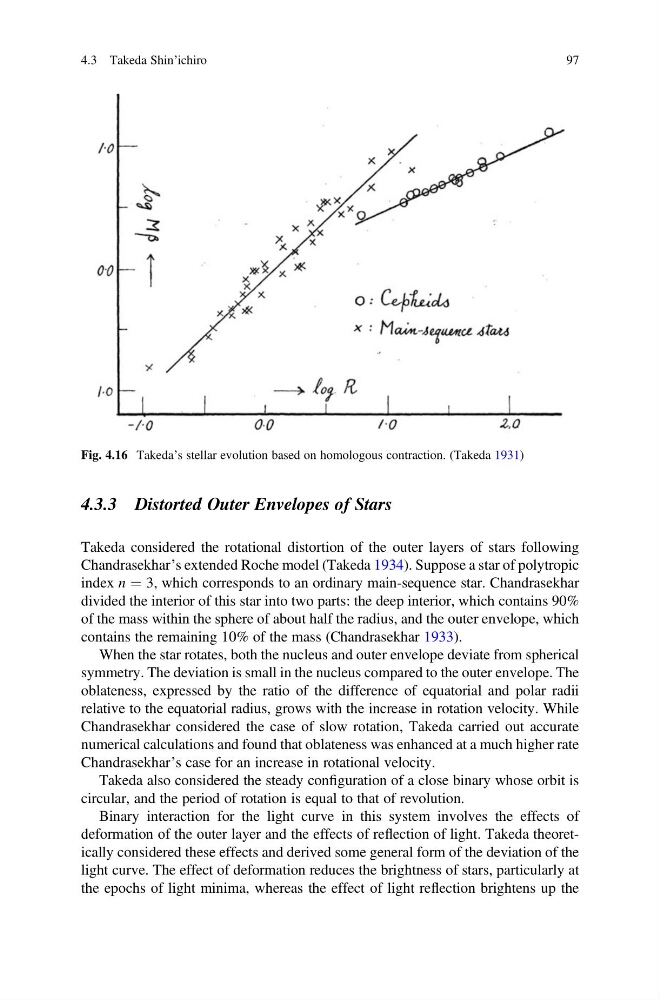
Fig. 4.16 Takeda’s stellar evolution based on homologous contraction. (Takeda 1931)
4.3 Takeda Shin’ichiro
97
Takeda considered the rotational distortion of the outer layers of stars following
Chandrasekhar’s extended Roche model (Takeda 1934). Suppose a star of polytropic
index n ¼ 3, which corresponds to an ordinary main-sequence star. Chandrasekhar
divided the interior of this star into two parts: the deep interior, which contains 90%
of the mass within the sphere of about half the radius, and the outer envelope, which
contains the remaining 10% of the mass (Chandrasekhar 1933).
When the star rotates, both the nucleus and outer envelope deviate from spherical
symmetry. The deviation is small in the nucleus compared to the outer envelope. The
oblateness, expressed by the ratio of the difference of equatorial and polar radii
relative to the equatorial radius, grows with the increase in rotation velocity. While
Chandrasekhar considered the case of slow rotation, Takeda carried out accurate
numerical calculations and found that oblateness was enhanced at a much higher rate
Chandrasekhar’s case for an increase in rotational velocity.
Takeda also considered the steady configuration of a close binary whose orbit is
circular, and the period of rotation is equal to that of revolution.
Binary interaction for the light curve in this system involves the effects of
deformation of the outer layer and the effects of reflection of light. Takeda theoretically considered these effects and derived some general form of the deviation of the
light curve. The effect of deformation reduces the brightness of stars, particularly at
the epochs of light minima, whereas the effect of light reflection brightens up the
Fig. 4.16 Takeda’s stellar evolution based on homologous contraction. (Takeda 1931)
4.3 Takeda Shin’ichiro
97