

of the energy source. These two types are defined by the stellar luminosity, as shown
in the following scheme (Milne 1930):
Luminosity
L:
0
L 0
L 1 and large
Energy
source:
Uniform source
Point source
No stable
state
Stellar type:
Collapsed (white dwarf
stars)
Normal (dwarf stars and Giant
stars)
Nonexistent
This scheme was widely accepted in the years around 1930. Araki began to work
on the structure of white dwarfs. As the standard model, Milne assumed that the
absorption coefficient κ and the rate of energy generation ε were both constant inside
stars, whereas Araki supposed that the energy production rate depended on gas
density ρ(r) in the form
ε ¼ κ 1 À B
ρ 0
ρ
ð4:1Þ
where K and B are constants. Araki constructed a stellar model in this case, and his
numerical solution is given in Table 4.1, along with Milne’s standard model and
observational values (Araki 1934). Thus, Araki claimed that his model yields better
agreement with observations.
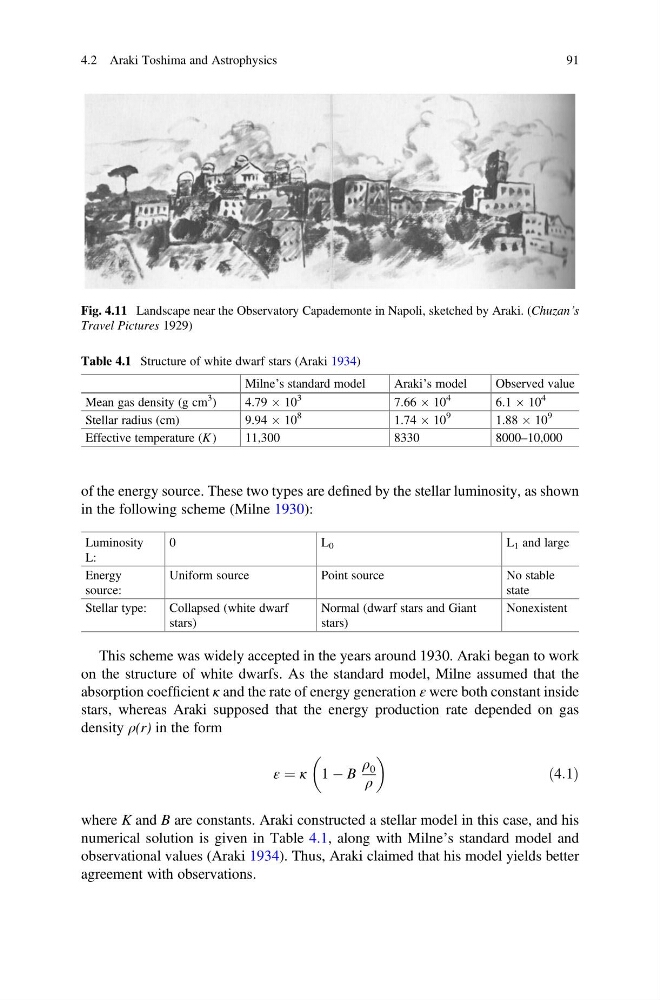
Fig. 4.11 Landscape near the Observatory Capademonte in Napoli, sketched by Araki. (Chuzan’s
Travel Pictures 1929)
Table 4.1 Structure of white dwarf stars (Araki 1934)
Milne’s standard model
Araki’s model
Observed value
Mean gas density (g cm
3
)
4.79 Â 10
3
7.66 Â 10
4
6.1 Â 10
4
Stellar radius (cm)
9.94 Â 10
8
1.74 Â 10
9
1.88 Â 10
9
Effective temperature (K )
11,300
8330
8000–10,000
4.2 Araki Toshima and Astrophysics
91
in the following scheme (Milne 1930):
Luminosity
L:
0
L 0
L 1 and large
Energy
source:
Uniform source
Point source
No stable
state
Stellar type:
Collapsed (white dwarf
stars)
Normal (dwarf stars and Giant
stars)
Nonexistent
This scheme was widely accepted in the years around 1930. Araki began to work
on the structure of white dwarfs. As the standard model, Milne assumed that the
absorption coefficient κ and the rate of energy generation ε were both constant inside
stars, whereas Araki supposed that the energy production rate depended on gas
density ρ(r) in the form
ε ¼ κ 1 À B
ρ 0
ρ
ð4:1Þ
where K and B are constants. Araki constructed a stellar model in this case, and his
numerical solution is given in Table 4.1, along with Milne’s standard model and
observational values (Araki 1934). Thus, Araki claimed that his model yields better
agreement with observations.
Fig. 4.11 Landscape near the Observatory Capademonte in Napoli, sketched by Araki. (Chuzan’s
Travel Pictures 1929)
Table 4.1 Structure of white dwarf stars (Araki 1934)
Milne’s standard model
Araki’s model
Observed value
Mean gas density (g cm
3
)
4.79 Â 10
3
7.66 Â 10
4
6.1 Â 10
4
Stellar radius (cm)
9.94 Â 10
8
1.74 Â 10
9
1.88 Â 10
9
Effective temperature (K )
11,300
8330
8000–10,000
4.2 Araki Toshima and Astrophysics
91