

director of the Potsdam Observatory and was working on the physical nature of
variable stars and globular clusters. When Araki was at Potsdam, Ludendorff was
undergoing statistical studies of light curves of long-period variables.
Because Araki wished to study more theoretical astrophysics, he moved to the
University of Berlin, where he learned quantum mechanics and relativity from
Max. T. F. von Laue. Laue was working on the diffraction of X-rays by crystals.
Although Araki studied theoretical physics under Laue, he showed little interest in
Laue’s X-ray physics. Instead, Araki was attracted by the works of E. A. Milne of the
Victoria University of Manchester on the internal structure of stars. Stellar structure
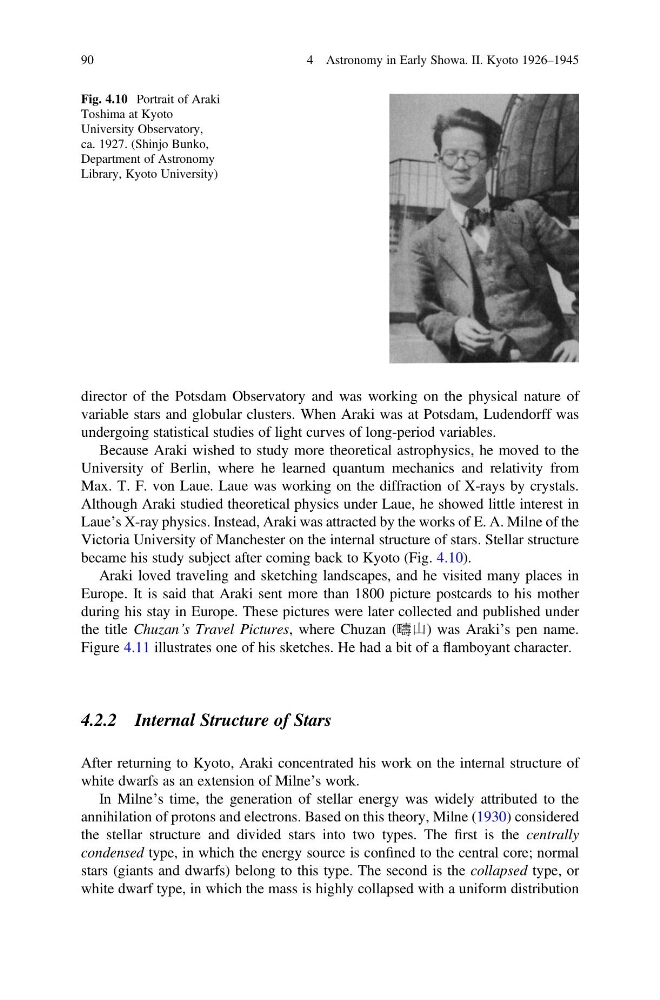
became his study subject after coming back to Kyoto (Fig. 4.10).
Araki loved traveling and sketching landscapes, and he visited many places in
Europe. It is said that Araki sent more than 1800 picture postcards to his mother
during his stay in Europe. These pictures were later collected and published under
the title Chuzan’s Travel Pictures, where Chuzan (疇山) was Araki’s pen name.
Figure 4.11 illustrates one of his sketches. He had a bit of a flamboyant character.
4.2.2 Internal Structure of Stars
After returning to Kyoto, Araki concentrated his work on the internal structure of
white dwarfs as an extension of Milne’s work.
In Milne’s time, the generation of stellar energy was widely attributed to the
annihilation of protons and electrons. Based on this theory, Milne (1930) considered
the stellar structure and divided stars into two types. The first is the centrally
condensed type, in which the energy source is confined to the central core; normal
stars (giants and dwarfs) belong to this type. The second is the collapsed type, or
white dwarf type, in which the mass is highly collapsed with a uniform distribution
Fig. 4.10 Portrait of Araki
Toshima at Kyoto
University Observatory,
ca. 1927. (Shinjo Bunko,
Department of Astronomy
Library, Kyoto University)
90
4 Astronomy in Early Showa. II. Kyoto 1926–1945
variable stars and globular clusters. When Araki was at Potsdam, Ludendorff was
undergoing statistical studies of light curves of long-period variables.
Because Araki wished to study more theoretical astrophysics, he moved to the
University of Berlin, where he learned quantum mechanics and relativity from
Max. T. F. von Laue. Laue was working on the diffraction of X-rays by crystals.
Although Araki studied theoretical physics under Laue, he showed little interest in
Laue’s X-ray physics. Instead, Araki was attracted by the works of E. A. Milne of the
Victoria University of Manchester on the internal structure of stars. Stellar structure
became his study subject after coming back to Kyoto (Fig. 4.10).
Araki loved traveling and sketching landscapes, and he visited many places in
Europe. It is said that Araki sent more than 1800 picture postcards to his mother
during his stay in Europe. These pictures were later collected and published under
the title Chuzan’s Travel Pictures, where Chuzan (疇山) was Araki’s pen name.
Figure 4.11 illustrates one of his sketches. He had a bit of a flamboyant character.
4.2.2 Internal Structure of Stars
After returning to Kyoto, Araki concentrated his work on the internal structure of
white dwarfs as an extension of Milne’s work.
In Milne’s time, the generation of stellar energy was widely attributed to the
annihilation of protons and electrons. Based on this theory, Milne (1930) considered
the stellar structure and divided stars into two types. The first is the centrally
condensed type, in which the energy source is confined to the central core; normal
stars (giants and dwarfs) belong to this type. The second is the collapsed type, or
white dwarf type, in which the mass is highly collapsed with a uniform distribution
Fig. 4.10 Portrait of Araki
Toshima at Kyoto
University Observatory,
ca. 1927. (Shinjo Bunko,
Department of Astronomy
Library, Kyoto University)
90
4 Astronomy in Early Showa. II. Kyoto 1926–1945