

4.2 Conventional Versus Surrogate-Based Optimization
51
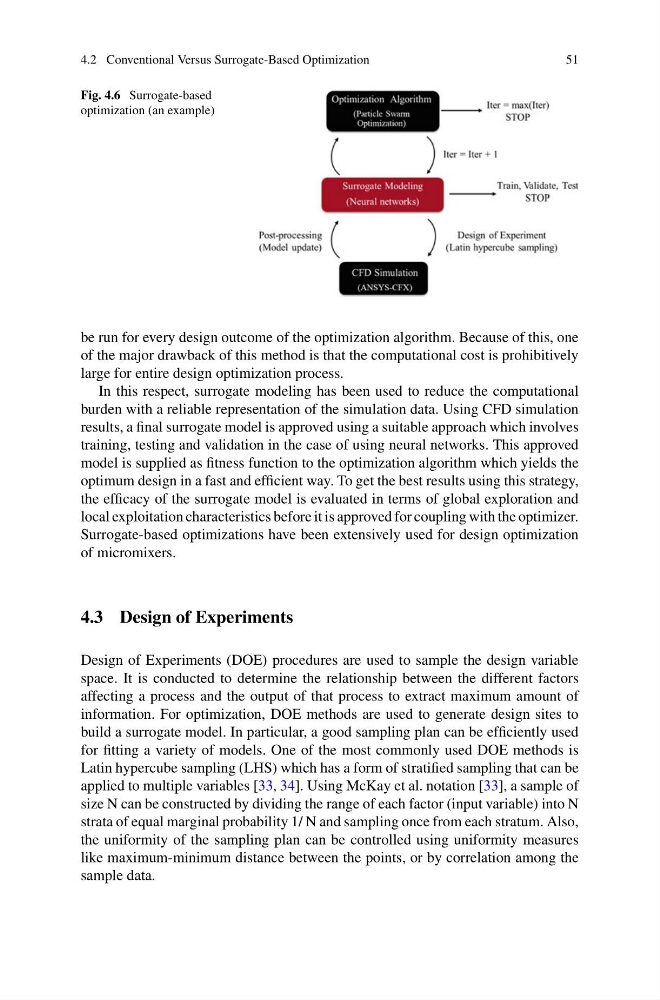
Fig. 4.6 Surrogate-based
optimization (an example)
be run for every design outcome of the optimization algorithm. Because of this, one
of the major drawback of this method is that the computational cost is prohibitively
large for entire design optimization process.
In this respect, surrogate modeling has been used to reduce the computational
burden with a reliable representation of the simulation data. Using CFD simulation
results, a final surrogate model is approved using a suitable approach which involves
training, testing and validation in the case of using neural networks. This approved
model is supplied as fitness function to the optimization algorithm which yields the
optimum design in a fast and efficient way. To get the best results using this strategy,
the efficacy of the surrogate model is evaluated in terms of global exploration and
local exploitation characteristics before it is approved for coupling with the optimizer.
Surrogate-based optimizations have been extensively used for design optimization
of micromixers.
4.3 Design of Experiments
Design of Experiments (DOE) procedures are used to sample the design variable
space. It is conducted to determine the relationship between the different factors
affecting a process and the output of that process to extract maximum amount of
information. For optimization, DOE methods are used to generate design sites to
build a surrogate model. In particular, a good sampling plan can be efficiently used
for fitting a variety of models. One of the most commonly used DOE methods is
Latin hypercube sampling (LHS) which has a form of stratified sampling that can be
applied to multiple variables [33, 34]. Using McKay et al. notation [33], a sample of
size N can be constructed by dividing the range of each factor (input variable) into N
strata of equal marginal probability 1/ N and sampling once from each stratum. Also,
the uniformity of the sampling plan can be controlled using uniformity measures
like maximum-minimum distance between the points, or by correlation among the
sample data.
51
Fig. 4.6 Surrogate-based
optimization (an example)
be run for every design outcome of the optimization algorithm. Because of this, one
of the major drawback of this method is that the computational cost is prohibitively
large for entire design optimization process.
In this respect, surrogate modeling has been used to reduce the computational
burden with a reliable representation of the simulation data. Using CFD simulation
results, a final surrogate model is approved using a suitable approach which involves
training, testing and validation in the case of using neural networks. This approved
model is supplied as fitness function to the optimization algorithm which yields the
optimum design in a fast and efficient way. To get the best results using this strategy,
the efficacy of the surrogate model is evaluated in terms of global exploration and
local exploitation characteristics before it is approved for coupling with the optimizer.
Surrogate-based optimizations have been extensively used for design optimization
of micromixers.
4.3 Design of Experiments
Design of Experiments (DOE) procedures are used to sample the design variable
space. It is conducted to determine the relationship between the different factors
affecting a process and the output of that process to extract maximum amount of
information. For optimization, DOE methods are used to generate design sites to
build a surrogate model. In particular, a good sampling plan can be efficiently used
for fitting a variety of models. One of the most commonly used DOE methods is
Latin hypercube sampling (LHS) which has a form of stratified sampling that can be
applied to multiple variables [33, 34]. Using McKay et al. notation [33], a sample of
size N can be constructed by dividing the range of each factor (input variable) into N
strata of equal marginal probability 1/ N and sampling once from each stratum. Also,
the uniformity of the sampling plan can be controlled using uniformity measures
like maximum-minimum distance between the points, or by correlation among the
sample data.