

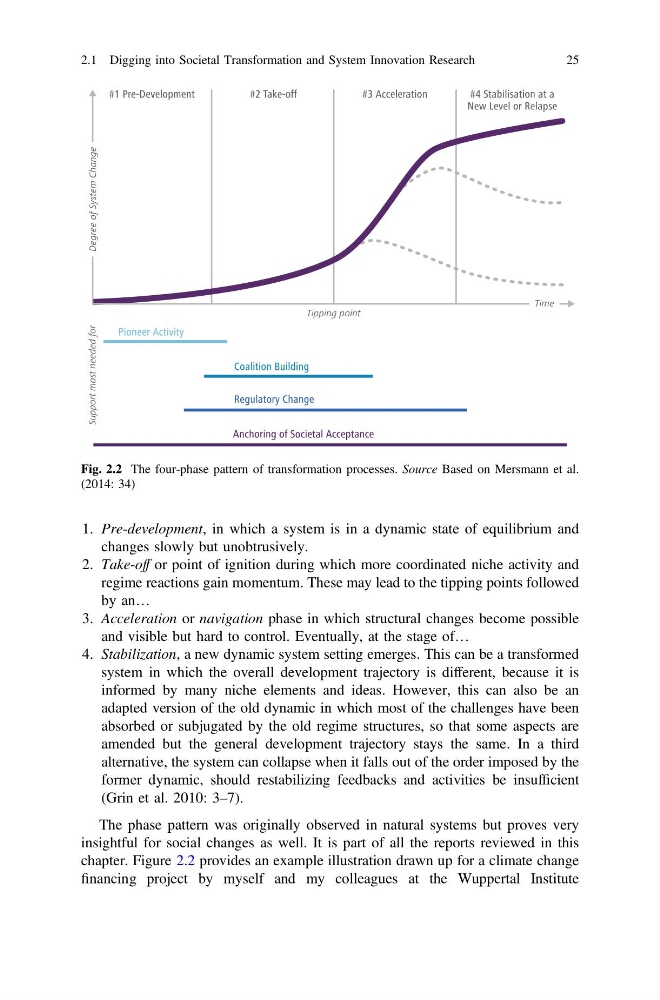
1. Pre-development, in which a system is in a dynamic state of equilibrium and
changes slowly but unobtrusively.
2. Take-off or point of ignition during which more coordinated niche activity and
regime reactions gain momentum. These may lead to the tipping points followed
by an…
3. Acceleration or navigation phase in which structural changes become possible
and visible but hard to control. Eventually, at the stage of…
4. Stabilization, a new dynamic system setting emerges. This can be a transformed
system in which the overall development trajectory is different, because it is
informed by many niche elements and ideas. However, this can also be an
adapted version of the old dynamic in which most of the challenges have been
absorbed or subjugated by the old regime structures, so that some aspects are
amended but the general development trajectory stays the same. In a third
alternative, the system can collapse when it falls out of the order imposed by the
former dynamic, should restabilizing feedbacks and activities be insufficient
(Grin et al. 2010: 3–7).
The phase pattern was originally observed in natural systems but proves very
insightful for social changes as well. It is part of all the reports reviewed in this
chapter. Figure 2.2 provides an example illustration drawn up for a climate change
financing project by myself and my colleagues at the Wuppertal Institute
Fig. 2.2 The four-phase pattern of transformation processes. Source Based on Mersmann et al.
(2014: 34)
2.1 Digging into Societal Transformation and System Innovation Research
25
changes slowly but unobtrusively.
2. Take-off or point of ignition during which more coordinated niche activity and
regime reactions gain momentum. These may lead to the tipping points followed
by an…
3. Acceleration or navigation phase in which structural changes become possible
and visible but hard to control. Eventually, at the stage of…
4. Stabilization, a new dynamic system setting emerges. This can be a transformed
system in which the overall development trajectory is different, because it is
informed by many niche elements and ideas. However, this can also be an
adapted version of the old dynamic in which most of the challenges have been
absorbed or subjugated by the old regime structures, so that some aspects are
amended but the general development trajectory stays the same. In a third
alternative, the system can collapse when it falls out of the order imposed by the
former dynamic, should restabilizing feedbacks and activities be insufficient
(Grin et al. 2010: 3–7).
The phase pattern was originally observed in natural systems but proves very
insightful for social changes as well. It is part of all the reports reviewed in this
chapter. Figure 2.2 provides an example illustration drawn up for a climate change
financing project by myself and my colleagues at the Wuppertal Institute
Fig. 2.2 The four-phase pattern of transformation processes. Source Based on Mersmann et al.
(2014: 34)
2.1 Digging into Societal Transformation and System Innovation Research
25