

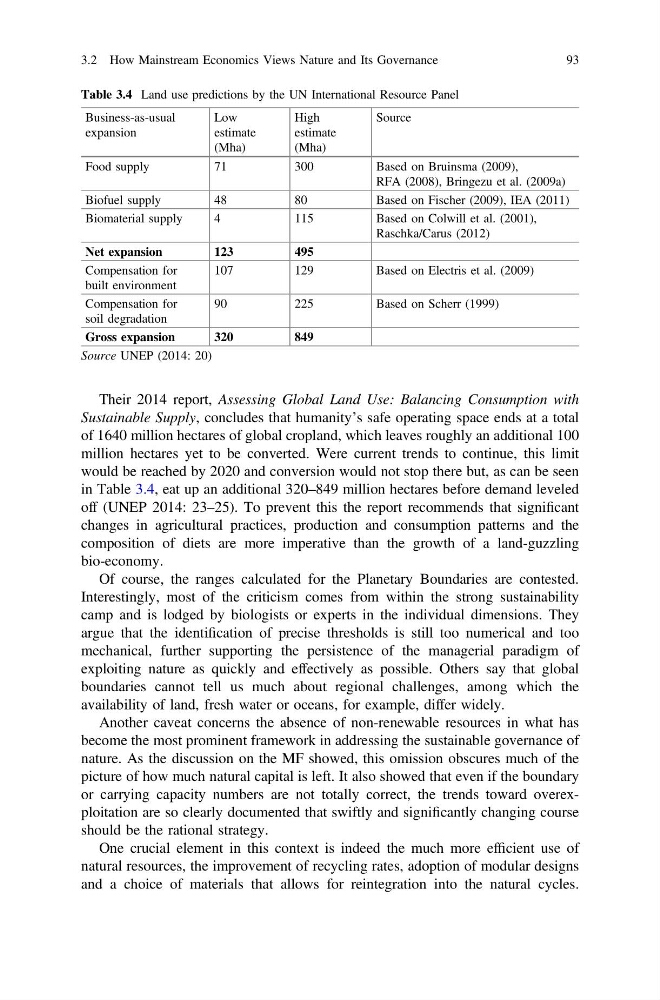
Their 2014 report, Assessing Global Land Use: Balancing Consumption with
Sustainable Supply, concludes that humanity’s safe operating space ends at a total
of 1640 million hectares of global cropland, which leaves roughly an additional 100
million hectares yet to be converted. Were current trends to continue, this limit
would be reached by 2020 and conversion would not stop there but, as can be seen
in Table 3.4, eat up an additional 320–849 million hectares before demand leveled
off (UNEP 2014: 23–25). To prevent this the report recommends that significant
changes in agricultural practices, production and consumption patterns and the
composition of diets are more imperative than the growth of a land-guzzling
bio-economy.
Of course, the ranges calculated for the Planetary Boundaries are contested.
Interestingly, most of the criticism comes from within the strong sustainability
camp and is lodged by biologists or experts in the individual dimensions. They
argue that the identification of precise thresholds is still too numerical and too
mechanical, further supporting the persistence of the managerial paradigm of
exploiting nature as quickly and effectively as possible. Others say that global
boundaries cannot tell us much about regional challenges, among which the
availability of land, fresh water or oceans, for example, differ widely.
Another caveat concerns the absence of non-renewable resources in what has
become the most prominent framework in addressing the sustainable governance of
nature. As the discussion on the MF showed, this omission obscures much of the
picture of how much natural capital is left. It also showed that even if the boundary
or carrying capacity numbers are not totally correct, the trends toward overexploitation are so clearly documented that swiftly and significantly changing course
should be the rational strategy.
One crucial element in this context is indeed the much more efficient use of
natural resources, the improvement of recycling rates, adoption of modular designs
and a choice of materials that allows for reintegration into the natural cycles.
Table 3.4 Land use predictions by the UN International Resource Panel
Business-as-usual
expansion
Low
estimate
(Mha)
High
estimate
(Mha)
Source
Food supply
71
300
Based on Bruinsma (2009),
RFA (2008), Bringezu et al. (2009a)
Biofuel supply
48
80
Based on Fischer (2009), IEA (2011)
Biomaterial supply
4
115
Based on Colwill et al. (2001),
Raschka/Carus (2012)
Net expansion
123
495
Compensation for
built environment
107
129
Based on Electris et al. (2009)
Compensation for
soil degradation
90
225
Based on Scherr (1999)
Gross expansion
320
849
Source UNEP (2014: 20)
3.2 How Mainstream Economics Views Nature and Its Governance
93
Sustainable Supply, concludes that humanity’s safe operating space ends at a total
of 1640 million hectares of global cropland, which leaves roughly an additional 100
million hectares yet to be converted. Were current trends to continue, this limit
would be reached by 2020 and conversion would not stop there but, as can be seen
in Table 3.4, eat up an additional 320–849 million hectares before demand leveled
off (UNEP 2014: 23–25). To prevent this the report recommends that significant
changes in agricultural practices, production and consumption patterns and the
composition of diets are more imperative than the growth of a land-guzzling
bio-economy.
Of course, the ranges calculated for the Planetary Boundaries are contested.
Interestingly, most of the criticism comes from within the strong sustainability
camp and is lodged by biologists or experts in the individual dimensions. They
argue that the identification of precise thresholds is still too numerical and too
mechanical, further supporting the persistence of the managerial paradigm of
exploiting nature as quickly and effectively as possible. Others say that global
boundaries cannot tell us much about regional challenges, among which the
availability of land, fresh water or oceans, for example, differ widely.
Another caveat concerns the absence of non-renewable resources in what has
become the most prominent framework in addressing the sustainable governance of
nature. As the discussion on the MF showed, this omission obscures much of the
picture of how much natural capital is left. It also showed that even if the boundary
or carrying capacity numbers are not totally correct, the trends toward overexploitation are so clearly documented that swiftly and significantly changing course
should be the rational strategy.
One crucial element in this context is indeed the much more efficient use of
natural resources, the improvement of recycling rates, adoption of modular designs
and a choice of materials that allows for reintegration into the natural cycles.
Table 3.4 Land use predictions by the UN International Resource Panel
Business-as-usual
expansion
Low
estimate
(Mha)
High
estimate
(Mha)
Source
Food supply
71
300
Based on Bruinsma (2009),
RFA (2008), Bringezu et al. (2009a)
Biofuel supply
48
80
Based on Fischer (2009), IEA (2011)
Biomaterial supply
4
115
Based on Colwill et al. (2001),
Raschka/Carus (2012)
Net expansion
123
495
Compensation for
built environment
107
129
Based on Electris et al. (2009)
Compensation for
soil degradation
90
225
Based on Scherr (1999)
Gross expansion
320
849
Source UNEP (2014: 20)
3.2 How Mainstream Economics Views Nature and Its Governance
93