

The concept of Planetary Boundaries was developed to host an ongoing process
of refinement in line with improving data and computer simulations (see, for
example, Steffen et al. 2015). The work includes the identification of the best
indicators for the remaining two of the nine dimensions and to understand regional
thresholds in line with the actual biophysical realities in these areas. Regional
assessments are necessary because, in certain regions, tipping points in some of the
dimensions will be reached much more quickly than in the global average. There
are prime examples in the cases of freshwater provision and soil erosion.
Another research angle addresses the correlations between the dimensions, for
example, of how land-use pattern changes impact on CO 2 emissions, freshwater
availability, and biodiversity. This is necessary because otherwise predictive calculations as to how many resources are left for production, or how they can be
substituted by renewable ones may end up relying on one source several times over.
This issue is currently emerging with the growing agenda for a ‘bio-economy.’
Raw material shortages are to be circumvented by using biomass and natural fibers
instead. While the political strategies tend to insist that food production has to have
priority over industrial use, quantifications on what this means in practice are
missing. The German bio-economy strategy of June 2013, for example, aligns its
goals with those of the German sustainable development strategy that seeks to limit
the conversion of land for settlement, transport, production, or agriculture from 87
to 30 ha daily by 2020. However, this policy fails to provide any safeguards for
maximum conversion limits, if Planetary Boundaries are to remain intact (Destatis
2012: 15). This relative target still allows for an indefinite 10,680 ha to be converted every year after 2020. Over the long run Germany could turn every forest
into a field for biomass.
It was research scientists at the UN International Resource Panel that shed some
light onto how much global cropland is actually available to sustainably supply
food for 9–10 billion people. They undertook extensive work to identify where
thresholds lie for land-use changes if biodiversity loss, release of CO 2 , disruption of
water and nutrient cycles and the loss of fertile soils should not plummet under their
Planetary Boundary levels.
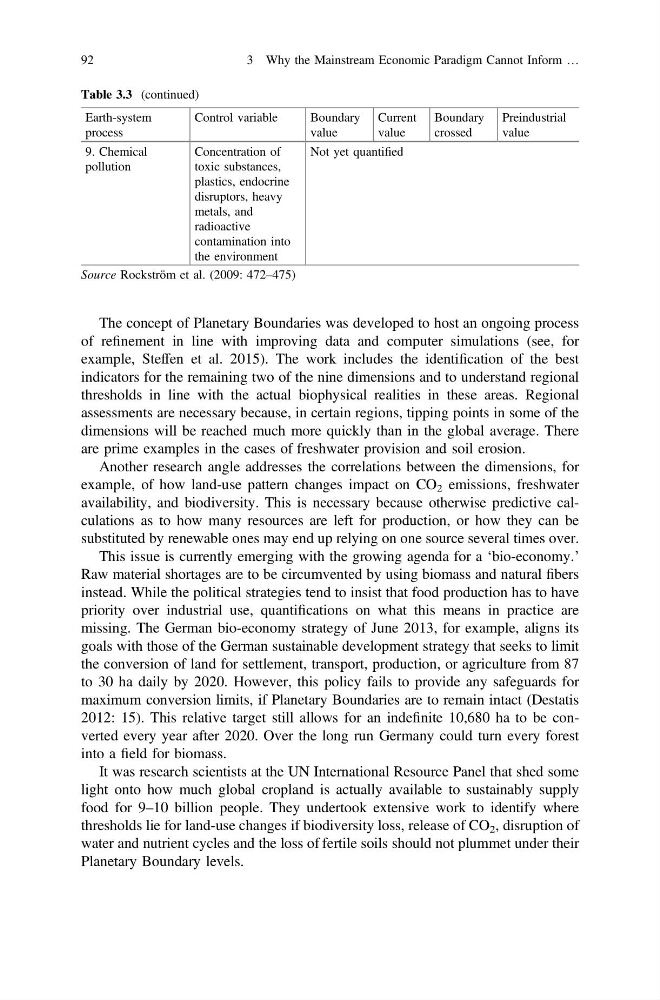
Table 3.3 (continued)
Earth-system
process
Control variable
Boundary
value
Current
value
Boundary
crossed
Preindustrial
value
9. Chemical
pollution
Concentration of
toxic substances,
plastics, endocrine
disruptors, heavy
metals, and
radioactive
contamination into
the environment
Not yet quantified
Source Rockström et al. (2009: 472–475)
92
3 Why the Mainstream Economic Paradigm Cannot Inform …
of refinement in line with improving data and computer simulations (see, for
example, Steffen et al. 2015). The work includes the identification of the best
indicators for the remaining two of the nine dimensions and to understand regional
thresholds in line with the actual biophysical realities in these areas. Regional
assessments are necessary because, in certain regions, tipping points in some of the
dimensions will be reached much more quickly than in the global average. There
are prime examples in the cases of freshwater provision and soil erosion.
Another research angle addresses the correlations between the dimensions, for
example, of how land-use pattern changes impact on CO 2 emissions, freshwater
availability, and biodiversity. This is necessary because otherwise predictive calculations as to how many resources are left for production, or how they can be
substituted by renewable ones may end up relying on one source several times over.
This issue is currently emerging with the growing agenda for a ‘bio-economy.’
Raw material shortages are to be circumvented by using biomass and natural fibers
instead. While the political strategies tend to insist that food production has to have
priority over industrial use, quantifications on what this means in practice are
missing. The German bio-economy strategy of June 2013, for example, aligns its
goals with those of the German sustainable development strategy that seeks to limit
the conversion of land for settlement, transport, production, or agriculture from 87
to 30 ha daily by 2020. However, this policy fails to provide any safeguards for
maximum conversion limits, if Planetary Boundaries are to remain intact (Destatis
2012: 15). This relative target still allows for an indefinite 10,680 ha to be converted every year after 2020. Over the long run Germany could turn every forest
into a field for biomass.
It was research scientists at the UN International Resource Panel that shed some
light onto how much global cropland is actually available to sustainably supply
food for 9–10 billion people. They undertook extensive work to identify where
thresholds lie for land-use changes if biodiversity loss, release of CO 2 , disruption of
water and nutrient cycles and the loss of fertile soils should not plummet under their
Planetary Boundary levels.
Table 3.3 (continued)
Earth-system
process
Control variable
Boundary
value
Current
value
Boundary
crossed
Preindustrial
value
9. Chemical
pollution
Concentration of
toxic substances,
plastics, endocrine
disruptors, heavy
metals, and
radioactive
contamination into
the environment
Not yet quantified
Source Rockström et al. (2009: 472–475)
92
3 Why the Mainstream Economic Paradigm Cannot Inform …