

In the case of PLLA and PDLA, we could not obtain the primary inventory data
from the polymer manufacturers due to confidentiality issues. However, regional
specific secondary datasets are used in the modelling of product system wherever
possible, in order to close the data gaps related to the geographical settings.
Transoceanic, intra-continental and the local transportation distance of raw materials from the production plant (PLLA and PDLA from Thailand and Spain) to the
supplier transformation site (Our institute in Germany where the blends are manufactured with the help of PLLA and PDLA) have been calculated with the help of
an online tool EcoTransIT [15], which calculates the distance in accordance to
realistic transportation scenarios. The availability and clarity of inventory data is
one of the main challenges for this study and is identified as an eco-design strategy
in Sect. 4.
3.2 Impact Assessment and Interpretation
Different impact assessment methods are available to perform the Life Cycle Impact
Assessment (LCIA). The recommendations from the International Reference Life
Cycle Data System (ILCD)/Product Environmental Footprint (PEF) were considered for the characterisation of each midpoint impact, and the LCIA results were
obtained from the method ‘Impacts ILCD/PEF recommendation v1.09’ [16] in the
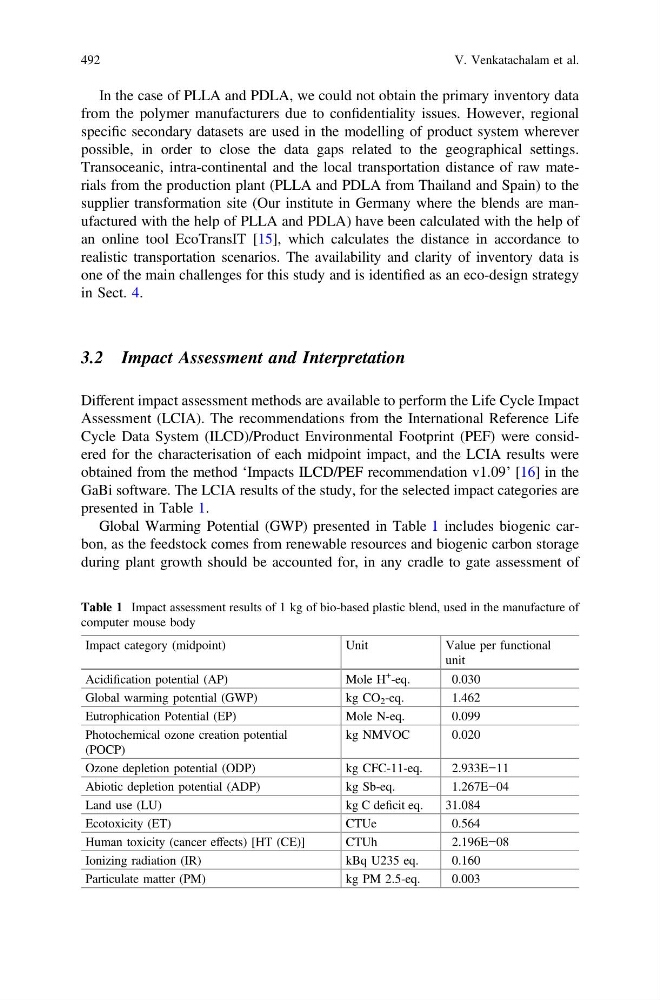
GaBi software. The LCIA results of the study, for the selected impact categories are
presented in Table 1.
Global Warming Potential (GWP) presented in Table 1 includes biogenic carbon, as the feedstock comes from renewable resources and biogenic carbon storage
during plant growth should be accounted for, in any cradle to gate assessment of
Table 1 Impact assessment results of 1 kg of bio-based plastic blend, used in the manufacture of
computer mouse body
Impact category (midpoint)
Unit
Value per functional
unit
Acidification potential (AP)
Mole H
+ -eq.
0.030
Global warming potential (GWP)
kg CO 2 -eq.
1.462
Eutrophication Potential (EP)
Mole N-eq.
0.099
Photochemical ozone creation potential
(POCP)
kg NMVOC
0.020
Ozone depletion potential (ODP)
kg CFC-11-eq.
2.933E−11
Abiotic depletion potential (ADP)
kg Sb-eq.
1.267E−04
Land use (LU)
kg C deficit eq.
31.084
Ecotoxicity (ET)
CTUe
0.564
Human toxicity (cancer effects) [HT (CE)]
CTUh
2.196E−08
Ionizing radiation (IR)
kBq U235 eq.
0.160
Particulate matter (PM)
kg PM 2.5-eq.
0.003
492
V. Venkatachalam et al.
from the polymer manufacturers due to confidentiality issues. However, regional
specific secondary datasets are used in the modelling of product system wherever
possible, in order to close the data gaps related to the geographical settings.
Transoceanic, intra-continental and the local transportation distance of raw materials from the production plant (PLLA and PDLA from Thailand and Spain) to the
supplier transformation site (Our institute in Germany where the blends are manufactured with the help of PLLA and PDLA) have been calculated with the help of
an online tool EcoTransIT [15], which calculates the distance in accordance to
realistic transportation scenarios. The availability and clarity of inventory data is
one of the main challenges for this study and is identified as an eco-design strategy
in Sect. 4.
3.2 Impact Assessment and Interpretation
Different impact assessment methods are available to perform the Life Cycle Impact
Assessment (LCIA). The recommendations from the International Reference Life
Cycle Data System (ILCD)/Product Environmental Footprint (PEF) were considered for the characterisation of each midpoint impact, and the LCIA results were
obtained from the method ‘Impacts ILCD/PEF recommendation v1.09’ [16] in the
GaBi software. The LCIA results of the study, for the selected impact categories are
presented in Table 1.
Global Warming Potential (GWP) presented in Table 1 includes biogenic carbon, as the feedstock comes from renewable resources and biogenic carbon storage
during plant growth should be accounted for, in any cradle to gate assessment of
Table 1 Impact assessment results of 1 kg of bio-based plastic blend, used in the manufacture of
computer mouse body
Impact category (midpoint)
Unit
Value per functional
unit
Acidification potential (AP)
Mole H
+ -eq.
0.030
Global warming potential (GWP)
kg CO 2 -eq.
1.462
Eutrophication Potential (EP)
Mole N-eq.
0.099
Photochemical ozone creation potential
(POCP)
kg NMVOC
0.020
Ozone depletion potential (ODP)
kg CFC-11-eq.
2.933E−11
Abiotic depletion potential (ADP)
kg Sb-eq.
1.267E−04
Land use (LU)
kg C deficit eq.
31.084
Ecotoxicity (ET)
CTUe
0.564
Human toxicity (cancer effects) [HT (CE)]
CTUh
2.196E−08
Ionizing radiation (IR)
kBq U235 eq.
0.160
Particulate matter (PM)
kg PM 2.5-eq.
0.003
492
V. Venkatachalam et al.