

considered stakeholder category. Thus, while the performance related to workers
and consumers show quite different profiles for the two companies, the
sub-categories related to society present a similar behaviour. Nevertheless, the score
of both companies in terms of benefits to workers and consumers revealed a relatively favourable performance. Despite the importance of the respective countries
in a national scale, the performance in terms of benefits to society was, in the
specific case of the evaluated SMEs, limited by the small size of the two companies,
which resulted in a low potential market share, compared to the total market volume
of blue biotechnology in the corresponding countries.
3.3 Economic Evaluation of H. pluvialis Astaxanthin
The NPV was obtained considering a production of 120 kg astaxanthin/year, a
12.5% nominal discount rate (according to typical values of 10–15% for biomass
products) and a 1.7% inflation rate (average inflation rate in the country for the year
2012). The calculated value was 2,068,203 €, which means that the assessed
process would be economically feasible, since NPV > 0. Among the different
groups of costs, the variable production costs were responsible for up to 75% of the
total cost. The highest fraction of these variable operating costs corresponded to the
staff, which represented more than three fourths of the production costs. Among
the other items, energy consumption would be the most relevant cost, with 20% of
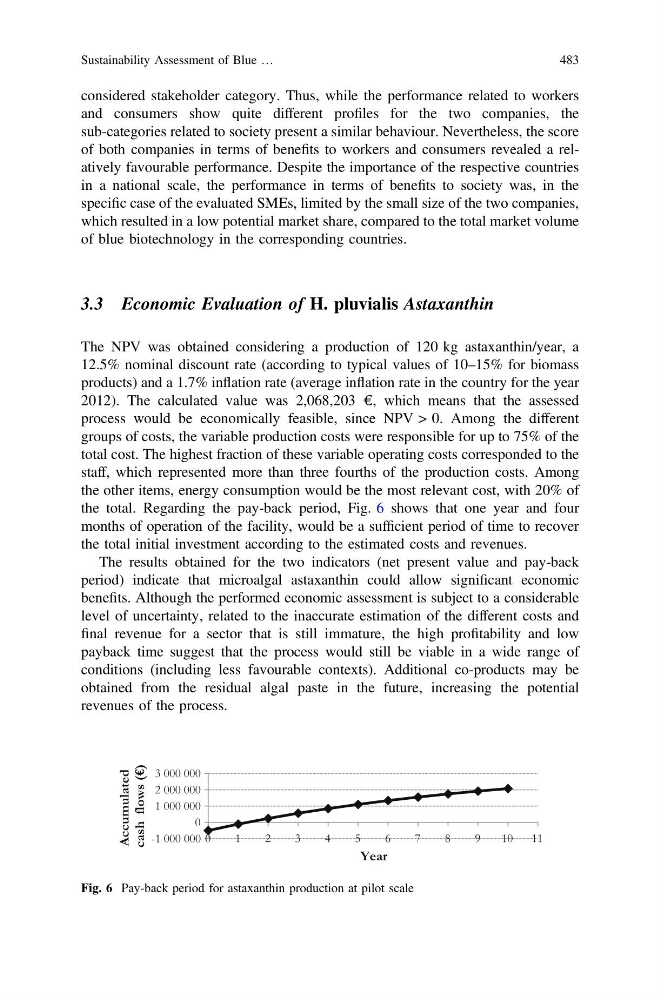
the total. Regarding the pay-back period, Fig. 6 shows that one year and four
months of operation of the facility, would be a sufficient period of time to recover
the total initial investment according to the estimated costs and revenues.
The results obtained for the two indicators (net present value and pay-back
period) indicate that microalgal astaxanthin could allow significant economic
benefits. Although the performed economic assessment is subject to a considerable
level of uncertainty, related to the inaccurate estimation of the different costs and
final revenue for a sector that is still immature, the high profitability and low
payback time suggest that the process would still be viable in a wide range of
conditions (including less favourable contexts). Additional co-products may be
obtained from the residual algal paste in the future, increasing the potential
revenues of the process.
-1 000 000
0
1 000 000
2 000 000
3 000 000
0
1
2
3
4
5
6
7
8
9
10
11
Accumulated
cash flows (€)
Year
Fig. 6 Pay-back period for astaxanthin production at pilot scale
Sustainability Assessment of Blue …
483
and consumers show quite different profiles for the two companies, the
sub-categories related to society present a similar behaviour. Nevertheless, the score
of both companies in terms of benefits to workers and consumers revealed a relatively favourable performance. Despite the importance of the respective countries
in a national scale, the performance in terms of benefits to society was, in the
specific case of the evaluated SMEs, limited by the small size of the two companies,
which resulted in a low potential market share, compared to the total market volume
of blue biotechnology in the corresponding countries.
3.3 Economic Evaluation of H. pluvialis Astaxanthin
The NPV was obtained considering a production of 120 kg astaxanthin/year, a
12.5% nominal discount rate (according to typical values of 10–15% for biomass
products) and a 1.7% inflation rate (average inflation rate in the country for the year
2012). The calculated value was 2,068,203 €, which means that the assessed
process would be economically feasible, since NPV > 0. Among the different
groups of costs, the variable production costs were responsible for up to 75% of the
total cost. The highest fraction of these variable operating costs corresponded to the
staff, which represented more than three fourths of the production costs. Among
the other items, energy consumption would be the most relevant cost, with 20% of
the total. Regarding the pay-back period, Fig. 6 shows that one year and four
months of operation of the facility, would be a sufficient period of time to recover
the total initial investment according to the estimated costs and revenues.
The results obtained for the two indicators (net present value and pay-back
period) indicate that microalgal astaxanthin could allow significant economic
benefits. Although the performed economic assessment is subject to a considerable
level of uncertainty, related to the inaccurate estimation of the different costs and
final revenue for a sector that is still immature, the high profitability and low
payback time suggest that the process would still be viable in a wide range of
conditions (including less favourable contexts). Additional co-products may be
obtained from the residual algal paste in the future, increasing the potential
revenues of the process.
-1 000 000
0
1 000 000
2 000 000
3 000 000
0
1
2
3
4
5
6
7
8
9
10
11
Accumulated
cash flows (€)
Year
Fig. 6 Pay-back period for astaxanthin production at pilot scale
Sustainability Assessment of Blue …
483