

2.3 Economic Analysis
As economic aspects cannot be neglected in life cycle based sustainability
assessment, a CBA approach is here proposed to evaluate this dimension. CBA is a
basic decision-making tool included by Huppes et al. [9] among the methods to
address the economic dimension of sustainability. It allows the comparison between
different proposals according to the net profit of each option. As the integration of
both CBA and LCA is now being widespread for the combined assessment of
economic and environmental aspects [10, 25], this methodology has been selected
for the evaluation of astaxanthin production.
CBA aims to compare the economic feasibility of a project or process by taking
into account the costs and benefits over its life time [10, 25]. The starting point of
the tool is the premise that a project should only be developed if all the benefits
exceed the aggregated costs. This premise is checked out by considering the net
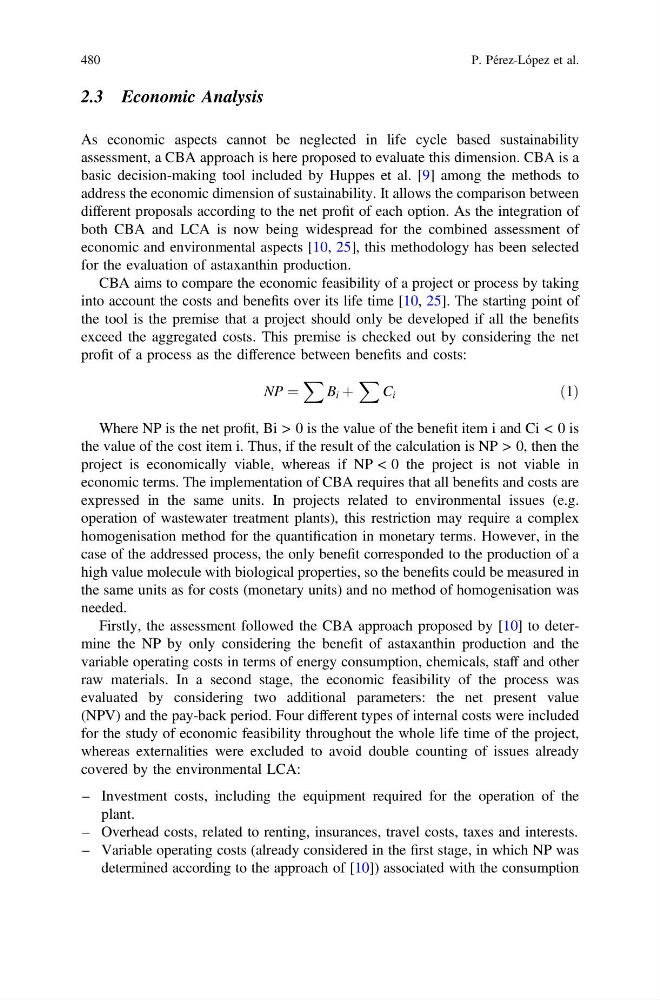
profit of a process as the difference between benefits and costs:
NP ¼
X
B i þ
X
C i
ð1Þ
Where NP is the net profit, Bi > 0 is the value of the benefit item i and Ci < 0 is
the value of the cost item i. Thus, if the result of the calculation is NP > 0, then the
project is economically viable, whereas if NP < 0 the project is not viable in
economic terms. The implementation of CBA requires that all benefits and costs are
expressed in the same units. In projects related to environmental issues (e.g.
operation of wastewater treatment plants), this restriction may require a complex
homogenisation method for the quantification in monetary terms. However, in the
case of the addressed process, the only benefit corresponded to the production of a
high value molecule with biological properties, so the benefits could be measured in
the same units as for costs (monetary units) and no method of homogenisation was
needed.
Firstly, the assessment followed the CBA approach proposed by [10] to determine the NP by only considering the benefit of astaxanthin production and the
variable operating costs in terms of energy consumption, chemicals, staff and other
raw materials. In a second stage, the economic feasibility of the process was
evaluated by considering two additional parameters: the net present value
(NPV) and the pay-back period. Four different types of internal costs were included
for the study of economic feasibility throughout the whole life time of the project,
whereas externalities were excluded to avoid double counting of issues already
covered by the environmental LCA:
– Investment costs, including the equipment required for the operation of the
plant.
– Overhead costs, related to renting, insurances, travel costs, taxes and interests.
– Variable operating costs (already considered in the first stage, in which NP was
determined according to the approach of [10]) associated with the consumption
480
P. Pérez-López et al.
As economic aspects cannot be neglected in life cycle based sustainability
assessment, a CBA approach is here proposed to evaluate this dimension. CBA is a
basic decision-making tool included by Huppes et al. [9] among the methods to
address the economic dimension of sustainability. It allows the comparison between
different proposals according to the net profit of each option. As the integration of
both CBA and LCA is now being widespread for the combined assessment of
economic and environmental aspects [10, 25], this methodology has been selected
for the evaluation of astaxanthin production.
CBA aims to compare the economic feasibility of a project or process by taking
into account the costs and benefits over its life time [10, 25]. The starting point of
the tool is the premise that a project should only be developed if all the benefits
exceed the aggregated costs. This premise is checked out by considering the net
profit of a process as the difference between benefits and costs:
NP ¼
X
B i þ
X
C i
ð1Þ
Where NP is the net profit, Bi > 0 is the value of the benefit item i and Ci < 0 is
the value of the cost item i. Thus, if the result of the calculation is NP > 0, then the
project is economically viable, whereas if NP < 0 the project is not viable in
economic terms. The implementation of CBA requires that all benefits and costs are
expressed in the same units. In projects related to environmental issues (e.g.
operation of wastewater treatment plants), this restriction may require a complex
homogenisation method for the quantification in monetary terms. However, in the
case of the addressed process, the only benefit corresponded to the production of a
high value molecule with biological properties, so the benefits could be measured in
the same units as for costs (monetary units) and no method of homogenisation was
needed.
Firstly, the assessment followed the CBA approach proposed by [10] to determine the NP by only considering the benefit of astaxanthin production and the
variable operating costs in terms of energy consumption, chemicals, staff and other
raw materials. In a second stage, the economic feasibility of the process was
evaluated by considering two additional parameters: the net present value
(NPV) and the pay-back period. Four different types of internal costs were included
for the study of economic feasibility throughout the whole life time of the project,
whereas externalities were excluded to avoid double counting of issues already
covered by the environmental LCA:
– Investment costs, including the equipment required for the operation of the
plant.
– Overhead costs, related to renting, insurances, travel costs, taxes and interests.
– Variable operating costs (already considered in the first stage, in which NP was
determined according to the approach of [10]) associated with the consumption
480
P. Pérez-López et al.